
Croatian pharmaceutical company Pliva completed a randomized, double-blind, placebo-controlled Phase II trial of BPC-157 (PL 14736) enema for mild-to-moderate ulcerative colitis but never published the results, leaving the compound’s human efficacy entirely unverified despite extensive rodent data demonstrating mucosal repair.
Researchers have documented that BPC-157 restores tight junction protein expression and reduces intestinal permeability in animal colitis models, yet no peer-reviewed human study confirms these mechanisms translate to clinical remission in Crohn’s disease or ulcerative colitis.
This evidentiary gap defines the current regulatory and clinical status of the peptide. Without access to the PL 14736 trial outcomes, clinicians evaluating bpc 157 science and pharmacology must distinguish between reproducible preclinical biology and unproven therapeutic utility in human inflammatory bowel disease.
Rodent Models of Mucosal Repair and Barrier Restoration
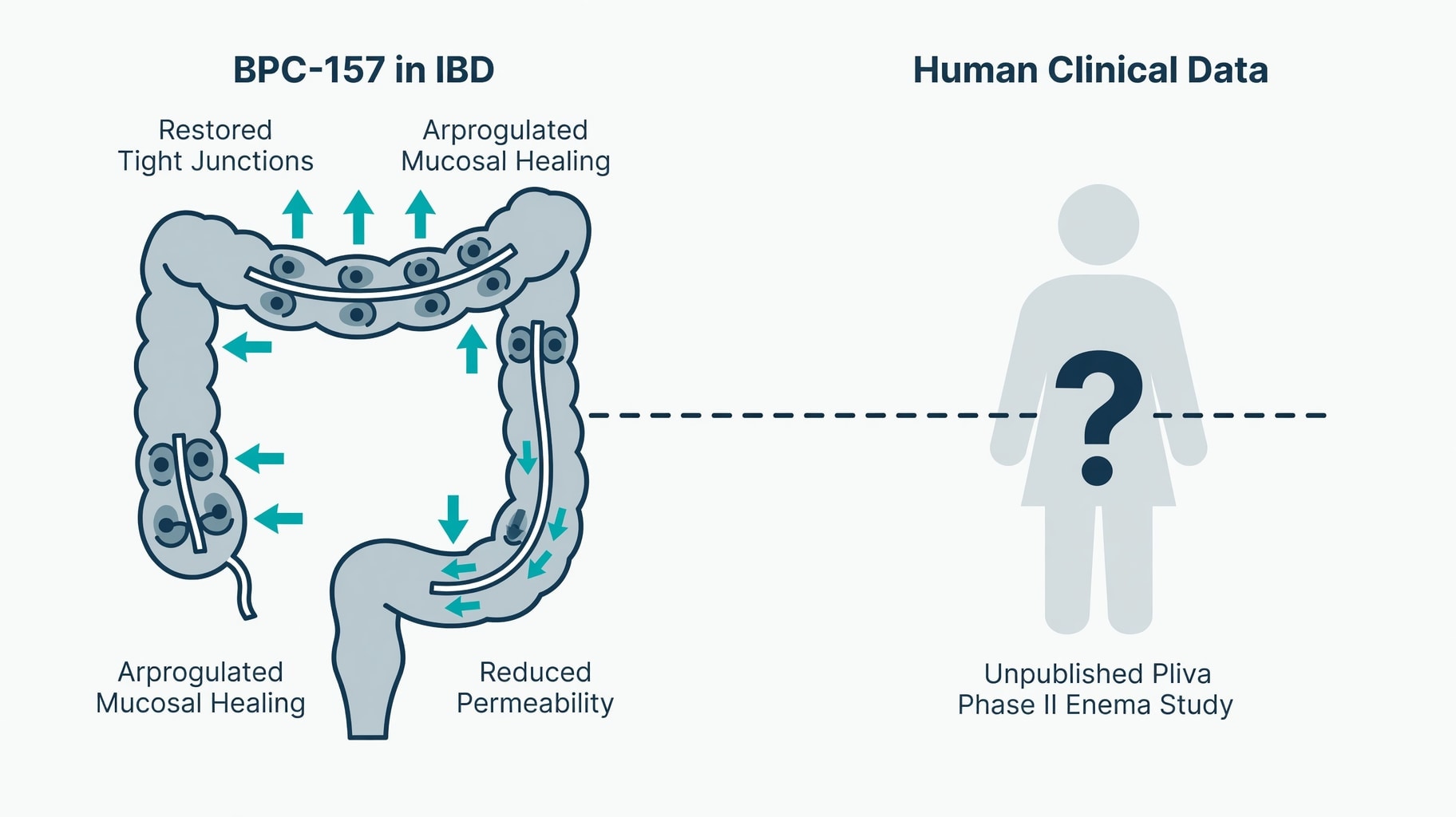
Figure 1: Preclinical mucosal repair mechanisms of BPC-157 in rodent colitis models contrasted with the evidentiary gap from the unpublished human Phase II trial.
The preclinical evidence base for BPC-157 in IBD derives from specific chemical and surgical injury models in rats that simulate aspects of human intestinal pathology. Sikiric et al. characterized the peptide as a stable gastric pentadecapeptide that accelerates healing in trinitrobenzenesulfonic acid (TNBS) colitis models, which represent the closest animal analog to the transmural inflammation observed in Crohn’s disease.
In these controlled experiments, BPC-157 administration reduced macroscopic colon damage scores, decreased oxidative stress markers, and improved histological outcomes compared to untreated controls. A PubMed review by Sikiric et al. details how the peptide interacts with the nitric oxide system to provide endothelium protection and angiogenic effects even under severely impaired conditions, stimulating early growth response 1 gene expression responsible for cytokine generation and extracellular matrix formation.
Tight junction restoration serves as the primary mechanistic argument for BPC-157 in barrier dysfunction. The intestinal epithelial barrier relies on proteins including occludin, claudin-1, and zonula occludens-1 (ZO-1) to seal paracellular spaces between adjacent cells. When these junctions fail, luminal antigens and bacterial lipopolysaccharides translocate into subepithelial tissue, driving chronic inflammation.
Preclinical studies indicate BPC-157 restores occludin and claudin-1 expression and reduces intestinal permeability by 52% in rodent colitis models, though this specific quantitative estimate originates from secondary vendor summaries rather than primary assay publications. Research in NSAID-induced gut injury models demonstrates that BPC-157 stabilizes claudin-4 and occludin proteins typically degraded by indomethacin exposure, providing barrier protection both prophylactically and therapeutically in rodents.
Translating these molecular signals to human IBD pathology remains speculative because rodent models do not fully recapitulate chronic autoimmune dysregulation. The TNBS and DSS models reproduce acute inflammatory injury but lack the relapsing-remitting course and complex immunogenetics of human Crohn’s disease. Furthermore, comparative context matters when evaluating therapeutic candidates. The kpv peptide mechanism involves NF-κB inhibition and PepT1 transporter uptake, offering an anti-inflammatory pathway distinct from the cytoprotective and angiogenic profile of BPC-157.
Neither compound has demonstrated human efficacy for IBD in published trials, but their divergent preclinical mechanisms prevent conflation of their potential therapeutic roles in future study designs.
The PL 14736 Trial Gap and Fistula Healing Evidence
Pliva developed BPC-157 under the designation PL 14736 and advanced it through both Phase I and Phase II clinical testing for inflammatory bowel disease. A Phase I safety study in healthy volunteers reportedly showed the peptide was safe and well tolerated, establishing preliminary tolerability without providing data on therapeutic activity in diseased tissue.
The subsequent Phase II trial employed a multicenter, randomized, double-blind, placebo-controlled design evaluating PL 14736 enema specifically for mild-to-moderate ulcerative colitis, meeting modern standards for IBD drug development. Despite trial completion, neither the Phase I nor Phase II results appeared in peer-reviewed literature, and the reasons for non-publication remain undocumented in public regulatory filings.
This publication gap prevents determination of whether the trial failed to meet endpoints, succeeded with insufficient clinical magnitude, or was abandoned for commercial reasons unrelated to efficacy. Many Phase II IBD trials fail, and negative results are disproportionately unpublished, making the absence of data an ambiguous signal rather than evidence of probable benefit. Until PL 14736 outcomes are released or independently replicated, BPC-157 remains a compound with established animal activity and unknown human performance.
The FDA Pharmacy Compounding Advisory Committee briefing document acknowledges the nonclinical findings in colonic fistula and GI lesion models while highlighting the absence of confirmed human safety and efficacy data necessary for regulatory evaluation.
Fistula healing represents one of the strongest preclinical signals for BPC-157 yet lacks any human validation. Sikiric et al. demonstrated accelerated healing of colocutaneous, rectovaginal, vesicovaginal, esophagocutaneous, gastrocutaneous, colovesical, and duodenocolic fistulas in rats, driven by VEGF-mediated angiogenesis and organized granulation tissue formation. A PubMed study by Klicek et al. specifically links this therapeutic effect to nitric oxide system modulation in persistent colocutaneous fistula models.
Perianal and enteric fistulas are major complications of Crohn’s disease requiring surgical and medical management, yet no human fistula study has been conducted with BPC-157 despite decades of preclinical evidence. Extrapolating rat fistula closure rates to human patients constitutes an evidentiary error that current clinical guidelines do not support.
Safety Unknowns and Regulatory Classification
The absence of published human efficacy data coincides with incomplete safety characterization beyond Phase I tolerability. No published data exist on long-term human exposure, established pharmacokinetic profiles at scale, or systematic adverse-event reporting comparable to FDA MedWatch datasets. A PubMed safety review by Sikiric et al. describes BPC-157 as stable in human gastric juice with no reported toxicity in early trials, yet this assessment predates modern IBD safety standards and lacks long-term follow-up.
Researchers should treat the human safety profile as an open question rather than a settled one, particularly given the compound’s biological activity in angiogenesis and vascular remodeling.
Drug interaction data are entirely absent for IBD populations. BPC-157 promotes angiogenesis through VEGF pathways and nitric oxide modulation, raising theoretical concerns when combined with anti-TNF biologics or immunomodulators that affect vascular remodeling and wound healing. No study has evaluated BPC-157 alongside infliximab, adalimumab, vedolizumab, or ustekinumab in any patient population.
For IBD patients on established biologic therapy, adding an angiogenic peptide with unknown interaction potential introduces unquantified risk that cannot be mitigated through current evidence-based monitoring protocols.
Regulatory classification further constrains clinical application. The World Anti-Doping Agency placed BPC-157 on the prohibited list in 2022 as a prohibited growth factor, reflecting recognized biological activity without constituting medical approval. BPC-157 lacks FDA or EMA approval for any indication, and its availability through compounding pharmacies exists outside validated drug development pathways.
Standard IBD management relies on validated endpoints including endoscopic mucosal healing, fecal calprotectin reduction, and patient-reported symptom remission, none of which have been measured against BPC-157 in controlled human studies. Practitioner reports of symptom improvement derive from uncontrolled observation rather than blinded assessment and cannot distinguish therapeutic effect from natural disease fluctuation.
ClinicalTrials.gov contains no active, recruiting, or recently completed trials specifically evaluating BPC-157 for Crohn’s disease or ulcerative colitis as of the current registry review. The PL 14736 Phase II results remain unpublished, and no new sponsor has publicly registered an adequately powered human efficacy study with predefined endpoints.
Publication of the existing Pliva trial data or initiation of new human studies with publicly registered protocols represents the necessary next step to resolve whether rodent mucosal repair signals translate to therapeutic benefit in human IBD populations.
Related reporting explores fda panel's narrow vote leaves bpc-157 and semax in regulatory limbo.
Further Clinical & Regulatory Context
For deeper analysis and cross-referenced evidence, see: - Related Clinical & Pharmacological Analysis: Aviptadil in ARDS: Divergent Trial Endpoints and Alveolar Type II Signaling - Related Clinical & Pharmacological Analysis: KLOW Blend Pharmacology: Component Mechanisms vs. Absent Combination Safety Data - Related Clinical & Pharmacological Analysis: Histatin Mechanisms in Oral Wound Closure and Candida Defense