
No human clinical trials have evaluated the KLOW fixed-dose combination of KPV, BPC-157, TB-500, and GHK-Cu for safety, pharmacokinetics, or efficacy. Current understanding of this formulation is derived exclusively from extrapolation of isolated component studies, creating a significant evidentiary gap between theoretical mechanism and verified biological effect. While individual compounds demonstrate distinct activities in murine and cell-culture models, their simultaneous administration introduces uncharacterized variables that distinguish research-grade rationale from established clinical evidence.
The absence of toxicological interaction data defines the current scientific status of this four-peptide blend. As noted in technical documentation from Klow Research, no safety data exist for the four-peptide blend as a unified entity, and long-term human safety profiles remain nonexistent. This formulation represents a theoretical convergence of NF-κB inhibition, angiogenesis, and matrix remodeling based on isolated component data.
However, no clinical evidence supports the safety, pharmacokinetics, or synergistic efficacy of this specific four-peptide combination in humans.
Any comprehensive klow blend peptide review must therefore separate established single-agent preclinical mechanisms from the unverified safety profile of the aggregate product.
The commercial availability of this blend precedes the regulatory validation typically required for combination therapeutics in European or North American pharmaceutical frameworks. While individual components demonstrate distinct preclinical activities, their simultaneous administration introduces uncharacterized variables. Toxicological interactions, competitive absorption via transporters like PepT1, and long-term safety remain unstudied in both animal models and human subjects.
This distinction separates theoretical rationale from verified clinical evidence and necessitates a rigorous examination of what is known versus what is merely hypothesized.
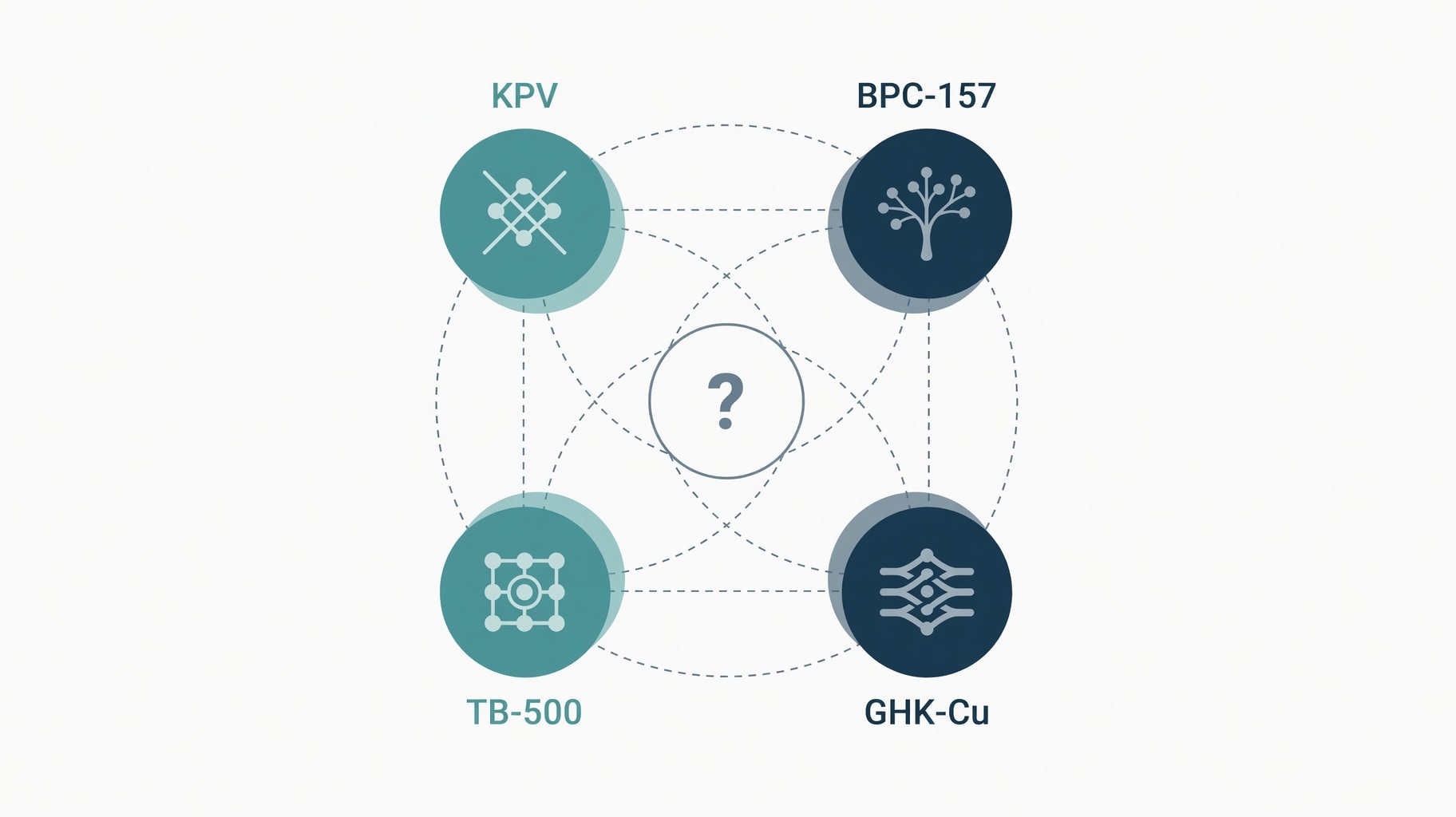
Figure 1: Theoretical mechanistic overlap of KPV, BPC-157, TB-500, and GHK-Cu versus complete absence of combination safety data.
Theoretical Pathway Convergence vs. Clinical Reality
The primary scientific rationale for combining these four agents rests on overlapping inflammatory and reparative signaling pathways. KPV and GHK-Cu theoretically converge on NF-κB, the master transcriptional regulator of inflammatory response, though from distinct molecular angles. KPV, a C-terminal tripeptide of alpha-melanocyte-stimulating hormone, enters cells via the PepT1 transporter and inhibits NF-κB nuclear translocation.
This kpv peptide mechanism has been characterized in vitro and in dextran sulfate sodium-induced colitis models, where it reduced pro-inflammatory cytokine expression.
GHK-Cu similarly modulates inflammatory gene expression and stimulates collagen synthesis in dermal fibroblasts, with genomic screening identifying its capacity to reverse tissue-destruction signatures in culture.
BPC-157 and TB-500 provide the complementary structural repair component of this theoretical model. BPC-157, a stable gastric pentadecapeptide, promotes angiogenesis via the VEGFR2-Akt-eNOS signaling pathway in rodent healing models. It increases fibroblast migration and growth-hormone receptor upregulation in tendon tissue. TB-500, a synthetic fragment of thymosin beta-4, facilitates actin polymerization and cell migration in preclinical wound-healing assays.
Unlike the wolverine stack peptide formulation, which typically pairs only BPC-157 and TB-500 for musculoskeletal repair, KLOW adds KPV for dedicated inflammatory modulation and GHK-Cu for extracellular matrix biology.
This four-pathway architecture is internally consistent on paper. Three of the four components push against inflammatory signaling while simultaneously supporting tissue architecture. Yet NF-κB inhibition for KPV is characterized primarily in vitro, and the translational pharmacokinetics of a subcutaneous multi-peptide dose in humans remain unknown. The distinction matters significantly. In European Medicines Agency frameworks, such a combination would require demonstration of bioequivalence and interaction studies before clinical evaluation.
In the current North American research-compound environment, these combinations proceed based on component-level plausibility alone.
Researchers investigating chronic gut inflammation or systemic autoimmune recovery often seek this specific overlap. The theoretical appeal lies in targeting upstream inflammatory drivers while supporting downstream tissue integrity. But pathway mapping in cell culture does not confirm that these peptides maintain their individual kinetics when co-administered. Competitive binding at transport sites, altered clearance rates, or unexpected metabolite formation could theoretically blunt efficacy or amplify toxicity.
None of these parameters have been measured for this specific fixed-dose combination.
Pharmacokinetic Gaps in Multi-Peptide Formulations
The most immediate safety concern involves the complete absence of interaction studies for this four-component formulation. Potential drug interactions with prescription medications remain entirely uncharacterized for the combination. Chronic use effects beyond several weeks are unstudied even in animal models. Effects on vulnerable populations, including pregnant individuals, children, and immunocompromised patients, are unknown. Reproductive and developmental toxicity of the combination has not been adequately studied, according to product safety disclosures from Cenexa Labs.
Copper delivery presents a specific pharmacological variable unique to this blend. GHK-Cu typically comprises the majority of the formulation by weight, often dosed at 50 mg per vial compared to 10 mg each for the other three components. Combined copper delivery alongside actin modulation, growth-factor signaling, and inflammation suppression creates a biological milieu with no precedent in the peer-reviewed literature.
Enhanced growth-factor signaling from BPC-157 and TB-500, paired with NF-κB suppression from KPV, raises theoretical questions about tumor progression that remain entirely uninvestigated for this four-component formulation.
Quality control variability compounds these pharmacological unknowns. Compounding occurs outside standard pharmaceutical manufacturing oversight, meaning batch-to-batch consistency relies entirely on supplier documentation rather than regulatory inspection. Strict quality control is essential for any compounded peptide, yet oversight varies significantly between providers. Documentation remains the only real safeguard for researchers sourcing this blend. The formulation sits in a research-only category, not an approved-drug category, and marketing it for human treatment violates federal regulations.
Differentiation from similar blends requires careful attention to composition. The glow stack peptides formulation typically emphasizes dermatological repair and frequently omits KPV entirely. Without KPV, the formulation lacks dedicated NF-κB suppression and becomes primarily a matrix-and-repair blend. KLOW’s inclusion of KPV is what provides its distinct anti-inflammatory and gut-barrier research angle. This distinction is not semantic; it represents a fundamental difference in pathway targeting that determines which research questions the blend can theoretically address.
Dosage parameters cited in supplier literature reflect research-grade conventions, not clinically validated therapeutic standards. The common 80 mg vial containing 50 mg GHK-Cu and 10 mg each of BPC-157, TB-500, and KPV represents a ratio derived from compounding tradition rather than dose-finding studies. Oral versus subcutaneous administration routes carry different theoretical implications for KPV specifically, given PepT1 expression in intestinal epithelium. Subcutaneous delivery bypasses this transporter, potentially altering the peptide’s anti-inflammatory bioavailability in gut tissue.
No comparative bioavailability studies exist to guide route selection for this blend.
The scientific community lacks consensus on how to interpret component-level safety data in the context of untested combinations. A 2025 BPC-157 intravenous safety pilot in two adults found no adverse events at 10–20 mg. GHK-Cu possesses a long topical safety record. KPV demonstrates favorable tolerance in cell and animal models. Yet linear extrapolation from these isolated profiles to a four-peptide injectable blend violates basic pharmacological principles.
Blend-specific adverse-effect attribution requires single-component control experiments that have not been conducted.
This evidentiary void does not negate the scientific interest in multi-target inflammatory modulation. The theoretical rationale for combining NF-κB inhibition with angiogenesis and matrix remodeling reflects legitimate biological reasoning. Researchers exploring systemic inflammation peptide stacks recognize that chronic inflammatory states involve simultaneous dysregulation across multiple pathways. Single-agent interventions often fail because they address only one node in a complex network. The KLOW formulation attempts to address this complexity through polypharmacy.
But theoretical elegance cannot substitute for empirical validation. Until combination-level safety and pharmacokinetic data emerge, this blend remains a research hypothesis rather than a characterized therapeutic entity. Investigators must distinguish clearly between what individual peptides do in isolation and what the combination does in practice. That distinction defines the boundary between rigorous science and speculative application.
Regulatory bodies, institutional review boards, and researchers themselves bear responsibility for maintaining that boundary as this class of compounds continues to evolve.
Further Clinical & Regulatory Context
For deeper analysis and cross-referenced evidence, see: - Related Clinical & Pharmacological Analysis: Histatin Mechanisms in Oral Wound Closure and Candida Defense