
In the 72-week SURMOUNT-1 Phase 3 trial, tirzepatide at 5 mg, 10 mg, and 15 mg doses produced mean body weight reductions of 15.0%, 19.5%, and 20.9% respectively in participants with obesity, compared to 3.1% with placebo. This dose-response relationship, as reported by PubMed, established the clinical efficacy profile of dual glucose-dependent insulinotropic polypeptide (GIP) and glucagon-like peptide-1 (GLP-1) receptor agonism for chronic weight management. The data separated tirzepatide from selective GLP-1 agonists by demonstrating sustained, dose-dependent efficacy across a large non-diabetic cohort.
Tirzepatide functions as a unimolecular dual agonist, distinguishing it from earlier incretin therapies through simultaneous activation of both receptor pathways within a single peptide backbone. The SURMOUNT clinical development program provides the primary efficacy dataset for obesity, while FDA approvals for Mounjaro and Zepbound reflect distinct regulatory evaluations of the same molecule based on different trial populations. Understanding tirzepatide clinical pharmacology SURMOUNT outcomes requires separating established Phase 3 endpoints and receptor binding kinetics from ongoing cardiovascular research and post-hoc analyses that have not yet achieved primary endpoint status.
Dual Receptor Pharmacokinetics and Molecular Design
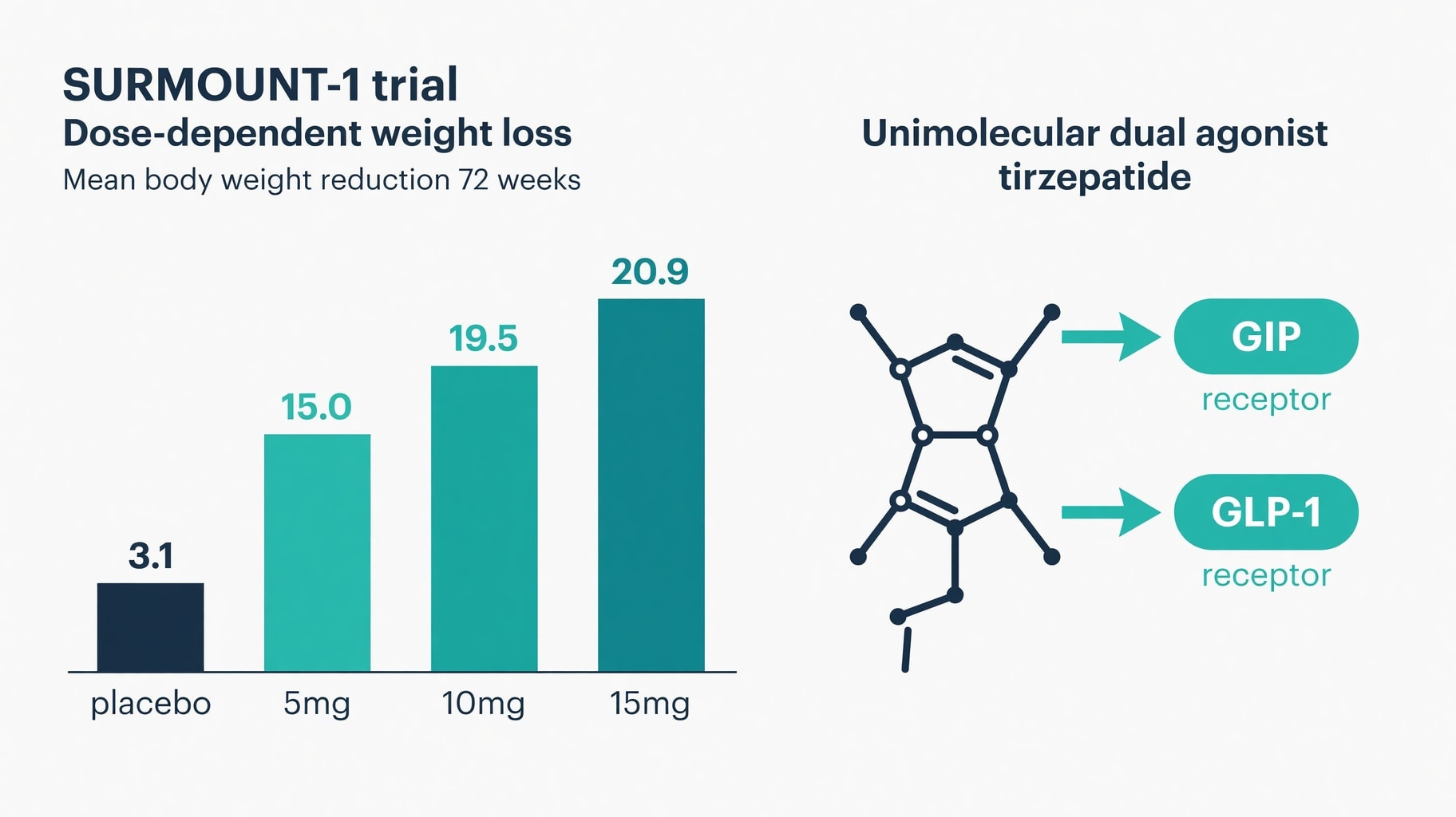
Figure 1: Tirzepatide dual agonism molecular design and SURMOUNT-1 dose-response weight loss data.
Tirzepatide is a synthetic 39-amino acid peptide based on the native GIP sequence, modified to bind both GIP and GLP-1 receptors with balanced affinity. Research published in PubMed characterizes the molecule as a unimolecular co-agonist rather than a combination therapy, meaning a single entity drives signaling at both targets. The peptide backbone is conjugated to a C20 fatty-diacid moiety at the lysine-17 residue. This structural modification enables albumin binding, extending the half-life to approximately five days and supporting once-weekly subcutaneous dosing.
In vitro binding assays using human embryonic kidney cells transfected with human receptors demonstrate that tirzepatide stimulates cyclic adenosine monophosphate (cAMP) accumulation at both GIP and GLP-1 receptors. Data summarized in pharmacological reviews indicate the compound acts as a biased ligand, preferentially activating GIP receptor signaling while maintaining sufficient GLP-1 receptor engagement to leverage established incretin effects. This bias is deliberate. Preclinical models suggested that pure GLP-1 agonism at high doses triggers counter-regulatory mechanisms or tolerability limits. Adding GIP receptor agonism appears to mitigate some GLP-1-mediated adverse effects while enhancing insulin sensitivity and lipid metabolism in adipose tissue.
The clinical translation of this dual mechanism remains an area of active investigation. While GLP-1 receptor agonism has well-established cardiovascular and renal protective effects, the independent long-term contribution of GIP receptor agonism to cardiorenal outcomes is not yet proven by completed trials in non-diabetic populations. Researchers caution against attributing the entire efficacy signal to simple additive effects. The interaction between the two pathways involves complex cross-talk in the central nervous system and peripheral tissues that differs qualitatively from either hormone alone. This distinction matters when evaluating emerging multi receptor incretin peptides that add glucagon or other targets to the mix.
SURMOUNT Program Efficacy Across Comorbidities
The SURMOUNT program comprises four global Phase 3 trials designed to evaluate tirzepatide specifically for chronic weight management. SURMOUNT-1 enrolled 2,539 participants with obesity but without diabetes. Trial results published in NEJM showed that 82% to 99% of participants across active treatment arms achieved at least 5% body weight reduction, with the highest dose arm approaching mean reductions of 21%. The trial met its primary endpoint with statistical significance at all three dose levels compared to placebo.
SURMOUNT-2 extended these findings to 938 participants with obesity and type 2 diabetes, a population that historically achieves lower percentage weight loss with incretin therapies. Mean weight reduction was 15.7% at the 15 mg dose, demonstrating that dual agonism retains substantial efficacy even in the presence of insulin resistance and concomitant glucose-lowering medications. SURMOUNT-3 and SURMOUNT-4 evaluated intensive lifestyle intervention integration and weight maintenance after withdrawal, respectively. Collectively, the program design paper confirms that the dose-response relationship observed in SURMOUNT-1 is reproducible across diverse metabolic phenotypes and trial durations ranging from 72 to 88 weeks.
Head-to-head comparisons provide additional context for efficacy claims. In the SURMOUNT-5 Phase 3 trial, tirzepatide demonstrated superior weight loss compared to semaglutide in adults with obesity without diabetes. Reporting on the trial outcomes indicates mean body weight reduction of 20.2% with tirzepatide versus 13.7% with semaglutide at 72 weeks. Waist circumference reduction was also greater with tirzepatide, suggesting differential effects on visceral adiposity. These comparative data are significant but require careful interpretation. Trial inclusion criteria, titration schedules, and population characteristics influence absolute outcomes. Generalizing head-to-head results to all clinical settings ignores these protocol-level variables.
Post-hoc analyses have explored composite cardiometabolic endpoints beyond weight alone. A PLOS One analysis assessed the proportion of SURMOUNT participants achieving simultaneous reductions in body weight, systolic blood pressure, and non-HDL cholesterol. While these exploratory analyses suggest broad metabolic improvements, they were not powered as primary endpoints. Regulatory bodies do not currently recognize these triple endpoints as approved indications.
Regulatory Distinctions and Outstanding Outcome Questions
Tirzepatide holds two distinct FDA approvals that reflect separate evidentiary packages. Mounjaro is approved for glycemic control in type 2 diabetes and, following the SURPASS-CVOT trial, for reducing major adverse cardiovascular events in adults with type 2 diabetes at high cardiovascular risk. Eli Lilly confirmed this expanded indication based on a head-to-head cardiovascular outcomes trial enrolling more than 13,000 participants. This makes Mounjaro the first dual GIP/GLP-1 agonist with proven cardiovascular benefit in a diabetic population. The FDA recently acted to protect this approved supply chain, as seen when the FDA slaps 30 telehealth firms with warning letters over compounded GLP-1 marketing for misrepresenting unapproved compounded versions as therapeutically equivalent.
Zepbound is approved for chronic weight management in adults with obesity or overweight with at least one weight-related comorbidity, and separately for moderate-to-severe obstructive sleep apnea in adults with obesity. Prescribing information for Zepbound explicitly notes that it is not approved for cardiovascular risk reduction. This regulatory boundary is critical. While the FDA expands Mounjaro label to reduce heart attack and stroke risk in type 2 diabetes, no such claim exists for Zepbound in patients without diabetes. The SURMOUNT-MMO cardiovascular outcomes trial in obesity without type 2 diabetes is ongoing. Until those data mature, cardiovascular benefit in non-diabetic obesity remains investigational.
Safety profiles in the SURMOUNT trials were consistent with incretin-based therapies but showed dose-dependent gastrointestinal adverse events. Nausea, diarrhea, vomiting, and constipation were the most frequently reported events in SURMOUNT-1. Discontinuation rates due to adverse events were 4.3%, 7.1%, and 6.2% for the 5 mg, 10 mg, and 15 mg doses respectively, compared to 2.6% with placebo. Safety data summarized in Pharmacy Times indicate that while gastrointestinal tolerability is generally manageable with titration, the discontinuation signal is numerically higher at the 10 mg and 15 mg doses than at 5 mg. Long-term safety beyond the 72-to-88-week trial windows remains under surveillance.
European regulatory alignment largely mirrors FDA determinations but with jurisdiction-specific nuances. The European Medicines Agency has evaluated the same SURMOUNT and SURPASS datasets, and approved indications track closely with U.S. labels. However, transatlantic divergence may emerge as post-marketing commitments and pharmacovigilance data accumulate. European regulators have historically required longer-term safety data for obesity indications given the chronic nature of treatment. Whether GIP receptor agonism introduces novel long-term signals distinct from GLP-1 monotherapy remains an open question for both agencies.
The distinction between approved indications and exploratory findings defines the current evidence boundary. Post-hoc analyses of cardiometabolic markers, while scientifically interesting, do not substitute for adequately powered outcomes trials. Researchers and clinicians must differentiate between what SURMOUNT definitively proved and what it suggested. The next evidentiary milestone will be completion of SURMOUNT-MMO, which will determine whether dual agonism confers cardiovascular protection in obesity independent of type 2 diabetes status. Until that readout, tirzepatide’s clinical pharmacology is defined by robust weight and glycemic efficacy, established safety in Phase 3, and pending confirmation of long-term cardiorenal outcomes in non-diabetic populations.
Further Clinical & Regulatory Context
For deeper analysis and cross-referenced evidence, see: - Related Clinical & Pharmacological Analysis: Retatrutide Triple Agonism: TRIUMPH Phase 3 Architecture and Energy Expenditure Data - Related Clinical & Pharmacological Analysis: Bremelanotide Clinical Pharmacology: MC4R Agonism and RECONNECT Trial Outcomes in HSDD - Related Clinical & Pharmacological Analysis: DACRA Pharmacology Separates Preclinical Weight Loss From Calcitonin Receptor Risks