
Bremelanotide Clinical Pharmacology: MC4R Agonism and RECONNECT Trial Outcomes in HSDD
The U.S. Food and Drug Administration approved bremelanotide (Vyleesi) in June 2019 for acquired, generalized hypoactive sexual desire disorder (HSDD) in premenopausal women, yet the European Medicines Agency has not granted marketing authorization for this indication. This transatlantic regulatory divergence frames the clinical pharmacology of the only centrally acting melanocortin receptor agonist cleared for sexual dysfunction. The FDA decision relied on two Phase 3 RECONNECT trials enrolling 1,247 participants that demonstrated statistically significant but numerically modest improvements in desire and distress scores alongside dose-limiting nausea. European regulators have not accepted this benefit-risk profile for a quality-of-life indication, leaving bremelanotide available in the EU solely as an unapproved research tool. Understanding bremelanotide requires navigating this split: a regulated pharmaceutical in North America defined by specific trial endpoints and a research chemical in Europe where clinical claims remain unvalidated by regional authorities.
RECONNECT Efficacy and Mechanism-Linked Safety
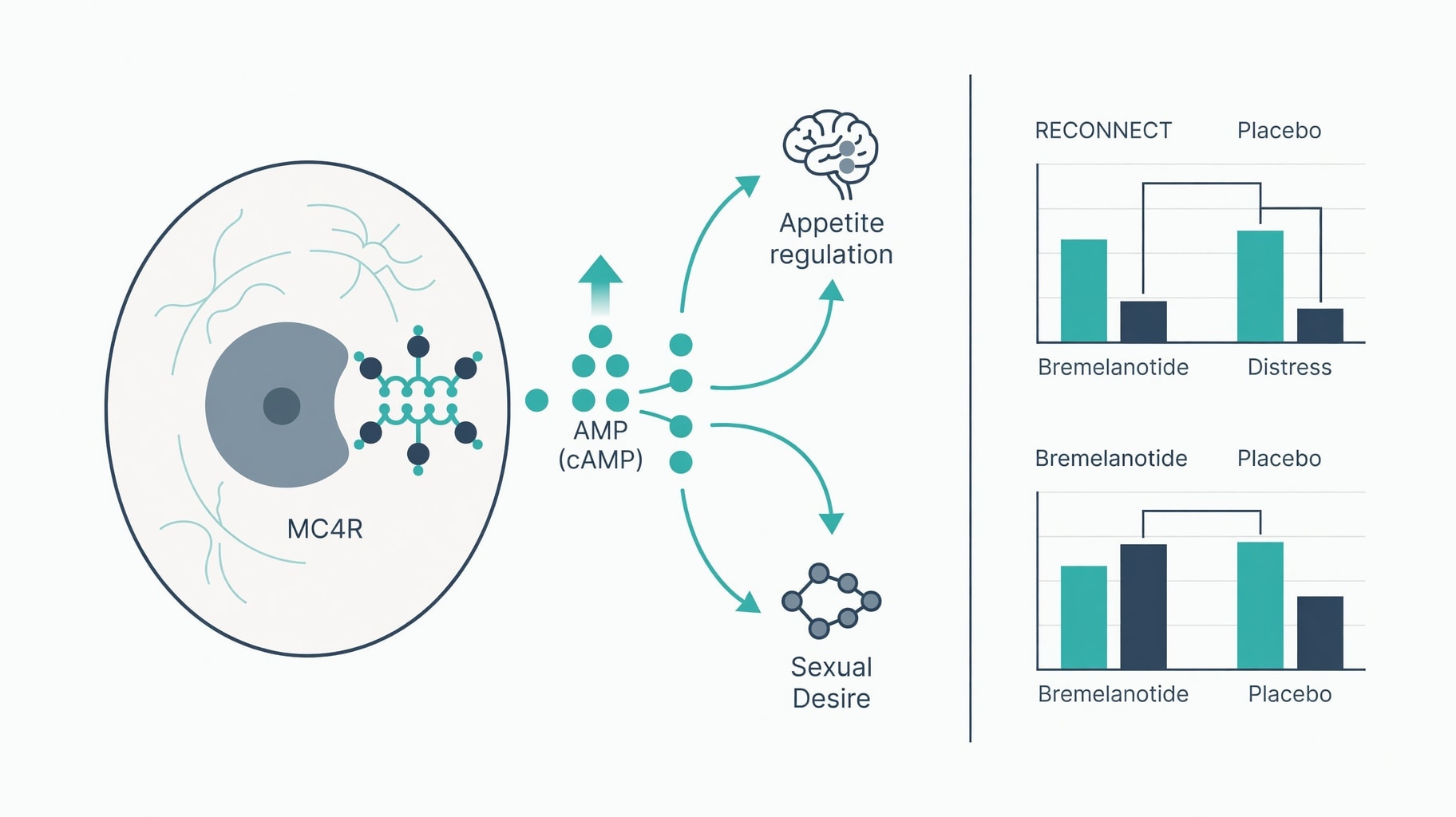
Figure 1: Bremelanotide MC4R agonism pathway and key efficacy and safety outcomes from the RECONNECT Phase 3 program.
The FDA approval rests exclusively on the RECONNECT program, which comprised two identical, randomized, double-blind, placebo-controlled Phase 3 trials. Investigators enrolled premenopausal women with acquired, generalized HSDD not attributable to co-existing medical conditions, psychiatric disorders, relationship problems, or medication effects. Primary efficacy endpoints measured change from baseline in the Female Sexual Function Index (FSFI) desire domain and the Female Sexual Distress Scale-Revised Item 13. Pooled results showed statistically significant improvements in both measures compared to placebo, but absolute effect sizes were small. The FDA prescribing information for NDA 210557 documents these treatment effects without claiming restoration of baseline desire for all responders. The magnitude of benefit observed in registration trials defines the therapeutic ceiling for clinical practice, distinguishing regulated efficacy from broader claims made in non-clinical literature.
Safety signals in RECONNECT directly reflect the drug’s central mechanism of action rather than off-target toxicity. Nausea occurred in 40% of bremelanotide-treated participants compared to 1.3% in the placebo arm. This adverse event stems from MC4R activation in the area postrema, a brainstem region controlling emesis that shares receptor targets with hypothalamic circuits modulating sexual desire. PubMed-indexed neurobiology reviews confirm that bremelanotide activates presynaptic MC4Rs on neurons in the medial preoptic area of the hypothalamus, triggering dopamine release that increases sexual desire while simultaneously engaging emetic pathways. Discontinuation rates due to nausea were significant in Phase 3 and continue to shape post-market adherence patterns. Transient blood pressure elevations also occurred, reflecting central autonomic modulation and imposing contraindications for patients with uncontrolled hypertension or cardiovascular disease.
Male use of bremelanotide remains outside the approved indication despite widespread off-label prescribing. No Phase 3 data supports efficacy or safety in men. Existing evidence consists primarily of Phase 2 trials and clinical experience rather than major registration studies. Prescribing bremelanotide to men constitutes an off-label decision based on extrapolation from female HSDD data and earlier-stage male research. Treatment effect size, optimal dosing, and safety parameters in male populations lack validation from major controlled trials. Researchers investigating male sexual dysfunction must distinguish between the established female HSDD dataset and the preliminary nature of male evidence when designing protocols or interpreting outcomes.
Structural Pharmacology and Neuroimaging Evidence
Bremelanotide functions as a non-selective melanocortin receptor agonist with primary therapeutic activity at MC4R in the hypothalamus and limbic system. The FDA label for Vyleesi specifies that binding to MC1R and MC4R is most relevant at therapeutic dose levels, with neurons expressing MC4R present throughout the central nervous system. This central mechanism distinguishes bremelanotide fundamentally from phosphodiesterase-5 inhibitors like sildenafil and tadalafil, which act on peripheral vascular smooth muscle to facilitate hydraulic response. Bremelanotide targets the upstream motivational signal itself through dopaminergic pathway modulation. Preclinical models established the necessity of MC4R for these effects; MC4R knockout rodents show abolished sexual responses to melanocortin agonists. Human hypothalamic MC4R circuit anatomy is substantially more complex than rodent models, requiring translational caution when applying preclinical findings to clinical populations.
Structural distinctions from other melanocortin analogs define both efficacy and safety boundaries. Bremelanotide possesses a C-terminal hydroxyl group that distinguishes it from the unapproved analog Melanotan II, which carries a C-terminal amide. This single-Dalton molecular difference reduces MC1R activity and associated tanning effects while preserving MC4R agonism necessary for sexual function. Cyclization of the heptapeptide lactam core is essential for MC4R binding conformation; linear forms lack biological activity at this receptor. Research-grade peptides purchased outside the FDA-approved Vyleesi product may contain uncyclized precursors or impurities absent in regulated autoinjectors. Structural analyses of targeted lipolytic peptides and melanocortin analogs emphasize that mass confirmation of cyclic structure is necessary to ensure biological activity, a quality control standard met by pharmaceutical-grade Vyleesi but variable in research compounds.
Human validation of central target engagement comes from functional MRI studies demonstrating altered neural responses to erotic stimuli following bremelanotide administration. Women with HSDD typically exhibit hypoactivation in reward and motivation brain regions when viewing erotic cues compared to healthy controls. Following bremelanotide administration, activation in these regions increases toward patterns observed in healthy women. A 2022 crossover fMRI study provided direct imaging evidence that the peptide enhances neural responses to sexual stimuli and reduces cognitive-emotional barriers to engagement. However, these neuroimaging studies utilized small sample sizes and were not powered for clinical outcome replication. The mechanistic model therefore synthesizes robust animal pharmacology with emerging, limited human neuroimaging rather than definitive large-scale CNS biomarker trials. This evidence gap contributes to regulatory caution in jurisdictions requiring direct human target engagement validation for central nervous system indications.
Regulatory Status and Post-Market Surveillance Gaps
The absence of EMA marketing authorization places bremelanotide in a fundamentally different legal category across Europe. PT-141 has no marketing authorization in France or the broader European Union and is available exclusively as a research compound for in vitro and preclinical investigation. This status persists despite Phase 3 data that satisfied FDA standards, illustrating divergent regulatory thresholds for accepting subjective patient-reported outcomes as primary endpoints in peptide drug development. The EMA assessment report for IMCIVREE, a related melanocortin agonist approved for rare genetic obesity, demonstrates European familiarity with MC4R pharmacology but does not extend to sexual dysfunction indications. European investigators studying central melanocortin pathways must handle research-only sourcing protocols rather than clinical prescribing frameworks, limiting direct comparison of real-world outcomes between North American and European populations.
Post-market safety surveillance remains incomplete beyond the 76-week horizon of the RECONNECT open-label extension. Long-term monitoring relies primarily on passive FAERS reporting rather than active registry follow-up. Hyperpigmentation risk, driven by residual MC1R activity, may not fully resolve after discontinuation and appears stratified by baseline melanin content. The FDA label notes this risk particularly in individuals with higher baseline skin melanin, yet post-marketing real-world evidence has not adequately oversampled underrepresented groups to quantify this disparity with precision. Whether bremelanotide’s efficacy and tolerability generalize across diverse populations remains unknown. The International Society for the Study of Women's Sexual Health has called for real-world evidence collection that intentionally oversamples underrepresented groups to address this gap.
Pharmacokinetic constraints further define operational limits globally. Bremelanotide is degraded by nonspecific peptidases rather than hepatic CYP enzymes, reducing drug-drug interaction potential but introducing variability based on individual peptidase activity. The FDA prescribing information confirms that mild to moderate hepatic impairment does not require dose adjustment, based on dedicated pharmacokinetic studies showing approximately 20% AUC increase in Child-Pugh A cirrhosis. Severe hepatic impairment (Child-Pugh C) has not been studied, creating a contraindication boundary for patients with advanced liver disease. Renal excretion of intact bremelanotide accounts for approximately 65% of the administered dose, further reducing hepatic clearance burden. These pharmacological parameters anchor clinical expectations to specific populations validated in registration trials rather than broader theoretical applications of melanocortin biology. Active post-market registries collecting standardized efficacy and safety data across diverse populations represent the next necessary step in defining bremelanotide’s clinical boundaries beyond the RECONNECT cohort.
Further Clinical & Regulatory Context
For deeper analysis and cross-referenced evidence, see: - Related Clinical & Pharmacological Analysis: AOD-9604 Clinical Evidence: Phase 2b Obesity Trial Failure and Regulatory Status