
Viking Therapeutics’ novel series of dual amylin calcitonin receptor agonists (DACRA) reduced lean rat body weight by up to 8% within 72 hours of a single subcutaneous dose, demonstrating EC50 values ranging from low nanomolar to micromolar potency at human AMY3 and calcitonin receptors (Viking Therapeutics). This magnitude of acute weight reduction in lean animals distinguishes the DACRA pharmacological class from selective amylin receptor agonists, yet it simultaneously exposes the central translational risk. Unbalanced calcitonin receptor engagement may drive aversive signaling rather than physiological satiation, a variable complicated by species-specific receptor activity-modifying protein (RAMP) expression differences between rodent models and human physiology.
The commercial and clinical stakes for resolving this mechanism are substantial. While GLP-1 receptor agonists dominate current obesity treatment, their efficacy plateaus and tolerability issues persist. DACRAs theoretically offer a complementary pathway by targeting hindbrain and hypothalamic circuits distinct from incretin signaling. However, no Phase 3 monotherapy efficacy outcomes currently exist for this class. The field currently relies on cross-study preclinical comparisons and early-phase human datasets to determine whether simultaneous CTR and AMYR activation produces sustainable metabolic benefits or unmanageable central nervous system toxicity.
Quantifying Receptor Bias in Binding Assays
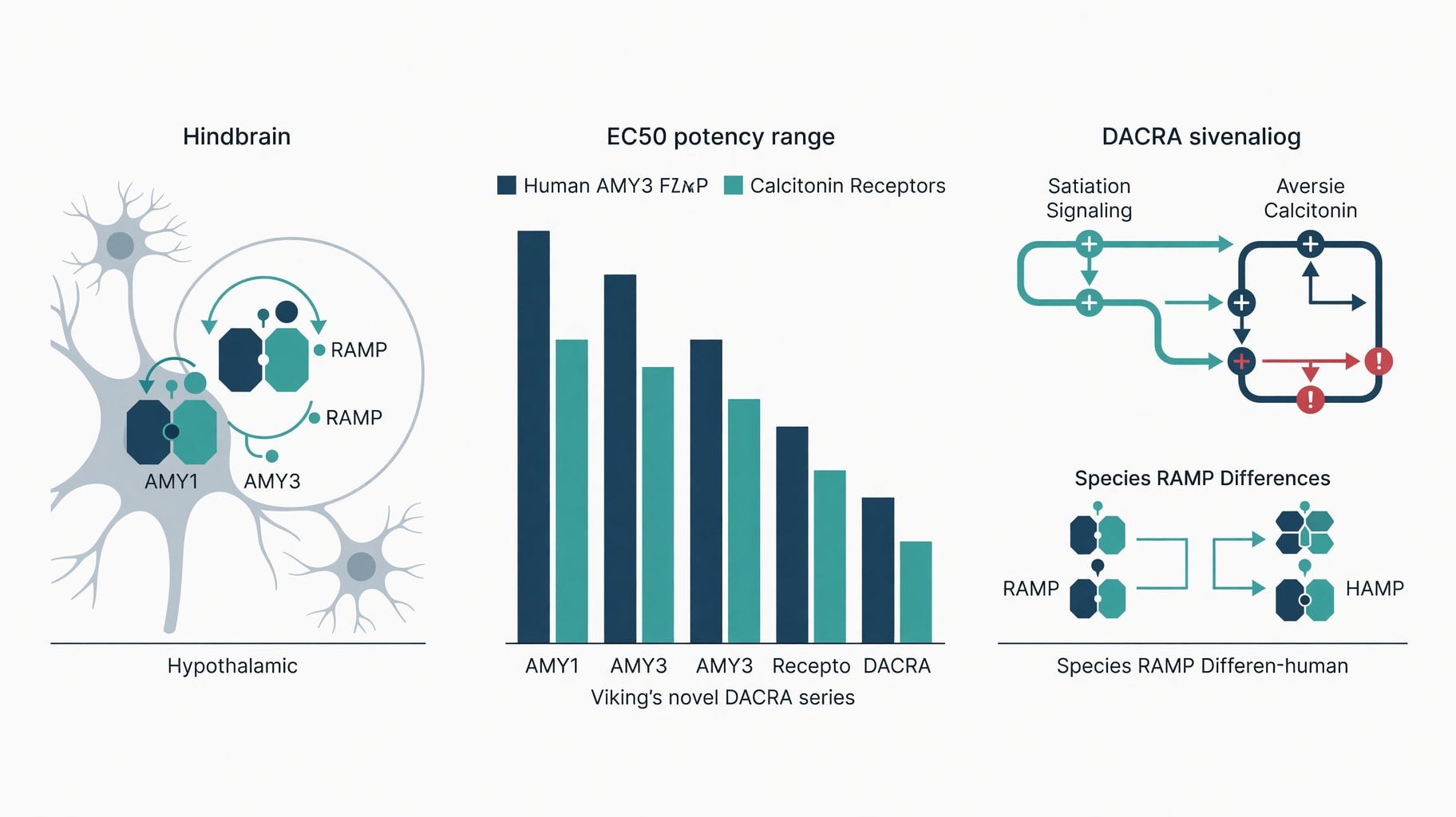
Figure 1: DACRA pharmacology separating AMY3-mediated weight loss from calcitonin receptor aversion risks in preclinical models.
Defining a DACRA requires quantitative separation from selective amylin analogs based on receptor occupancy, not marketing nomenclature. Amylin receptors are heterodimers formed by the calcitonin receptor (CTR) paired with one of three RAMP subunits, creating AMY1, AMY2, and AMY3 subtypes with distinct tissue distributions. A true DACRA activates both the CTR core and these RAMP-modified complexes with comparable potency. Cagrilintide, the most advanced clinical candidate, demonstrates binding affinity for AMY3R and CTR in the low picomolar range (ScienceDirect). This non-selective profile contrasts sharply with eloralintide, an investigational Eli Lilly compound engineered for 12-fold selectivity toward AMY1R over CTR to theoretically reduce calcitonin-associated side effects.
Binding kinetics alone do not predict in vivo efficacy. Head-to-head comparisons in high-fat diet-fed obese rats reveal that receptor balance matters more than absolute potency. KBM-336, a DACRA with a distinct CTR bias compared to cagrilintide, demonstrated superior metabolic efficacy in Zucker Diabetic Fatty rats despite similar in vitro activation profiles (PubMed). This suggests that the ratio of CTR to AMYR engagement, rather than dual activation per se, determines the therapeutic window. Viking’s preclinical series further illustrates this spectrum, with compounds spanning low nanomolar to micromolar potencies at human AMY3 and CTR, indicating active optimization of this bias ratio during lead selection.
The structural basis for this dual engagement has been resolved through cryo-electron microscopy. Cagrilintide’s lipid modification and an ionic lock create distinctive interaction patterns at the receptor interface that stabilize Gs-coupled conformations across AMY1, AMY2, AMY3, and CTR (Superpower). This molecular architecture enables once-weekly subcutaneous dosing but also locks in the non-selective pharmacology. Unlike small molecules that might be tuned for biased signaling, lipidated peptide DACRAs present a fixed pharmacological fingerprint that must be validated entirely through downstream functional assays.
RAMP Heterodimer Validation in Knockout Models
Genetic validation confirms that DACRA efficacy depends on specific receptor subtypes rather than generic CTR activation. Weight loss effects from cagrilintide were eliminated in mice lacking both RAMP1 and RAMP3, confirming that AMY1 and AMY3 heterodimers are necessary for the full metabolic response (Superpower). Hindbrain neuronal activation, measured by cFos expression in the area postrema, was substantially diminished across all single and double RAMP knockout genotypes. This genetic evidence establishes that CTR agonism alone cannot replicate the DACRA phenotype; the RAMP interface is obligatory.
Chronic dosing introduces additional complexity that acute binding assays cannot capture. Research comparing the AMYR-selective agonist NN1213 with salmon calcitonin in male mice found that AMY3 is necessary for sustained action on body weight and food intake, whereas unbalanced CTR activation by salmon calcitonin produced divergent chronic effects (PubMed). The authors noted that chronic DACRA use in mice can produce unfavorable weight loss trajectories compared to selective agonists, a species-dependent effect that directly challenges extrapolation to human trials. Rat and mouse models show fundamentally different responses to CTR engagement, making regulatory reliance on a single preclinical species insufficient for safety prediction.
Peripheral administration studies confirm that these molecules reach target CNS regions. Fluorescently labeled amycretin, a unimolecular GLP-1/amylin/calcitonin triple agonist, successfully reached the area postrema, nucleus tractus solitarius, hypothalamus, and dorsal motor nucleus of the vagus in mice (ScienceDirect). This biodistribution validates the intended mechanism but also confirms exposure to brainstem regions governing nausea and emesis. The question is not whether DACRAs engage central targets, but whether that engagement produces satiation or sickness. Selective AMY1 agonists like eloralintide have demonstrated reduced taste aversion in rodent models compared to cagrilintide, as reported by Superpower, suggesting that CTR sparing may improve tolerability without sacrificing efficacy.
Translational Gaps Between Rodent Efficacy and Human Tolerability
Preclinical weight loss data for DACRAs are robust but carry significant limitations for human prediction. Viking’s compounds achieved up to 10% weight loss from baseline in diet-induced obese mice over 24 days, according to the ADA presentation records. KBM-089 reduced fat mass specifically while preserving lean tissue in preclinical models (PubMed). These findings support the hypothesis that DACRAs improve body composition beyond simple caloric restriction. Yet no Phase 3 human dataset has confirmed that this fat-selective reduction translates to clinical populations. All cited body weight reduction data remain preclinical or early-phase.
Bone and muscle safety represent the most significant evidence gap. CTR activation theoretically promotes bone formation and inhibits resorption via osteoblast and osteoclast modulation, according to therapeutic reviews on Medscape. Satellite cells specifically express CTR, and amylin agonist binding may help preserve skeletal muscle during weight loss. However, long-term human data on bone density, renal function, and cardiovascular outcomes are not yet available for any long-acting DACRA. Preclinical osteoblast activation has not been validated in obesity trial populations, and GLP-1 receptor agonists themselves have shown associations with modest bone mineral density reductions that could compound or mask DACRA effects in combination regimens.
Combination strategies may ultimately define the clinical niche for DACRAs. Sequencing KBM-336 with semaglutide produced durable weight loss in preclinical models that exceeded either agent alone (PubMed). This complements the existing tirzepatide clinical pharmacology surmount dataset and emerging retatrutide triple agonist triumph trials, positioning amylin-calcitonin engagement as a potential add-on rather than standalone therapy. DACRAs have also been proposed as disease-modifying agents for osteoarthritis, targeting metabolically driven pathways beyond mechanical load reduction (Nature). This expanded indication set distinguishes the class from pure appetite suppressants but requires validation endpoints that current obesity trials do not capture.
The broader pipeline context shows multi receptor incretin peptides evolving toward increasingly complex pharmacology. Amycretin combines GLP-1 and amylin/calcitonin agonism in a single molecule with low picomolar potency at all three targets (ScienceDirect). Oral small-molecule DACRAs like ACCG-2671 have shown potent target engagement and enhanced weight loss when combined with GLP-1 agonists in preclinical studies, according to pipeline analyses by PatentVest. These developments confirm industry commitment to the mechanism but do not resolve the fundamental tolerability question.
Human Phase 1 data for selective amylin analogs provide initial safety signals. Eloralintide achieved 4.4% body weight reduction at 12 mg over the dosing period versus 0.6% on placebo in a 48-participant first-in-human trial, according to translational study records. This demonstrates that amylin-pathway engagement can produce measurable weight loss in humans with acceptable short-term tolerability. Whether non-selective DACRAs can match this tolerability profile while delivering superior efficacy remains the unproven hypothesis. Comparative efficacy claims between DACRAs and selective agonists currently rely on cross-study preclinical data, as no head-to-head human trials exist. The next definitive evidence milestone will be Phase 2 dose-ranging studies that directly measure aversion biomarkers alongside weight loss in human cohorts.