
AOD-9604 and PT-141: Divergent Lipolytic Mechanisms in Human Adipose Tissue
Heffernan et al. (2001) demonstrated that AOD-9604 reduces adipose tissue mass in obese mice exclusively through beta-3 adrenergic receptor activation, an effect abolished in knockout models lacking this specific receptor. This murine dependency stands in direct contrast to ex vivo human tissue studies where beta-3 adrenergic stimulation produces negligible lipolytic flux in subcutaneous white adipose tissue. While AOD-9604 relies on a peripheral adrenergic mechanism that fails to replicate in human fat cells, PT-141 modulates energy balance through central hypothalamic melanocortin receptors without direct peripheral lipolytic action. These distinct biological realities separate the two compounds despite their frequent categorization as interchangeable metabolic agents in commercial literature. Understanding this divergence requires examining the specific receptor pharmacology validated in Endocrinology against the refractory nature of human white fat depots.
Murine Beta-3 Adrenergic Efficacy Versus Human Tissue Refractoriness
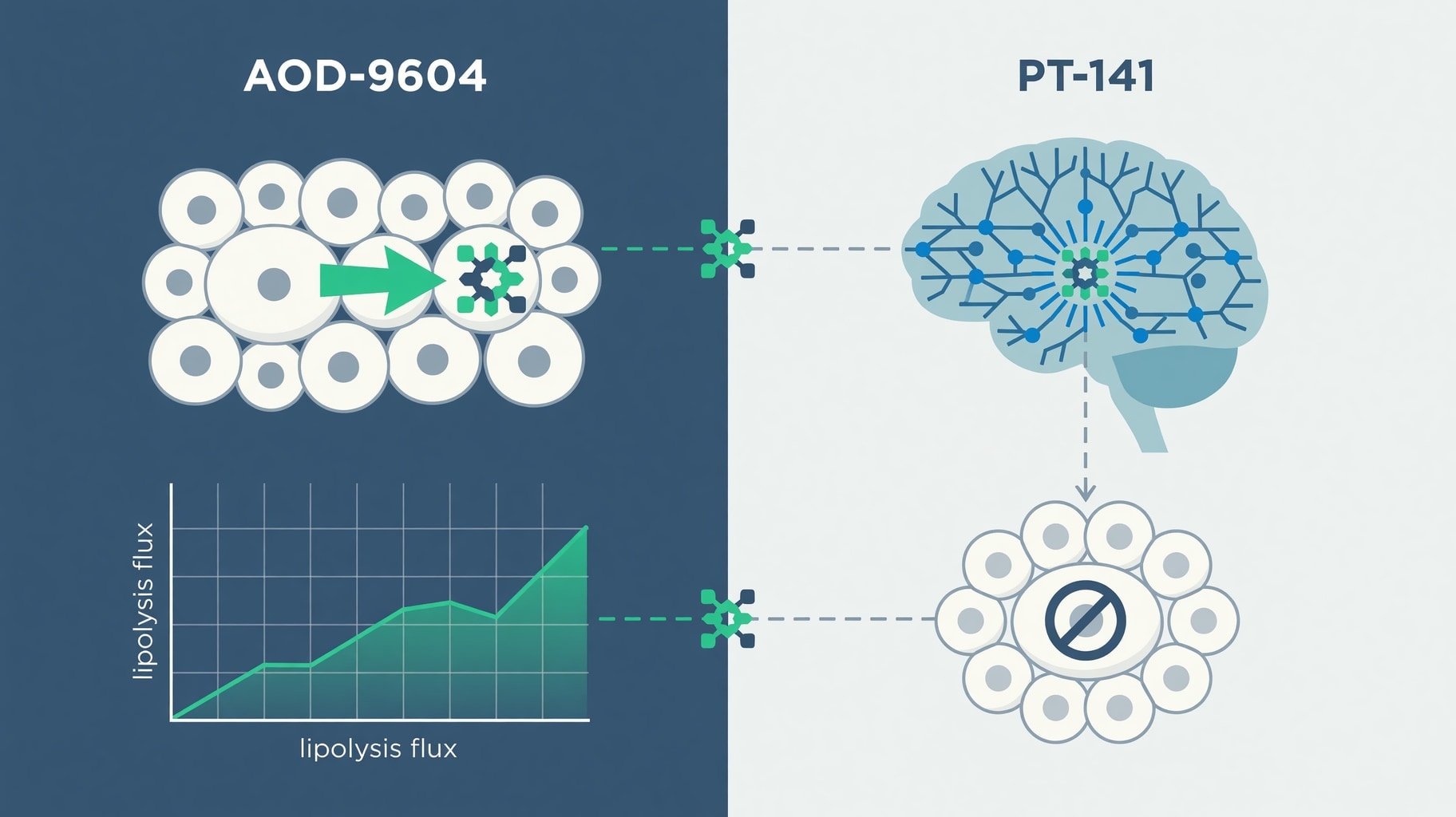
Figure 1: Divergent mechanisms of AOD-9604 (peripheral beta-3 adrenergic in mice) versus PT-141 (central melanocortin modulation) in human adipose tissue.
AOD-9604 functions as a modified C-terminal fragment of human growth hormone comprising amino acids 176-191 with a tyrosine substitution at the N-terminus to enhance stability. Ng et al. (2000) established that this synthetic peptide induces weight loss and increases lipolytic sensitivity in ob/ob mice without triggering the insulin resistance or IGF-1 elevation associated with intact hGH, as detailed in Metabolic Studies of AOD9604. The peptide avoids the growth hormone receptor entirely, instead targeting the beta-3 adrenergic receptor expressed on murine adipocytes. In vitro assays using differentiated 3T3-L1 mouse adipocytes confirm this engagement, showing dose-dependent increases in cAMP accumulation and HSL phosphorylation consistent with beta-3 AR signaling. This pathway drives triglyceride hydrolysis in rodent models, providing the preclinical rationale for subsequent human investigation.
The mechanistic validation in mice is absolute. Heffernan et al. showed that AOD-9604 treatment in beta-3 AR knockout mice failed to reduce fat mass or improve metabolic markers, confirming the receptor as the sole mediator of the compound’s lipolytic activity. This genetic proof established the beta-3 adrenoceptor as the non-negotiable target for efficacy. Early clinical trial designs extrapolated this finding to human subjects, assuming conservation of the adrenergic lipolytic pathway across species. However, human adipose tissue biology presents a fundamentally different pharmacological landscape. Multiple independent investigations have characterized beta-3 adrenergic receptor function in human fat, reaching a consensus that contradicts the murine gold standard.
Research published in the Journal of Clinical Investigation found that while beta-3 adrenoceptor mRNA is detectable in human subcutaneous white adipocytes, the functional protein does not contribute significantly to catecholamine-induced lipolysis. The receptor appears expressed at levels insufficient to drive measurable triglyceride hydrolysis even under maximal agonist stimulation. Similar findings extend to visceral fat depots. Investigations into human omental adipocytes demonstrated that putative beta-3 adrenoceptor agonists fail to stimulate lipolysis at concentrations highly effective in rodent tissue. Earlier work concluded that beta-3 ARs, if present in human adipocyte plasma membranes, do not significantly affect lipolysis rates under physiological conditions. This species-specific discrepancy creates a translational barrier for AOD-9604 development.
The distinction between white and brown adipose tissue adds complexity but does not resolve the efficacy gap. Recent molecular studies confirm beta-3 adrenergic receptors are functional in human brown and beige adipocytes, regulating thermogenesis and lipolysis in these specialized depots. However, AOD-9604 research has predominantly targeted white adipose tissue reduction in obesity models. Unless the peptide selectively recruits or activates brown fat in humans, reliance on murine white fat beta-3 AR data remains an evidentiary limitation. Researchers evaluating lipolysis mechanisms must account for this tissue-specific receptor expression when interpreting preclinical-to-clinical translation. The FDA Pharmacy Compounding Advisory Committee has noted that AOD-9604’s effects depend at least in part on intact beta-3 adrenergic receptor signaling, raising questions about human applicability given the tissue refractoriness documented in primary literature.
Central Melanocortin Signaling and Peripheral Tissue Limitations
PT-141 (bremelanotide) operates through a pharmacologically distinct system that bypasses peripheral adrenergic receptors entirely. This synthetic cyclic heptapeptide acts as an agonist at melanocortin receptors, displaying preferential affinity for MC4R and MC3R subtypes expressed in hypothalamic and mesolimbic circuits. Receptor binding assays demonstrate differential affinity weighting toward MC4R over MC1R compared to earlier linear analogs like melanotan II. This central selectivity drives established clinical effects on sexual function and appetite regulation through paraventricular nucleus activation. Any resulting metabolic changes occur downstream of central signaling rather than through direct receptor-ligand interactions on adipocytes.
The European Medicines Agency assessment for setmelanotide, a related MC4R agonist, confirms that melanocortin pathway activation regulates appetite and energy expenditure through central mechanisms. Nonclinical evidence shows MC4Rs are important for agonist-regulated weight loss, but this occurs via hypothalamic modulation of sympathetic outflow rather than peripheral lipolysis. In isolated human adipocyte preparations, melanocortin receptor agonists show variable and generally weak direct lipolytic effects compared to beta-adrenergic stimulation. Research published in BMC Research Notes investigated this interaction specifically, finding that while non-selective melanocortin agonists stimulated lipolysis in intact white adipose tissue, the effect was absent in isolated differentiated adipocytes. Furthermore, the lipolytic response in intact tissue was attenuated by beta-adrenergic antagonists, suggesting dependence on neuronal innervation and noradrenaline release rather than direct adipocyte receptor activation.
This neuro-adipose axis dependency means PT-141’s metabolic influence cannot be replicated in standard cell culture assays. Clinical trial endpoints reflect this mechanistic reality. FDA briefing documents for bremelanotide focus on hypoactive sexual desire disorder with safety monitoring centered on cardiovascular and central nervous system parameters. Trials investigating PT-141 for obesity have been limited and early-phase. Active investigations listed on ClinicalTrials.gov continue to test metabolic boundaries, yet primary endpoints remain divided along mechanistic lines established by preclinical data. Weight loss observed in small studies correlates with reduced caloric intake, supporting an anorectic mechanism via MC4R rather than direct fat mobilization.
Regulatory Status and Evidentiary Boundaries
The conflation of AOD-9604 and PT-141 in commercial discourse obscures their separate translational statuses and regulatory trajectories. AOD-9604 faces a mechanistic validity problem in humans because its primary validated target is functionally silent in subcutaneous white adipose tissue. PT-141 faces an indication problem where its central mechanism is validated for sexual dysfunction but lacks peripheral tissue support for direct lipolysis. Regulatory bodies now scrutinize these mechanistic discrepancies more closely. The FDA has included AOD-9604 acetate and free base forms in bulk drug substance evaluations, requiring sponsors to address species-specific receptor pharmacology before advancing claims.
For AOD-9604, the critical question is whether human brown fat activation or alternative non-adrenergic pathways can rescue the murine beta-3 AR hypothesis. Current literature does not support this rescue, leaving the compound in a translational limbo between robust rodent efficacy and human tissue refractoriness. For PT-141, the question is whether central appetite modulation provides sufficient metabolic benefit to justify investigation outside approved sexual health indications. Researchers must handle these separate evidentiary landscapes rather than treating the compounds as a unified class of metabolic modulators.
Pending decisions from regulatory advisory committees will likely hinge on this distinction between central and peripheral mechanisms. Sponsors pursuing AOD-9604 for metabolic indications must provide human tissue evidence demonstrating functional beta-3 adrenergic lipolysis or identify alternative targets that explain observed clinical effects. PT-141 developers face the challenge of designing trials that distinguish central appetite suppression from peripheral fat mobilization. Until human tissue studies resolve these mechanistic questions, the species-specific receptor divergence remains the defining constraint for both compounds. The next step for AOD-9604 research requires direct measurement of beta-3 AR protein function in human subcutaneous adipocytes under standardized lipolysis assay conditions.
Further Clinical & Regulatory Context
For deeper analysis and cross-referenced evidence, see: - Related Clinical & Pharmacological Analysis: Bremelanotide Clinical Pharmacology: MC4R Agonism and RECONNECT Trial Outcomes in HSDD - Related Clinical & Pharmacological Analysis: AOD-9604 Clinical Evidence: Phase 2b Obesity Trial Failure and Regulatory Status