
Semax and Selank: Translating Russian Clinical Data for English-Speaking Wellness Markets
Online wellness retailers market Semax and Selank as a synergistic stack for simultaneous focus and calm, yet Russian pharmaceutical records define them as distinct therapeutic agents with separate indications and evidentiary standards. Semax holds approval in Russia for ischemic stroke and optic nerve atrophy based on uncontrolled observational data, while Selank is approved for generalized anxiety disorders and neurasthenia backed by a 62-patient randomized controlled trial against medazepam. This regulatory divergence contradicts the interchangeable "brain health" framing common in English-language biohacking communities, where nootropic peptide protocols often conflate two compounds that originate from different peptide families and act through non-overlapping primary mechanisms. The gap between documented clinical use and consumer marketing represents a translation failure rather than a pharmacological synergy, as Semax targets BDNF signaling for neuroprotection while Selank modulates enkephalin degradation for anxiolysis.
The strongest evidence distinguishing these compounds lies in their contrasting clinical trial designs rather than subjective user reports. Selank demonstrated efficacy comparable to benzodiazepines in a controlled psychiatric study, as documented in Russian medical literature, providing verified human data for anxiety treatment. Semax relies on a 110-patient uncontrolled study for stroke rehabilitation and extensive rodent models for cognitive claims, according to Superpower’s research guide, leaving its nootropic applications without equivalent randomized validation. Consumers navigating peptide regulation and safety encounter this asymmetry indirectly through marketing language that presents both compounds with equal confidence despite their unequal evidentiary foundations.
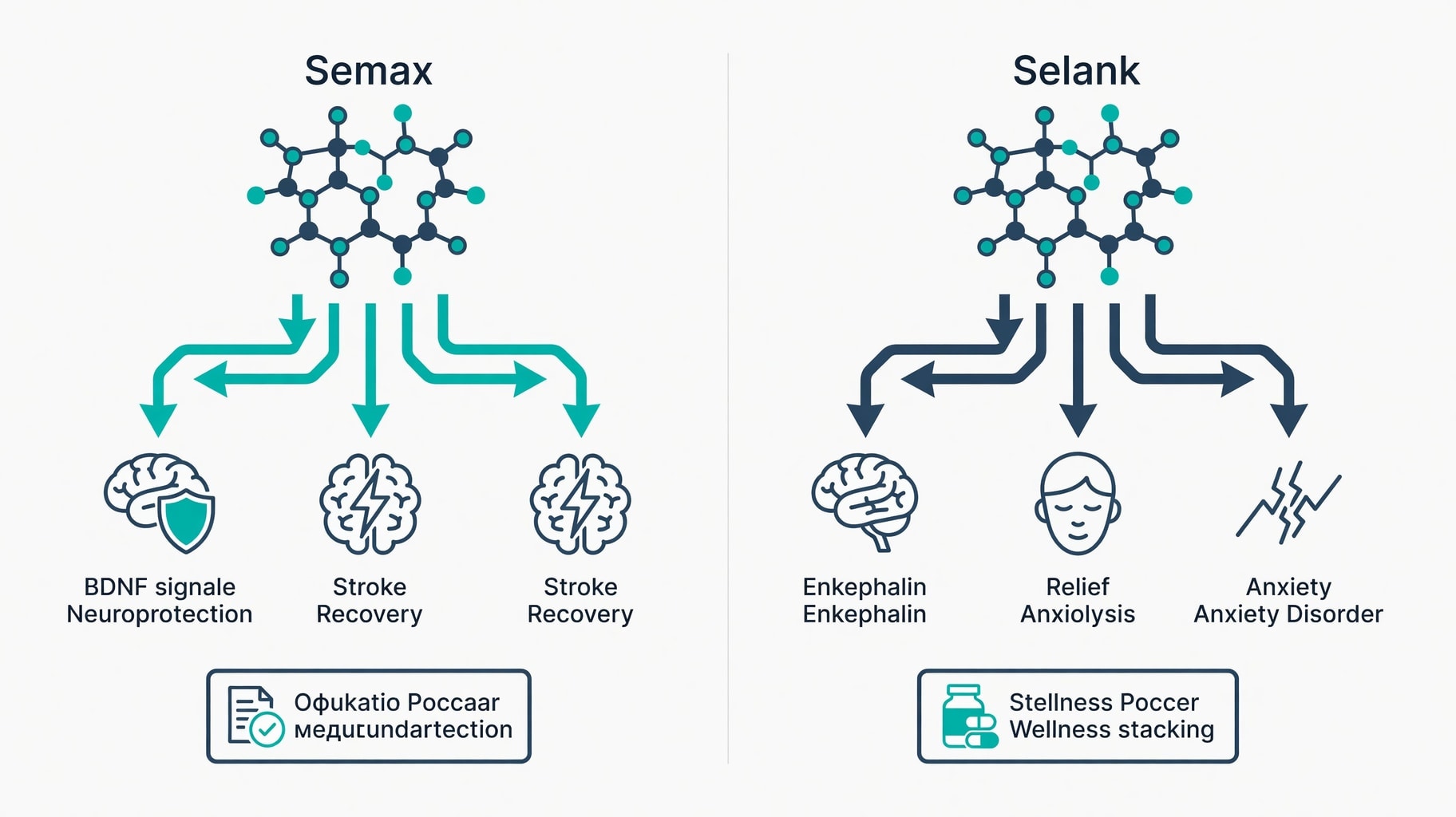
Figure 1: Regulatory and mechanistic divergence between Semax (BDNF/neuroprotection) and Selank (enkephalin/anxiolysis) based on Russian clinical approvals.
Divergent Origins and Receptor Mechanisms
Semax derives from the ACTH(4-10) hormone fragment stabilized with a Pro-Gly-Pro extension to resist enzymatic degradation. Its mechanism centers on melanocortin receptor agonism, particularly at MC4R, which triggers downstream upregulation of brain-derived neurotrophic factor (BDNF) and nerve growth factor (NGF) in hippocampal and cortical tissue. This neurotrophic pathway supports synaptic plasticity and neuronal survival, forming the biological rationale for its approved use in post-stroke cognitive rehabilitation rather than healthy cognitive enhancement. The compound modulates neuroplasticity programs that may support recovery after neurological insult, operating on a different timescale and through different signaling cascades than classical stimulants or anxiolytics.
Selank belongs to an entirely separate pharmacological class as a synthetic analog of tuftsin, an endogenous immunomodulatory peptide also modified with a Pro-Gly-Pro tail for stability. Its anxiolytic effects emerge through allosteric GABA receptor modulation combined with inhibition of enkephalin-degrading enzymes, extending the half-life of endogenous opioids during stress states. Research established that Selank dose-dependently inhibits plasma enkephalin hydrolysis with an IC50 of 15 microM, as reported in enzymatic studies, distinguishing it from benzodiazepines that bind directly to GABA-A receptors and carry dependence liability. This dual action on immune signaling and anxiety regulation reflects its tuftsin lineage, a biological origin completely absent in Semax’s ACTH-derived structure.
The clinical indications approved by Russian health authorities map precisely onto these mechanistic differences. Semax is indicated for ischemic stroke, transient ischemic attacks, and optic nerve diseases requiring neuroprotection. Selank is indicated for generalized anxiety disorder, neurasthenia, and stress-related conditions where anxiolysis without cognitive impairment is the therapeutic goal. English-language biohacking communities describe these peptides as complementary stacks, as noted by Perfect B, yet no pharmacological interaction studies have verified the safety or synergistic efficacy of combined administration. The stacking practice remains a cultural protocol derived from user consensus rather than validated therapeutic strategy grounded in receptor kinetics or clinical trials.
Evidence Asymmetry Between Stroke Observation and Anxiety RCTs
The evidentiary foundation for Semax in human populations rests primarily on uncontrolled observational studies rather than randomized controlled trials. A 2018 study by Gusev and Martynov involving 110 stroke patients reported improvements in Barthel index scores and motor function following intranasal Semax administration, according to Superpower. While consistent with the compound’s neuroprotective mechanism, the absence of randomization and blinding limits causal inference strength. No controlled clinical trials have evaluated Semax for attention-deficit/hyperactivity disorder or healthy cognitive enhancement despite theoretical proposals linking its dopaminergic and BDNF-upregulating properties to these endpoints. Cognitive claims circulating in wellness communities largely extrapolate from rodent hippocampal data to human neurology without direct clinical validation.
Selank possesses a stronger human clinical signal for its primary indication through comparative trial data. The RCT against medazepam in patients with generalized anxiety disorders demonstrated equivalent anxiolytic efficacy without sedation, muscle relaxation, or withdrawal effects characteristic of benzodiazepines, as documented in PubMed. This design provides higher-level evidence for anxiety treatment than exists for Semax in any cognitive indication. Research also identified phenotype-specific responses aligning with Selank’s immunomodulatory mechanism, with effects observed in BALB/c mice but not C57Bl/6 strains, as reported in behavioral studies. This mechanistic granularity is largely absent from Semax literature, where cognitive effects are typically reported as uniform across test populations without genetic or immunological stratification.
Bioavailability and pharmacokinetic data further complicate translation of Russian clinical protocols to international contexts. Both peptides are administered intranasally in Russian pharmaceutical formulations to bypass first-pass metabolism and facilitate direct CNS transport. The Pro-Gly-Pro extension extends tissue half-life by inhibiting enkephalinase cleavage, allowing BDNF gene expression changes to persist 24 to 48 hours after a single Semax dose, according to Peptpedia. However, bioavailability data for research-grade nasal sprays sold outside Russia remain unpublished and unverified. Variations in formulation, concentration, and delivery device performance introduce significant uncertainty when consumers attempt to replicate Russian clinical dosing regimens using internationally sourced products. Community dosing norms for Semax (500-1000mcg) and Selank (250-500mcg) circulate widely, as tracked by Peptide Library, but derive from user consensus rather than standardized pharmaceutical labeling.
Marketing Translation and Regulatory Liminality
The gap between Russian clinical evidence and global consumer claims reflects broader challenges in cross-cultural pharmacology translation. Semax and Selank were developed within a Soviet and post-Soviet research tradition integrating neurology, immunology, and psychiatry in ways diverging from Western pharmaceutical categorization. The Institute of Molecular Genetics in Moscow produced decades of peer-reviewed literature on these compounds, yet much remains inaccessible to English-speaking audiences due to language barriers and differences in clinical trial registration standards. When these peptides enter Western wellness markets, they are stripped of original regulatory and clinical context and repositioned within biohacking frameworks prioritizing subjective optimization over diagnosed pathology.
Marketing narratives emphasize the complementary nature of Semax and Selank, describing one as building neural connections and the other as clearing anxiety to create optimal cognitive conditions, as framed by PS Peptides. This framing imposes functional symmetry the pharmacological record does not support. Semax’s BDNF upregulation and Selank’s enkephalinase inhibition operate on different timescales through different receptor systems with different evidentiary backing. The notion that they form a balanced stack assumes pharmacological interoperability never tested in controlled settings. Consumers adopting combination protocols conduct unmonitored experiments with compounds having distinct safety profiles and incomplete interaction data.
Regulatory status in Western jurisdictions adds complexity to consumer decision-making. Neither Semax nor Selank holds FDA approval for any indication, and both exist in gray areas between research chemicals and unapproved drugs. Compounding pharmacies in the United States have historically prepared these peptides, but regulatory scrutiny has intensified and availability remains inconsistent. The World Anti-Doping Agency prohibits Semax for athletic use, as noted in comparative analyses, recognizing potential performance-modulating effects even without Western clinical validation. This regulatory limbo means consumers handle the Semax vs Selank comparison without approved pharmaceutical labeling safeguards, standardized dosing verification, or guaranteed product quality.
The FDA Pharmacy Compounding Advisory Committee has evaluated semax acetate and semax free base as distinct bulk drug substances with potentially different pharmacokinetic characteristics, signaling continued regulatory attention to formulation specificity rather than blanket approval.
Further Clinical & Regulatory Context
For deeper analysis and cross-referenced evidence, see: - Related Clinical & Pharmacological Analysis: Nootropic Peptide Stacking Safety Depends on Washout Kinetics, Not Vendor Protocols - Related Clinical & Pharmacological Analysis: Galanin Claims Outpace Clinical Evidence as Receptor Complexity Stalls Drug Development