
Manufacturer technical dossiers for palmitoyl tripeptide-1 consistently demonstrate extracellular matrix upregulation in cell cultures, yet independent clinical evidence confirming that this palmitoyl tripeptide 1 lip peptide delivers measurable volumization via topical application remains unverified in current literature. Sederma’s Maxi-Lip complex attributes lip contour refinement and volume enhancement to this specific signal peptide via glycosaminoglycan and collagen synthesis stimulation (Ci).
However, FormBlends’ 2026 evidence ledger identifies zero independent randomized controlled trials confirming measurable lip volume increase from topical peptide application, creating a distinct regulatory bifurcation between validated biochemistry and substantiated consumer claims (FormBlends Evidence Ledger). This evidentiary divergence defines the current compliance boundary for peptide lip care across U.S. and Pacific markets.
While fibroblast assays reliably show palmitoyl tripeptide-1 upregulates collagen I and glycosaminoglycans in controlled laboratory environments, the translation to clinical lip volumization lacks independent verification.
Consequently, product claims now face a reckoning where manufacturers possessing robust human data may support structural modification claims, while those relying solely on supplier in vitro datasets must increasingly limit labeling to hydration or barrier support to avoid misbranding risk under cosmetic regulations that separate drug-like volume alteration from permissible cosmetic conditioning.
In Vitro Synthesis Versus Topical Delivery Constraints
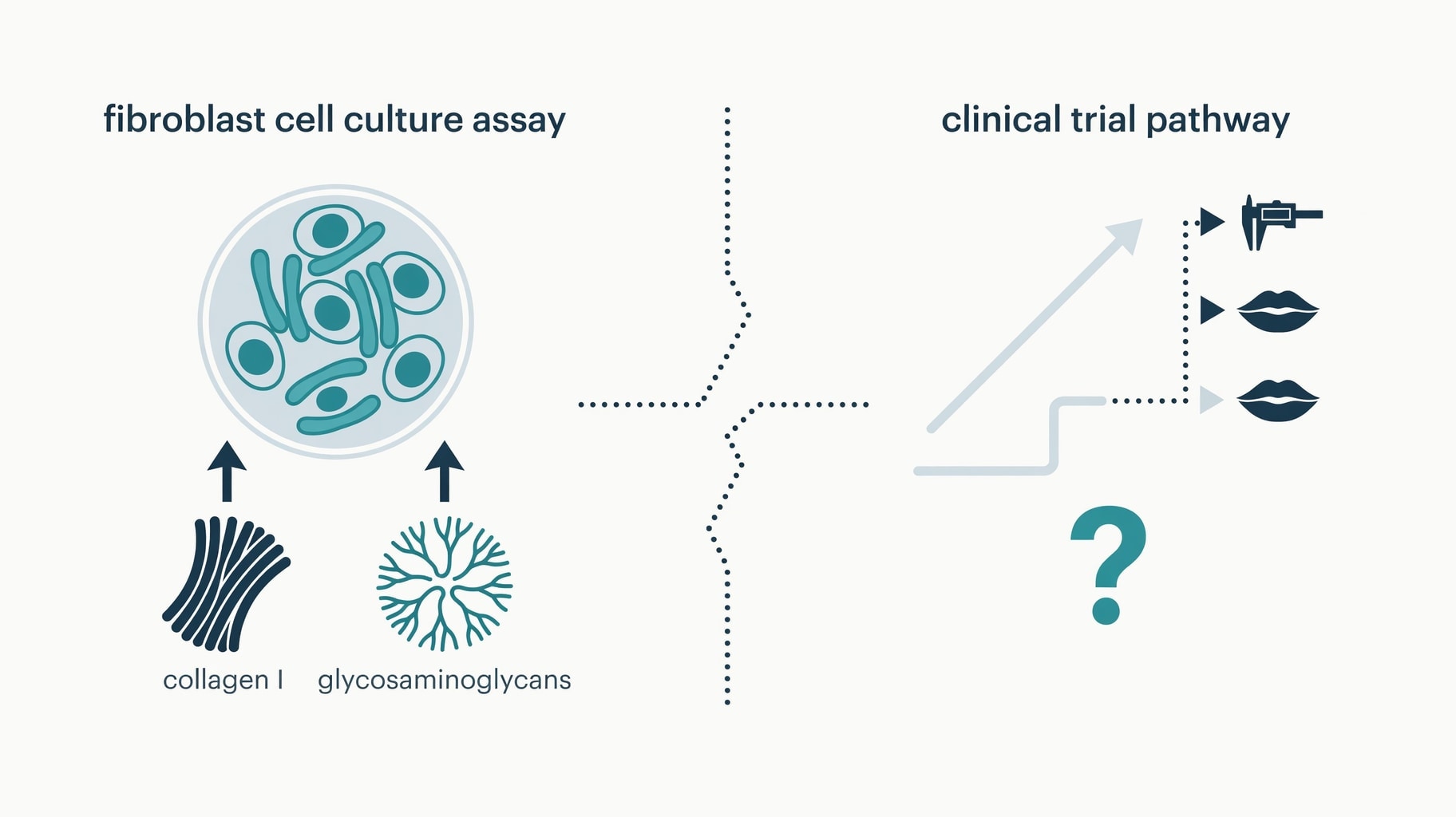
Figure 1: Evidentiary gap between validated in-vitro upregulation of extracellular matrix by palmitoyl tripeptide-1 and absence of independent RCTs confirming topical lip volumization.
The biochemical mechanism of palmitoyl tripeptide-1 is well-documented at the cellular level, where the molecule consists of a glycine-histidine-lysine (GHK) sequence attached to a palmitic acid chain.
This lipidation is functional rather than decorative, as the GHK portion serves as a biological signal recognized by fibroblast cell surface receptors to mimic fragments released during natural collagen breakdown, while the attached 16-carbon palmitic acid tail provides necessary lipophilicity to theoretically allow the molecule to traverse the lipid-rich stratum corneum.
Research profiles detailed by Peptide Journal confirm this design improves skin penetration compared to unmodified hydrophilic peptides, and cell culture data supports the signaling hypothesis with fibroblasts exposed to palmitoyl tripeptide-1 in buffer solutions consistently showing increased production of collagen I, collagen III, and hyaluronic acid synthase-1.
A 2025 bioactive peptide review published in ScienceDirect notes that collagen I production is the most frequently tested parameter for signal peptides, with glycosaminoglycans following closely, establishing high biological plausibility when the molecule is applied directly to naked cells in optimal concentrations. Translation to living tissue introduces formidable biophysical barriers because the molecular weight of palmitoyl tripeptide-1 ranges from approximately 1,000 to 1,100 Daltons, which exceeds the conventional 500-Dalton cutoff for efficient transepidermal diffusion.
Although the lip vermilion presents a unique anatomical challenge with a stratum corneum thinner than facial skin, it remains a significant diffusion barrier for molecules of this size, and analysis by FormBlends highlights that achieving fibroblast-level concentrations in the living dermis requires traversal of this barrier without confirmation from independent pharmacokinetic studies.
The distinction between mRNA expression and protein synthesis further complicates efficacy assessments, as the ScienceDirect review emphasizes that assessing mRNA levels provides only an indication of potential effect and actual protein expression requires confirmation.
Studies on related peptides have shown significant increases in gene expression without corresponding increases in protein supernatant levels, suggesting that even if palmitoyl tripeptide-1 successfully penetrates the lip tissue and triggers signaling cascades, the downstream production of volumizing matrix components may be rate-limited by factors absent in simplified cell cultures, leading regulatory bodies evaluating volume claims to increasingly demand protein-level confirmation in human tissue rather than just transcriptional upregulation in isolated cells.
Clinical Evidence Tiers and Adjacent Modalities
The absence of independent RCTs for topical lip volumization stands in stark contrast to the robust data supporting adjacent interventions, requiring formulators to distinguish between distinct evidence bases to prevent conflation.
Oral collagen peptide supplementation has demonstrated statistically significant improvements in skin hydration and dermal collagen density in double-blind, placebo-controlled trials, with research published in PubMed confirming that oral bioactive peptides increase natural moisturizing factor content in the stratum corneum, and separate ex vivo and clinical models showing increased dermal collagen density and reduced network fragmentation after four weeks of supplementation.
These systemic effects are mechanistically distinct from topical signaling because oral peptides act through digestive metabolites that circulate systemically, whereas topical palmitoyl tripeptide-1 relies entirely on local penetration and receptor binding, making the citation of oral trials to substantiate topical lip volume claims a fundamental scientific error.
Occlusive agents represent the high-confidence comparator for lip care, as petrolatum and shea butter reduce transepidermal water loss through well-established physical mechanisms, and the FormBlends Evidence Ledger rates occlusive base efficacy as "High Confidence" based on multiple human RCTs.
When consumers perceive plumping from a peptide lip balm, the effect often derives from this immediate occlusive hydration rather than long-term matrix remodeling, just as hyaluronic acid provides similar temporary volumization through water attraction but does not permanently increase lip size, making the distinction between transient hydration and structural volume essential for accurate labeling.
Facial studies cannot be automatically extrapolated to lip tissue, even though Matrixyl 3000, which combines palmitoyl tripeptide-1 with palmitoyl tetrapeptide-7, has demonstrated wrinkle reduction in facial trials where product research summaries indicate objective methods like profilometry show modest average improvements in wrinkle parameters.
These studies typically target periorbital or forehead skin, yet the lip vermilion differs significantly in thickness, sebaceous gland density, and exposure to mechanical stress, meaning that even these facial datasets do not constitute proof of lip-specific volumization.
Systematic reviews reinforce this anatomical precision, as a 2026 Frontiers in Medicine meta-analysis found that tripeptides showed the greatest effect on roughness and texture smoothing, which aligns with the biochemical mechanism of matrix stimulation but remains silent on lip volumization, indicating that the scientific community has not yet validated the volume endpoint for topical tripeptides despite extensive investigation of their textural effects.
For formulators seeking broader structural support validated in facial contexts, the mechanism of matrixyl collagen synthesis offers a parallel pathway, though it similarly requires lip-specific validation to substantiate volumization claims in this distinct anatomical zone.
Regulatory Implications for Volume and Hydration Claims
The current evidence tier dictates formulation and labeling strategy because U.S. Food and Drug Administration regulations distinguish cosmetics from drugs based on intended use and claim substantiation. Claims of structural alteration, such as increasing lip volume through collagen synthesis, risk classification as unapproved new drugs, while claims limited to conditioning, hydration, and barrier support remain within the cosmetic framework.
The absence of independent RCTs for palmitoyl tripeptide-1 lip volumization makes structural claims legally precarious, placing brands relying solely on supplier in vitro data at heightened enforcement risk unless they utilize the safe harbor of hydration and texture claims supported by the established occlusive and humectant properties of the formulation base.
Formulation chemists are responding by pairing peptides with high-confidence hydrators, as retail product analysis by Today shows leading treatments combining palmitoyl tripeptide-1 with shea butter, hyaluronic acid, and fatty acids to address both mechanisms simultaneously. This dual approach allows the peptide to provide theoretical long-term matrix support while the occlusive and humectant components deliver immediate, verifiable hydration, enabling brands to market peptide benefits while grounding consumer satisfaction in proven moisturization and reducing regulatory exposure.
The distinction between palmitoyl tripeptide-1 and related compounds requires precise nomenclature because marketing materials sometimes conflate palmitoyl tripeptide-1, palmitoyl tripeptide-38, and palmitoyl oligopeptide, which are distinct molecules with different molecular weights, receptor affinities, and evidence bases.
Palmitoyl tripeptide-38 targets six extracellular matrix proteins while palmitoyl tripeptide-1 targets a narrower subset, and ingredient comparisons clarify that standalone palmitoyl tripeptide-1 offers targeted support while complexes address broader concerns, necessitating that regulatory submissions and ingredient decks reflect this specificity to avoid obscuring the actual bioactive present. Future substantiation will require anatomically specific clinical trials using three-dimensional profilometry and standardized photography to build the clinical superstructure upon existing supplier mechanistic foundations.
Until such data emerges, the industry operates in a transitional state where the biochemistry is sound and the delivery is theoretically plausible but empirically unconfirmed, meaning volume claims await verification in a normal cadence of scientific validation that brands must respect to build durable regulatory positions.
Further Clinical & Regulatory Context
For deeper analysis and cross-referenced evidence, see: - Related Clinical & Pharmacological Analysis: Topical Versus Injectable GHK-Cu: Franz Cell Diffusion Data and Regulatory Evidence Gaps - Related Clinical & Pharmacological Analysis: Palmitoyl Tetrapeptide-7: IL-6 Suppression Data Defines Cosmetic Boundaries