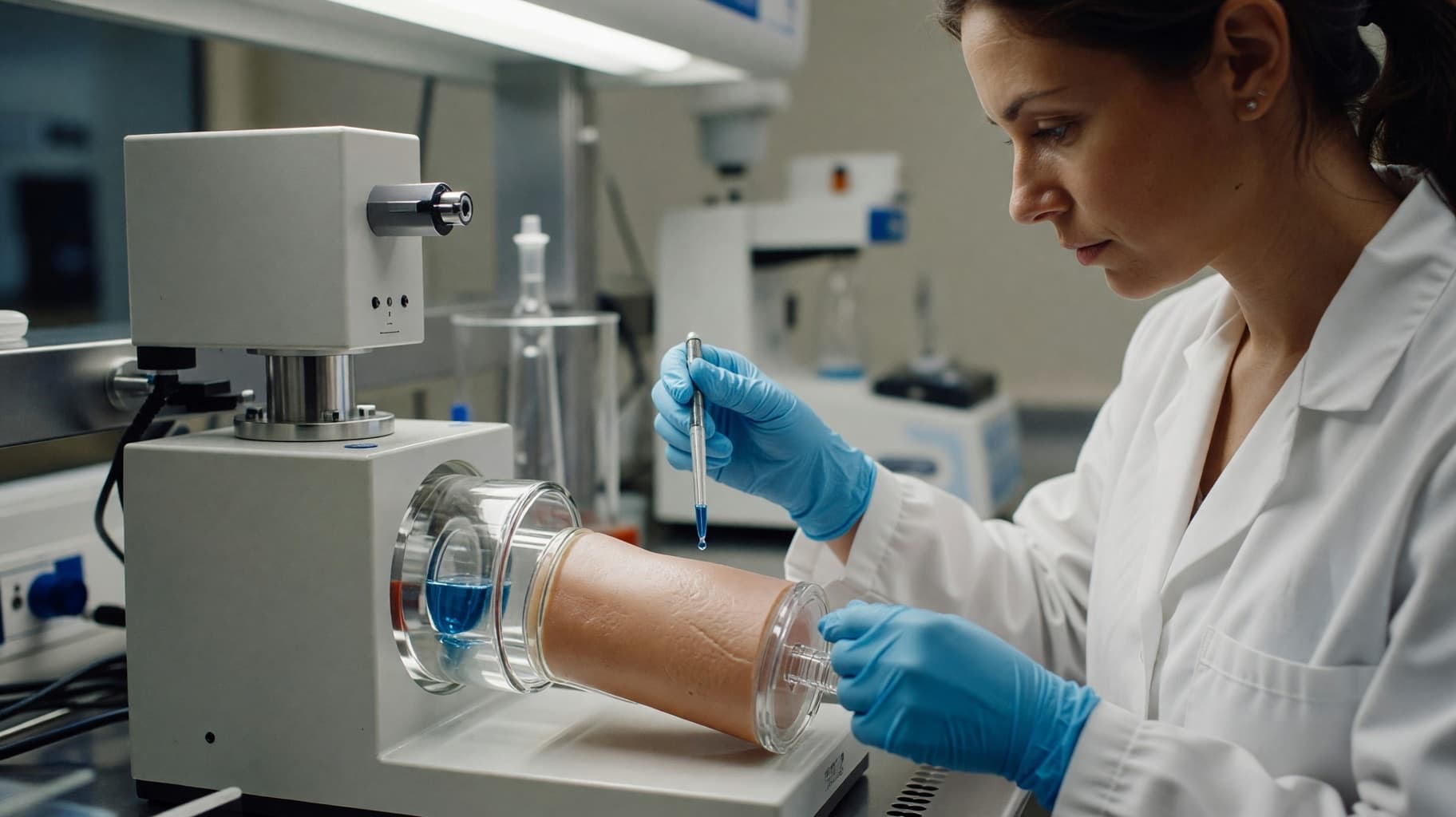
The U.S. Food and Drug Administration has identified unapproved injectable peptides as a primary enforcement target because they bypass established cosmetic safety frameworks without meeting drug approval standards, a distinction that directly governs the commercial viability of topical vs injectable copper peptides.
Injectable GHK-Cu currently lacks the human randomized controlled trial data required for new drug approval, leaving it in an unapproved category when marketed for intradermal use, whereas topical applications operate under cosmetic regulations provided manufacturers avoid physiological drug claims. In vitro Franz diffusion cell assays establish that plain aqueous GHK-Cu solutions exhibit limited dermal penetration compared to formulations utilizing liposomes or chemical enhancers, making the formulation vehicle the primary determinant of bioavailability.
While injectable protocols theoretically bypass the skin barrier to achieve higher tissue concentrations, no head-to-head human trials exist to validate their superiority over optimized topical delivery systems for skin rejuvenation endpoints (FormBlends).
This evidentiary asymmetry defines the current regulatory landscape. The strongest human evidence base supports topical application for wound healing and skin texture modification, whereas injectable human RCT data remains absent as of the most recent comprehensive reviews. Regulatory compliance therefore hinges on documented penetration enhancers and gene expression modulation in fibroblast cultures for topical products, while injectable protocols remain excluded from the peer-reviewed human clinical record.
This divergence creates a market where consumer claims regarding injectable efficacy frequently outpace regulatory validation, necessitating a precise understanding of what in vitro permeation data actually supports versus what remains theoretical. Formulation optimization, rather than route escalation, remains the only legally compliant pathway for verified delivery under current FDA and EMA frameworks.
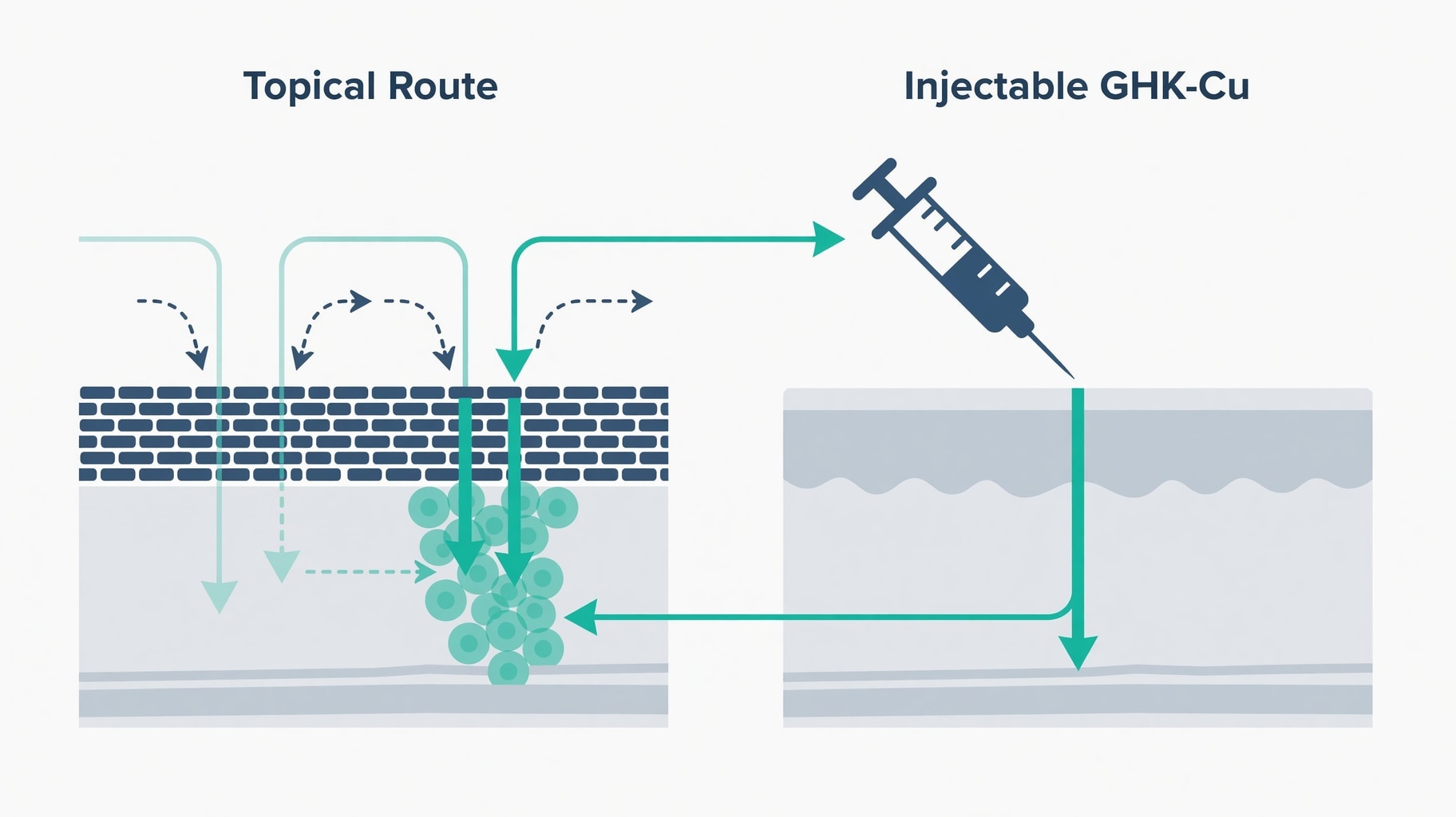
Figure 1: Franz cell diffusion comparison of aqueous versus enhanced GHK-Cu formulations and regulatory pathways for topical versus injectable routes.
Physicochemical Barriers and Formulation Solutions
GHK-Cu weighs approximately 340 daltons, placing it below the 500-dalton threshold generally required for passive diffusion through intact skin. Size alone does not guarantee delivery. The copper coordination increases the compound's polarity and alters its charge state at physiological pH, creating a hydrophilic molecule that partitions poorly into the lipid-rich stratum corneum.
This charge-dependent exclusion is the central friction point in transdermal peptide delivery and explains why molecular weight compliance is a necessary but insufficient condition for bioavailability.
The stratum corneum preferentially excludes hydrophilic molecules, causing GHK-Cu to partition poorly relative to its aqueous concentration despite clearing the size threshold.
In vitro permeation studies consistently validate this barrier function. Research using Franz diffusion cells with liposome membranes modeling the intercellular cement of the stratum corneum has shown that GHK-Cu penetration is significantly impeded without specialized vehicles (PubMed).
Flow-through diffusion cell data further confirms that when applied as an aqueous solution, the copper tripeptide exhibits limited transit through heat-separated epidermis and dermatomed skin, with significant retention occurring in the upper layers rather than reaching the receptor fluid below (PubMed).
These assays provide the regulatory baseline for substantiating topical claims: without modification, the molecule largely stays on the surface.
Formulation science offers validated workarounds that address this polarity mismatch without resorting to injection. Liposomal encapsulation and chemical penetration enhancers such as propylene glycol disrupt the lipid structure sufficiently to facilitate transport. Microneedling has demonstrated increased GHK-Cu penetration compared to passive delivery, allowing the peptide to reach the dermis where collagen-stimulating effects are most relevant. Crucially, these procedural enhancements apply to topical or cosmetic-grade products and do not constitute validation of sterile injectable protocols.
The enhanced penetration achieved through microneedling or liposomal delivery demonstrates that the stratum corneum barrier can be navigated topically, challenging the assumption that injection is the only route to dermal bioavailability. For a detailed breakdown of how these delivery systems compare in regulatory filings, see our analysis of peptide cosmeceuticals and marketing claims.
Transcriptomic Data and Clinical Evidence Limitations
Bioinformatic analysis by Pickart and Margolina utilized the Broad Institute Connectivity Map to associate GHK-Cu with the modulation of over 4,000 human genes, suggesting a broad regenerative potential that resets cellular patterns from damaged to healthier states. In fibroblast cell cultures, the peptide reliably upregulates collagen I and III gene expression and stimulates glycosaminoglycan synthesis. These mechanisms form the scientific backbone of copper peptide marketing and provide a plausible biological rationale for the compound's effects.
Regulatory affairs professionals must distinguish this connectivity mapping from proven clinical outcomes in intact human skin. The 4,000-gene figure derives from bioinformatic modeling, not direct measurement of gene expression changes in patients applying serum or receiving injections. Connectivity mapping identifies potential associations based on databases of gene signatures, but it does not confirm that these changes occur in vivo following topical or injectable administration.
Skin permeability remains a dismissed necessity for peptide performance, since many topical products cannot deliver active ingredients past the stratum corneum at the concentrations used in these cell-culture assays. The gap between in vitro transcriptomics and in vivo histology is substantial and currently unbridged by comparative human data.
Confirmed dermal delivery at fibroblast depth from topical application has not been demonstrated in large, well-controlled human trials, even though laboratory models support its plausibility. Ex vivo skin penetration data consistently shows that a significant fraction of applied peptide remains in the epidermis.
This limitation applies equally to injectable claims: while bypassing the stratum corneum theoretically ensures dermal presence, the downstream gene expression effects observed in petri dishes have not been quantified in human subjects receiving subcutaneous or intradermal GHK-Cu.
The biological mechanism is established in isolation; the clinical translation remains inferred. Without human pharmacokinetic data linking injected doses to specific gene expression changes in dermal tissue, the superiority of injection over optimized topical delivery remains a hypothesis rather than a regulatory fact. Manufacturers seeking to bridge this gap must handle FDA guidance on peptide development to structure valid clinical endpoints.
Regulatory Classifications and Safety Compliance
Topical copper peptides are generally regulated as cosmetics in the United States, provided they limit claims to cleansing or beautifying and avoid asserting drug-like physiological changes. Injectable GHK-Cu, by contrast, meets the statutory definition of a drug because it is intended for injection and marketed with structural or functional claims. No injectable GHK-Cu product currently holds FDA approval for skin rejuvenation or wound healing.
The absence of head-to-head human RCTs comparing the two routes means that any assertion of injectable superiority is, by definition, an unverified claim under current regulatory frameworks (FormBlends). This regulatory asymmetry means that topical products benefit from decades of safety data and permissible market presence, while injectables face the full burden of new drug approval without the supporting clinical dossier.
Safety profiles further distinguish the two pathways and inform risk assessments. Cosmetic topical products are formulated for external use and are not tested for sterility or pyrogenicity. Medical professionals explicitly warn that home microneedling should not be used to force cosmetic copper peptide serums into the skin, as these formulas are not designed or tested as sterile injectable products.
Discoloration or precipitation in GHK-Cu solutions signals copper dissociation or peptide degradation, a stability risk that carries heightened consequences when the product bypasses the skin's immune surveillance via injection. The introduction of non-sterile cosmetic formulations into the dermis through microneedling or injection circumvents the very barrier that protects against infection and granuloma formation, creating a safety profile fundamentally distinct from topical application.
The FDA Pharmacy Compounding Advisory Committee continues to evaluate compounded peptide products, specifically examining whether entities are essentially copying approved drugs or creating unapproved new drugs under the guise of compounding. This ongoing review signals that regulatory scrutiny of injectable peptides will likely intensify rather than relax, particularly for compounds like GHK-Cu that lack an approved reference listed drug.
Formulators and clinicians must therefore treat the current evidentiary gap as a permanent compliance constraint rather than a temporary market inefficiency.
Until human RCTs compare liposomal topical formulations against sterile intradermal administration under controlled conditions, the choice between routes remains a decision governed by formulation science and regulatory risk tolerance rather than comparative clinical evidence.
Further Clinical & Regulatory Context
For deeper analysis and cross-referenced evidence, see: - Related Clinical & Pharmacological Analysis: Copper Tripeptide-1 Hair Loss Evidence Stops at the Petri Dish