
Sederma’s proprietary in vitro fibroblast assays report that Pal-KTTKS stimulates type I and III collagen synthesis by up to 117% in cell culture, a figure frequently cited in marketing but distinct from measured outcomes in human subjects. This specific data point establishes biological plausibility for Matrixyl collagen synthesis mechanisms, yet it does not confirm structural remodeling in living tissue.
Regulatory affairs specialists and formulators must distinguish between these two evidence tiers when evaluating product claims or cross-border compliance documentation.
While in vitro data supports the matrikine signaling hypothesis, human efficacy claims for this ingredient derive exclusively from split-face studies using instrumental imaging and expert grading rather than tissue biopsies. Reporting by Klow Peptide confirms that the widely quoted percentage increases originate from controlled dish assays, not histological verification of new collagen in intact skin.
Decisions regarding formulation stability, claim substantiation, and market positioning therefore depend on recognizing where cellular activity ends and clinically validated structural change begins.
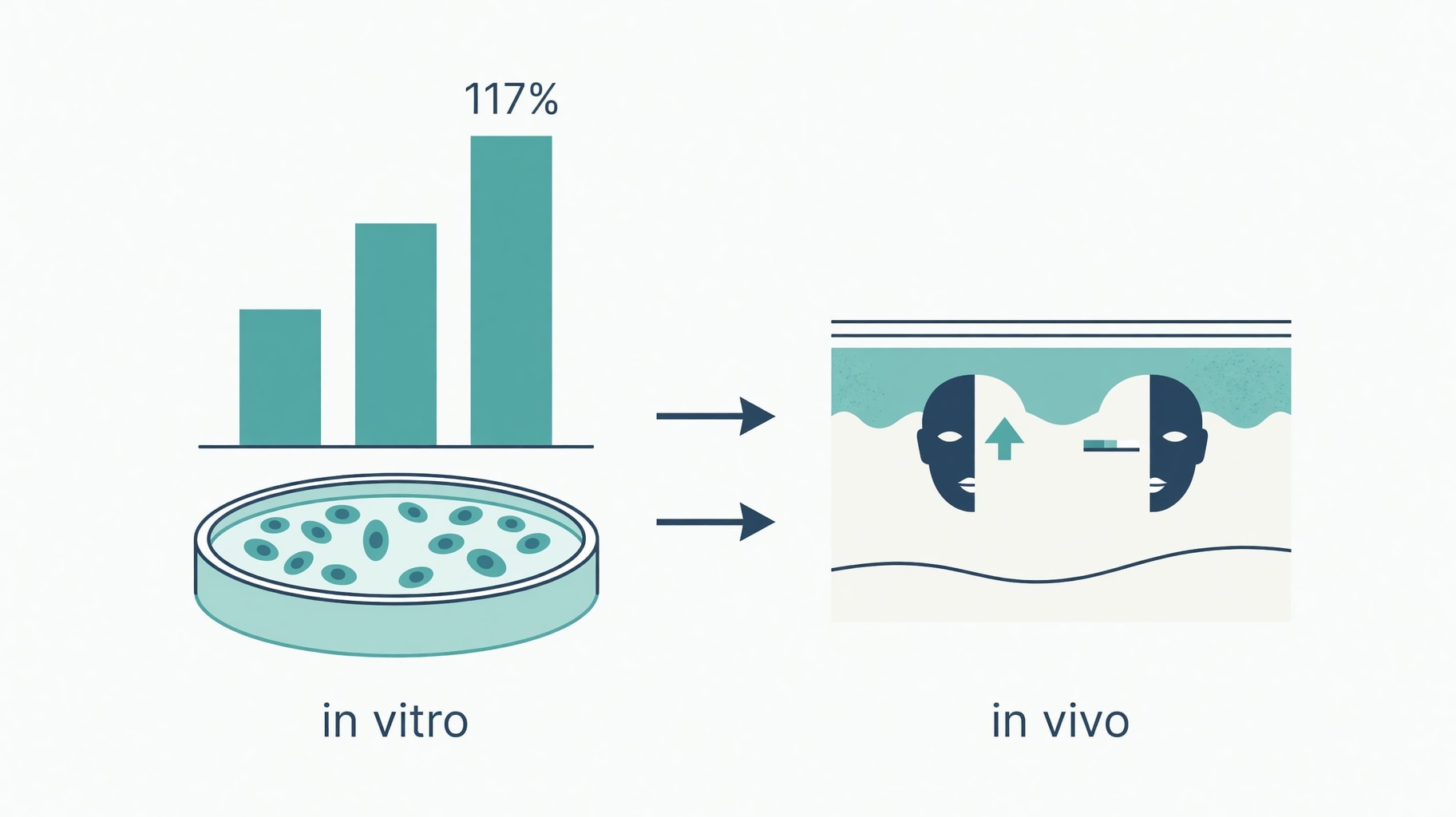
Figure 1: Comparison of in vitro collagen synthesis assays versus human clinical imaging endpoints for Matrixyl (Pal-KTTKS).
In Vitro Mechanism vs. Clinical Endpoints
The scientific case for Palmitoyl Pentapeptide-4 rests on its identity as a matrikine, a messenger peptide mimicking fragmented procollagen. When collagen degrades naturally, it releases small protein fragments that signal fibroblasts to initiate repair. Pal-KTTKS replicates this fragment synthetically. Research detailed by FormBlends indicates this molecule activates TGF-beta signaling pathways and downstream Smad2/3 phosphorylation, instructing cells to upregulate extracellular matrix production. This mechanism provides a coherent biological rationale for topical application.
Independent validation of this cellular response exists outside manufacturer-sponsored research. Jones and colleagues at the University of Reading demonstrated that C16-KTTKS stimulated collagen production in cultured human dermal and corneal fibroblasts, as noted in Pure Peptides' evidence review. Crucially, this academic work carried no commercial affiliation. The researchers observed that the response clustered near the molecule's critical aggregation concentration, suggesting self-assembly may influence bioavailability in ways that simple receptor binding models do not capture.
Despite robust cellular data, a significant evidentiary gap persists at the tissue level. No published study has quantified collagen histologically in living human skin following topical application of this specific peptide. Abu Samah and Heard at Cardiff University described a sound in vitro basis for fibroblast effects alongside a surprising absence of in vitro skin penetration data, according to the same Pure Peptides analysis.
Without direct measurement of dermal collagen density in human biopsies, the translation from cell culture percentages to visible anti-aging benefits remains inferential rather than proven.
Human clinical trials have nonetheless documented measurable surface improvements using non-invasive endpoints. Robinson and colleagues conducted a 12-week, double-blind, placebo-controlled, split-face study involving 93 women to evaluate Pal-KTTKS efficacy. The peptide formulation produced statistically significant improvement versus placebo for wrinkle and fine line reduction, measured by quantitative image analysis and expert grading.
Every author on this major study was affiliated with The Procter & Gamble Company, and the trial relied entirely on instrumental imaging and self-report without biopsy confirmation.
This distinction between cellular mechanism and clinical observation defines the current regulatory environment. Objective methods such as profilometry and standardized photography typically show modest average improvements in wrinkle parameters, often in the single-digit to low double-digit percentage range. These measured surface changes are real but substantially smaller than the triple-digit collagen synthesis figures cited in promotional materials.
Formulators operating in both U.S. and Pacific markets must align their claims with the specific endpoint validated in human trials, not the maximal cellular response observed in isolated fibroblasts.
Variant-Specific Evidence Tiers
The Matrixyl trade name now encompasses multiple distinct chemical entities, each with separate composition and evidence profiles. Conflating these variants creates regulatory risk and technical inaccuracy. Matrixyl 3000, perhaps the most commercially prevalent variant, is a proprietary blend of Palmitoyl Tripeptide-1 (Pal-GHK) and Palmitoyl Tetrapeptide-7 (Pal-GQPR). This combination differs chemically from the original Pal-KTTKS pentapeptide.
Clinical data for Matrixyl 3000 focuses on wrinkle depth reduction and skin roughness improvement over 12-week periods, with efficacy characterized as modest but statistically significant compared to vehicle controls.
Matrixyl Synthe'6 represents another divergence in both chemistry and targeted biological activity. This variant consists of Palmitoyl Tripeptide-38 (Pal-Lys-Thr-Thr-Lys-Ser-Thr) and targets basement membrane components alongside dermal matrix proteins. Product literature from PeptideDeck indicates this molecule was designed to stimulate collagen IV, laminin, and other structural elements specific to the dermal-epidermal junction. Evidence supporting Synthe'6 remains largely manufacturer-sponsored, with fewer independent academic validations compared to the original pentapeptide.
The newest addition, Matrixyl Morphomics, carries an even thinner public evidence base. While marketed for facial contouring and volume restoration, published clinical data specific to this variant is sparse. Most available information derives from supplier technical documents rather than peer-reviewed human trials. Technical buyers evaluating this ingredient should recognize that its evidence tier differs materially from the decades of research supporting Pal-KTTKS or the established clinical datasets for Matrixyl 3000.
Palmitoylation serves as the common delivery strategy across all variants. Naked peptides cannot penetrate the stratum corneum effectively due to their hydrophilic nature. Attaching a palmitic acid chain renders the molecule lipophilic, enabling transit through the lipid-rich outer barrier to reach viable dermal cells. This chemical modification is essential for topical bioavailability but introduces formulation stability considerations.
The fatty acid tail can affect solubility, emulsion compatibility, and shelf-life performance in ways that formulators must validate empirically for each specific product matrix.
Regulatory Claim Boundaries Across Markets
U.S. Food and Drug Administration regulations define cosmetic peptides as ingredients intended to cleanse, beautify, or alter appearance without affecting bodily structure or function. Claims suggesting that a topical product stimulates new collagen synthesis approach the boundary between cosmetic and drug classification. Structure/function claims permitted for cosmetics must focus on visible appearance changes rather than underlying biological processes.
Marketing language citing specific percentage increases in cellular collagen production requires careful qualification to avoid implying drug-like physiological effects.
Pacific regulatory frameworks, including those governing Taiwanese and broader Asian markets, often apply different standards for functional cosmetic ingredients. These jurisdictions may permit more explicit biological mechanism claims when supported by specified testing protocols and safety data. Cross-border suppliers must therefore maintain parallel claim substantiation dossiers that address each market's specific evidentiary requirements.
A claim acceptable in Taipei based on in vitro fibroblast data may require modification for U.S. labeling to emphasize surface appearance endpoints instead.
Systematic reviews of topical peptide research highlight the limitations of current evidence standards. A comprehensive analysis published in Frontiers in Medicine notes that most human trials for cosmetic peptides are small, industry-funded, and employ surrogate endpoints rather than histological gold standards. This pattern holds true across the Matrixyl family.
While signal peptides demonstrably stimulate fibroblast activity in laboratory models, the magnitude of visible clinical benefit remains constrained by penetration efficiency, dose delivery, and individual biological variability.
Comparative evidence further contextualizes Matrixyl's position in the anti-aging ingredient hierarchy. Prescription retinoids like tretinoin possess decades of randomized controlled trial data demonstrating both wrinkle reduction and histologically confirmed collagen synthesis. Retinol, the over-the-counter precursor, also maintains stronger human evidence for structural remodeling than topical peptides. Matrixyl offers a tolerability advantage for sensitive skin types unable to use retinoids, but this benefit comes with less definitive evidence of dermal restructuring.
Honest product positioning acknowledges this trade-off rather than claiming equivalence to vitamin A derivatives.
The commercial implications of these evidence distinctions are substantial. Brands building premium pricing on peptide technology must ensure their marketing claims align with the specific variant used and the corresponding data tier available. Citing original Pal-KTTKS fibroblast studies to support a Matrixyl Synthe'6 product creates technical inaccuracy regardless of regulatory permissibility. Similarly, extrapolating in vitro collagen percentages directly to consumer-facing efficacy claims invites scrutiny from regulators increasingly focused on substantiation rigor.
Future research may eventually close the gap between cellular mechanisms and human histological confirmation. Advances in non-invasive imaging technologies could potentially provide dermal collagen quantification without biopsy, offering a path to validate topical peptide effects in living skin. Until such methods achieve regulatory acceptance and widespread adoption, the Matrixyl evidence base will remain bifurcated between robust in vitro plausibility and modest but reproducible clinical surface improvements.
Technical buyers and regulatory professionals must handle this duality with precision, recognizing that neither tier alone provides the complete picture that marketing narratives often imply.
Pending decisions on functional cosmetic classification in several Asian markets may shift how peptide mechanism claims are evaluated regionally. Industry stakeholders should monitor guidance updates from relevant authorities rather than assuming current interpretations will remain static. The next substantive evidentiary milestone will likely come from independent academic groups applying advanced imaging to validate or refine manufacturer-sponsored findings, establishing whether the cellular signals observed in culture translate to measurable dermal remodeling in clinical practice.
Further Clinical & Regulatory Context
For deeper analysis and cross-referenced evidence, see: - Related Clinical & Pharmacological Analysis: Palmitoyl Tripeptide-1 Lip Claims Face Scrutiny Amid Clinical Gaps