
No published clinical trial has ever tested the fixed combination of GHK-Cu, BPC-157, and TB-500 as a unified formulation, despite widespread commercial promotion of glow stack peptides in aesthetic medicine. The protocol’s popularity rests entirely on theoretical pathway complementarity rather than demonstrated pharmacokinetic compatibility or human efficacy data for the blend. Practitioners prescribing this combination are extrapolating from three distinct evidence bases that have never been validated as a single therapeutic unit.
While individual components possess specific preclinical or topical evidence, their concurrent administration relies on biological inference. GHK-Cu has documented effects on collagen gene expression in topical applications, BPC-157 demonstrates angiogenesis in animal models, and TB-500 shows actin-binding activity in wound healing studies. However, analysis by Peptide Advisors confirms that no trial has evaluated these compounds together.
This distinction defines the regulatory risk profile in U.S. compounding, where the FDA has categorized BPC-157 and TB-500 as Category 2 bulk substances lacking sufficient safety evidence for human use, contrasting sharply with GHK-Cu’s established history in topical cosmetics.
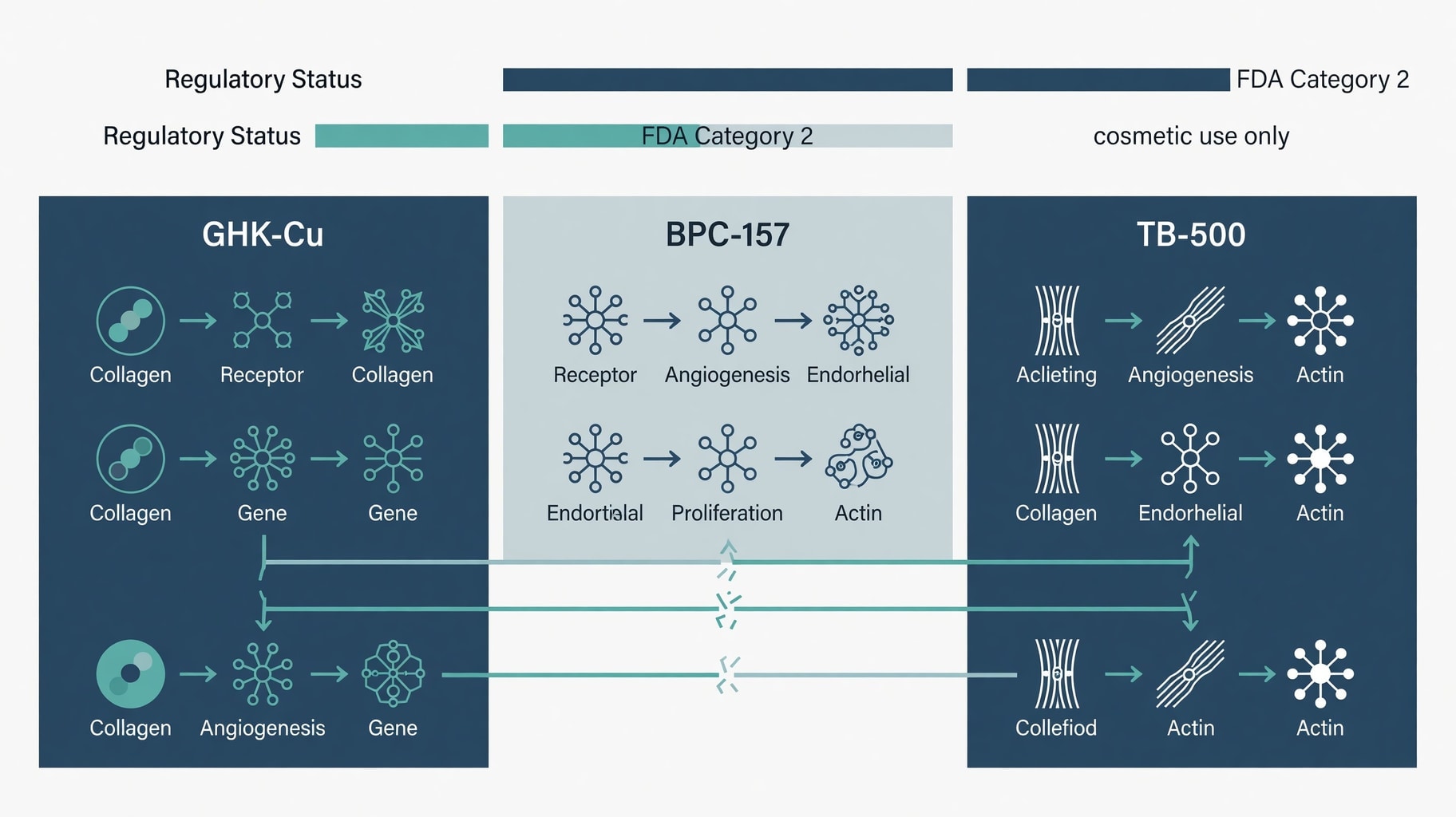
Figure 1: Theoretical pathway overlap versus absence of clinical synergy data for the GHK-Cu, BPC-157 and TB-500 glow stack.
The commercial stakes are significant. Aesthetic clinics market this trio as a comprehensive rejuvenation system, yet the regulatory foundation is fractured. Understanding the gap between marketing nomenclature and verified science is now a compliance necessity. The term "glow" functions as a branding descriptor, not a biological classification. Distinguishing verified individual mechanisms from unproven combined efficacy is essential for practitioners navigating significant regulatory divergence between U.S. FDA restrictions and international research exemptions.
Divergent Evidence Tiers for Stack Components
The biological rationale for combining these three peptides assumes that targeting multiple repair pathways simultaneously produces additive benefits. Scientific literature supports the individual mechanisms but not the interaction. GHK-Cu is the most clinically substantiated component for dermatological outcomes. First isolated from human plasma in 1973 by Loren Pickart, the tripeptide has been extensively studied for its ability to modulate gene expression.
A review by Pickart and Margolina catalogs its activity in collagen and elastin signaling, skin remodeling, and antioxidant pathways.
In vitro fibroblast data demonstrates upregulation of collagen I, collagen III, and elastin synthesis. Crucially, this evidence is predominantly topical. Bioavailability through intact stratum corneum is limited, and effect sizes in blinded human trials are often smaller than vendor marketing implies. Extrapolating topical safety and efficacy data to injectable protocols remains scientifically unsupported.
BPC-157 occupies a different evidence tier. This synthetic pentadecapeptide, based on a protein found in gastric juice, is studied primarily for soft-tissue repair and cytoprotection. Work by Sikiric and colleagues examined BPC-157 in angiogenesis and musculoskeletal healing models. The peptide appears to promote new blood vessel formation via VEGF pathway upregulation in murine and rat models. These are animal studies.
There are no published human clinical trials validating BPC-157 for aesthetic skin rejuvenation or facial recovery.
The compound’s inclusion in the glow stack is based on the hypothesis that enhanced microcirculation supports dermal health, but this remains an untested extrapolation from gastrointestinal and orthopedic research.
TB-500, a synthetic analogue of Thymosin Beta-4, completes the triad through actin regulation. Research builds on studies by Maar and colleagues regarding cell migration and tissue regeneration. The primary mechanism involves sequestration of G-actin monomers and modulation of the actin polymerization cycle, which influences cell motility and wound healing. Like BPC-157, TB-500 data is largely preclinical or derived from Phase 2 wound-healing trials unrelated to cosmetic dermatology.
Its role in the stack is theoretically to support cellular migration and structural rebuilding. Yet reporting by LearnMuscles emphasizes that complementary pathways do not constitute proven synergy. The compounds are graded on their own terms because the combination has never been trialed as a unit.
This evidence stratification matters clinically. GHK-Cu has human topical data. BPC-157 and TB-500 have animal parenteral data for non-aesthetic indications. Combining them creates a protocol where the strongest evidence (GHK-Cu) is topical, while the injectable components (BPC-157, TB-500) lack human aesthetic safety profiles. Practitioners must recognize that the "synergy" promoted commercially is a theoretical construct, not a validated pharmacological phenomenon.
Regulatory Status and Cross-Border Supply Chains
The regulatory environment for glow stack peptides is defined by asymmetry. In the United States, the FDA’s interim policy on compounding using bulk drug substances places BPC-157 and TB-500 in Category 2. This designation indicates insufficient evidence to establish safety and efficacy for human compounding. These compounds are not FDA-approved drugs. They are not recognized as safe and effective for any indication.
Compounding pharmacies operating under Section 503A of the Federal Food, Drug, and Cosmetic Act face enforcement risk when dispensing these substances for human use. The agency has issued warning letters to facilities compounding unapproved peptides, and the regulatory trajectory points toward continued restriction.
GHK-Cu occupies a different regulatory category. It has a long history of use in topical cosmetics and is generally recognized as safe for external application. However, this topical safety designation does not extend to injectable use. When GHK-Cu is compounded for injection alongside Category 2 substances, the entire formulation inherits the regulatory risk of its most restricted components. There is no regulatory pathway that validates the injectable glow stack as a safe, effective combination product.
International regulatory frameworks differ substantially. Taiwan’s TFDA and other Pacific biotech regulators may classify these same molecules as research chemicals or laboratory reagents rather than therapeutic drugs. This creates a cross-border supply chain reality where the same molecular combination carries different legal statuses depending on jurisdiction. Peptides manufactured in Taiwan or elsewhere in Asia may be legally exported as research materials, yet importing them for human clinical use in the U.S. violates federal law.
This divergence explains why sourcing appears inconsistent. Vendors operating in Pacific jurisdictions may legitimately sell these compounds for laboratory research, while U.S. compounding pharmacies face prohibition for identical substances intended for patient care.
Recent regulatory developments have intensified scrutiny. Following the FDA’s compounding votes and subsequent industry reactions, including the 'wolverine stack' boom, attention has expanded to derivative combinations like the glow stack. The regulatory lens now captures not just individual peptides but the protocols that combine them. Simultaneously, dog owners inject bpc-157 and tb-500 as fda compounding vote fuels a pet peptide surge, highlighting how enforcement gaps in veterinary medicine create parallel markets.
These dynamics influence supply chain stability and compliance risk for aesthetic practitioners.
Political and administrative shifts further complicate the landscape. Coverage of the 'grifter' panel illustrates the volatile policy environment surrounding peptide regulation. Practitioners cannot assume regulatory stasis. The Category 2 designation for BPC-157 and TB-500 is subject to review, and enforcement priorities shift with administrative changes. Relying on current availability as a proxy for regulatory approval is a compliance error.
Formulation Constraints in Compounding Practice
Beyond regulatory and evidence limitations, chemical compatibility presents practical barriers to the glow stack concept. Copper peptides like GHK-Cu present known formulation challenges when combined with other bioactive molecules. Copper ions can interact with amino acid residues in BPC-157 and TB-500, potentially causing precipitation, degradation, or loss of bioactivity. There is no published stability data validating that these three compounds remain chemically intact and biologically active when mixed in a single vial or syringe.
This chemical reality undermines the "pre-mixed stack" concept promoted by some vendors. Responsible compounding practice typically requires separate vials and reconstitution immediately prior to administration. Even then, compatibility at the injection site is unverified. The assumption that mixing three peptides produces a stable, effective formulation is a manufacturing claim without supporting chemistry data. Practitioners accepting pre-mixed glow stack products from unverified sources assume unknown stability risks.
Storage and handling requirements further complicate clinical use. GHK-Cu, BPC-157, and TB-500 have different optimal storage conditions and reconstitution protocols. Combining them into a single protocol requires managing these variables simultaneously. Temperature excursions, pH incompatibilities, and container interactions can degrade individual components at different rates. Without validated stability studies for the specific combination, practitioners cannot know what patients actually receive.
The dosing protocols circulating in commercial materials also lack clinical validation. Standard research protocols suggesting 4–8 week cycles followed by breaks are derived from vendor recommendations, not pharmacokinetic studies. There is no human data establishing optimal dosing, frequency, or cycle duration for the combined administration of these three peptides. Individual compound dosing in animal studies does not translate directly to human aesthetic protocols.
The absence of pharmacokinetic compatibility data means that even if individual doses are theoretically safe, their combined metabolic clearance and tissue distribution are unknown.
Ultimately, the glow stack represents a marketing-defined protocol where three distinct peptides are combined based on theoretical pathway complementarity. GHK-Cu addresses collagen and extracellular matrix signaling. BPC-157 targets angiogenesis and tissue repair in animal models. TB-500 modulates actin dynamics in preclinical wound healing. Each mechanism is supported by tier-specific evidence. The combination is not. Complementary biology does not equal proven clinical synergy.
Until human trials test this specific formulation, practitioners must distinguish between verified individual mechanisms and unproven combined efficacy while navigating a regulatory environment that restricts two of the three core components.
Further Clinical & Regulatory Context
For deeper analysis and cross-referenced evidence, see: - Related Clinical & Pharmacological Analysis: Copper Tripeptide-1 Hair Loss Evidence Stops at the Petri Dish