
Researchers at Stanford University designed the synthetic oligopeptide Decapeptide-12 to function as a reversible, competitive inhibitor of human tyrosinase that reduces melanin synthesis without inducing melanocyte cytotoxicity, a kinetic distinction verified by Lineweaver-Burk analysis. This specific biochemical mechanism separates the compound, commercially known as Lumixyl, from traditional depigmenting agents that rely on cellular toxicity to halt pigment production.
The design intent was to create a molecule that occupies the enzyme’s active site temporarily rather than destroying the cell machinery responsible for melanogenesis (PubMed).
This mechanism of action provides the toxicological basis for the regulatory treatment of decapeptide 12 Lumixyl as a cosmetic ingredient rather than a restricted drug. While hydroquinone faces concentration limits and prescription requirements in the United States alongside outright bans in Pacific markets due to dose-dependent cytotoxicity and ochronosis risks, Decapeptide-12’s competitive binding kinetics allow it to inhibit pigmentation at concentrations where cell viability remains intact.
This safety margin, documented in comparative in vitro assays, allows formulators to handle divergent U.S. and Taiwanese regulatory frameworks using a single active ingredient compliant with both cosmetic safety substantiation requirements and long-term use profiles.
Competitive Kinetics Versus Cytotoxic Inhibition
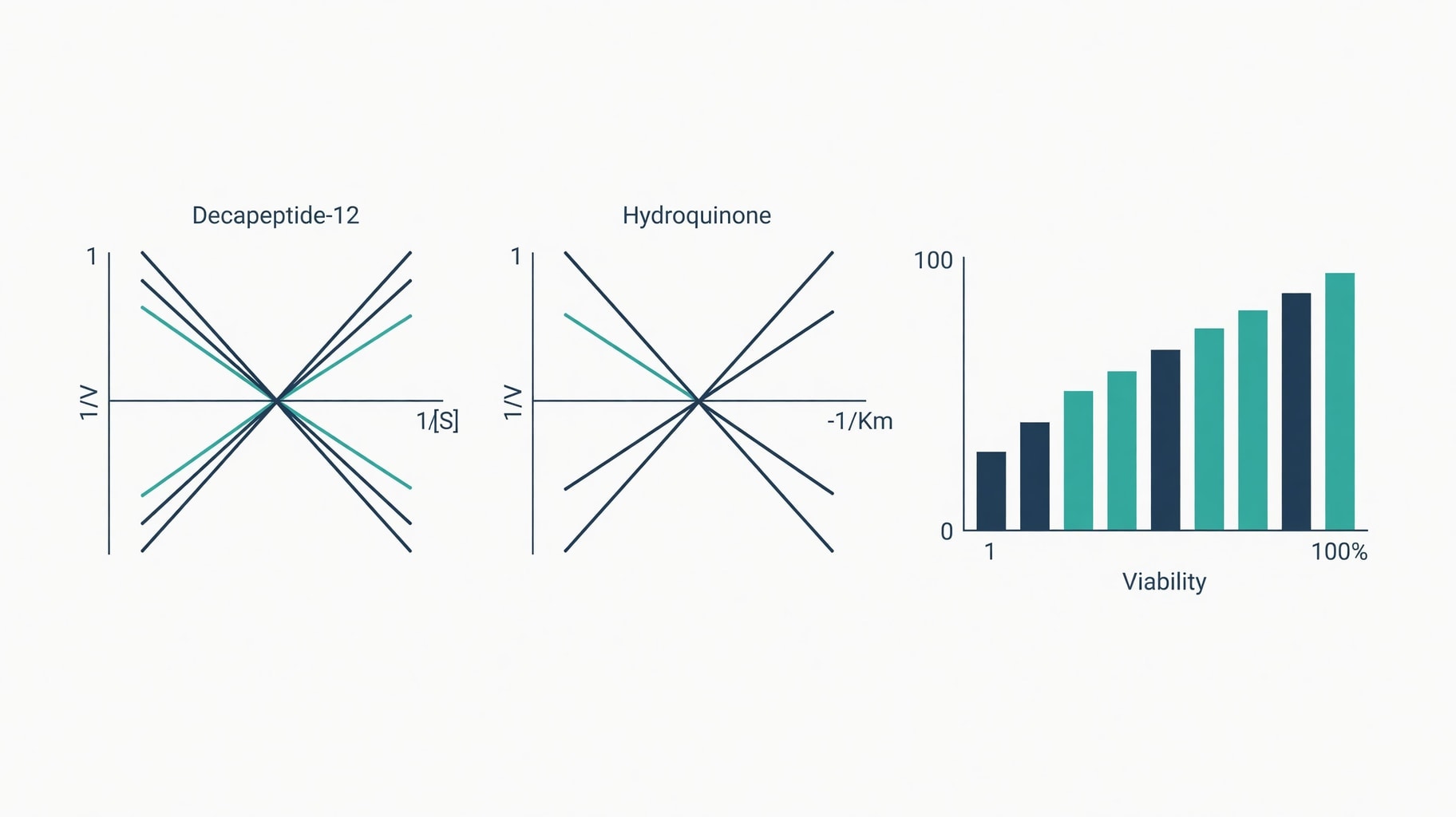
Figure 1: Lineweaver-Burk kinetic analysis illustrating Decapeptide-12 competitive tyrosinase inhibition versus hydroquinone cytotoxicity.
The regulatory divergence between peptide-based inhibitors and phenolic agents stems directly from enzyme kinetic data. Lineweaver-Burk plots generated during the peptide's development confirmed that Decapeptide-12 functions as a competitive inhibitor of tyrosinase. This means the peptide binds reversibly to the enzyme's active site, competing directly with the substrate L-tyrosine. When the peptide dissociates, enzymatic activity resumes.
Hydroquinone and similar phenolic compounds often act through irreversible inhibition or redox cycling that generates reactive oxygen species, leading to permanent enzyme damage or melanocyte death. Research published in Peptides confirms that molecular docking analysis predicted this competitive blocking of the tyrosinase active site based on the YRSRKYSSWY amino acid sequence.
Potency claims for Decapeptide-12 require precise contextualization against these kinetic parameters. Trade literature frequently cites that the peptide is 17 times more potent than hydroquinone, but this figure derives specifically from in vitro tyrosinase inhibition assays using mushroom tyrosinase, where Decapeptide-12 demonstrated an IC50 of 40 µM compared to hydroquinone’s IC50 of 680 µM. However, the same bioactive peptides review notes a critical divergence when testing shifts to human tyrosinase.
Against the human enzyme, Decapeptide-12 showed a 35% reduction in activity at 100 µM. This discrepancy highlights the limitations of mushroom tyrosinase as a sole predictive model for human efficacy, a constraint further detailed in ACS Omega analyses which found that many inhibitors effective against fungal enzymes exhibit reduced or no activity against human tyrosinase.
Despite the lower absolute potency against human tyrosinase compared to mushroom models, the safety profile remains the defining regulatory asset. Comparative cytotoxicity assays provide the quantitative boundary that separates cosmetic compliance from drug classification. In vitro studies cited in Peptides demonstrated that melanocytes incubated with Decapeptide-12 at 10 µM and 100 µM for seven days maintained viability while showing melanin reductions of 40% and 43%, respectively.
In contrast, hydroquinone at 100 µM proved 100% toxic to the same cell cultures under identical conditions. Even at lower concentrations, hydroquinone and kojic acid have been shown to induce significant cytotoxicity at levels exceeding 50 µM, according to a ScienceDirect review of tyrosinase inhibitors.
This lack of cytotoxicity at effective concentrations is not merely a safety benefit but a regulatory prerequisite. For a product to be marketed as a cosmetic in the U.S. or Taiwan, it must not alter the structure or function of the skin in a way that constitutes drug action. Killing melanocytes or irreversibly inhibiting metabolic pathways typically triggers pharmaceutical classification.
By demonstrating that Decapeptide-12 reduces melanin content through reversible competitive inhibition without compromising cell membrane integrity or metabolic viability, manufacturers can substantiate claims of "skin brightening" or "tone evening" without crossing into "depigmenting" or "bleaching" territory, which carries drug connotations under FDA and TFDA regulations.
Regulatory Consequences of the Safety Margin
The toxicological distinction translates directly into market access strategies across jurisdictions with differing regulatory philosophies. In the United States, hydroquinone was removed from the Over-the-Counter monograph for skin bleaching products, effectively restricting it to prescription status or requiring extensive new drug applications for OTC use. This regulatory tightening created a compliance vacuum for non-prescription pigment control.
Decapeptide-12 fills this gap because its safety substantiation dossier relies on the absence of cytotoxicity rather than clinical efficacy endpoints required for drugs.
Formulators can include the peptide in cosmetic products sold through retail channels without triggering FDA drug enforcement actions, provided marketing claims remain within cosmetic boundaries.
Pacific markets, particularly Taiwan, Japan, and South Korea, maintain stricter prohibitions on hydroquinone in cosmetics due to concerns about exogenous ochronosis and potential carcinogenicity. These jurisdictions generally permit tyrosinase inhibitors only if they appear on approved positive lists or meet rigorous safety standards that exclude cytotoxic agents. The reversible, non-cytotoxic mechanism of Decapeptide-12 aligns with these regional safety requirements.
Unlike hydroquinone, which is banned in cosmetic products throughout the European Union and many Asian markets, Decapeptide-12’s peptide structure and safety profile allow it to be incorporated into formulations destined for these regulated environments without reformulation. This cross-border compatibility reduces supply chain complexity for brands targeting both Western and Pacific consumers.
The regulatory utility of Decapeptide-12 extends to combination formulations that would be problematic with cytotoxic agents. Dermatologists frequently recommend peptide-based maintenance therapy following initial hydroquinone treatment cycles to prevent rebound hyperpigmentation while avoiding cumulative toxicity. Trade reporting on dark spot treatments indicates that combining hydroquinone with peptides can enhance efficacy, but such combinations require careful safety monitoring due to hydroquinone's side effect profile.
Decapeptide-12 can also be combined with other pathway-specific peptides without additive toxicity concerns.
For example, nonapeptide 1 skin brightening targets the MC1R receptor upstream of tyrosinase, while oligopeptide 68 melasma modulates MITF transcription. Because Decapeptide-12 acts at the enzyme level through competitive inhibition without cellular damage, it can theoretically be stacked with these signaling modulators in multi-target formulations that remain within cosmetic safety parameters.
Clinical evidence supporting these regulatory positions remains bounded by study design limitations that formulators must acknowledge. An open-label evaluation by Zoe Draelos published in the Journal of Drugs in Dermatology demonstrated the skin-brightening efficacy of a Decapeptide-12 system, as indexed in PubMed. However, this was not a randomized, vehicle-controlled major trial required for drug approval.
Similarly, a pilot study by Bhatia et al. examining combined topical delivery and dermalinfusion of Decapeptide-12 for post-inflammatory erythema as reported by Jddonline, but the small sample size and lack of control groups limit the strength of efficacy claims. Regulatory submissions must therefore rely primarily on the in vitro safety and kinetic data rather than these preliminary clinical observations to substantiate compliance.
Evidence Boundaries in Cross-Border Substantiation
The distinction between mushroom and human tyrosinase inhibition remains the most significant evidentiary constraint for regulatory affairs specialists. While the 17-fold potency advantage over hydroquinone is a compelling marketing metric, it applies strictly to the mushroom enzyme assay. The 35% inhibition of human tyrosinase at 100 µM, as reported in the Bioactive Peptides review, suggests that higher concentrations may be necessary for clinical equivalence in human skin.
Formulators must balance this requirement against the cosmetic safety margin; while the peptide shows no cytotoxicity at 100 µM in vitro, regulatory dossiers must demonstrate safety at the actual use concentration in finished products, accounting for potential accumulation or enhanced penetration via delivery systems.
Molecular docking studies provide supporting mechanistic evidence but cannot replace functional validation in human tissue models. In silico analysis has confirmed that the YRSRKYSSWY sequence can occupy the tyrosinase active site, and separate kinetic studies on related peptides have identified copper chelating activity alongside competitive inhibition, as noted in PubMed research. However, computational predictions do not account for stratum corneum penetration barriers or intracellular metabolism that may reduce bioavailability at the target site.
Regulatory bodies in Taiwan and the EU increasingly expect ex vivo human skin permeation data or reconstructed human epidermis models to bridge the gap between in vitro kinetics and claimed topical efficacy.
The absence of large-scale, randomized controlled trials specifically for Decapeptide-12 monotherapy creates a reliance on mechanistic plausibility and historical safety data. A search of ClinicalTrials.gov reveals limited registration of major trials for the peptide as a standalone intervention for melasma or post-inflammatory hyperpigmentation. This evidence gap does not preclude cosmetic use, as cosmetics do not require drug-level clinical proof, but it does limit the ability to make comparative efficacy claims against prescription hydroquinone in advertising.
Claims must be carefully calibrated to reflect the available evidence: competitive tyrosinase inhibition without cytotoxicity, supported by in vitro safety data and preliminary clinical observations, rather than proven therapeutic equivalence to pharmaceutical standards.
For regulatory affairs teams managing cross-border compliance, the key takeaway is that Decapeptide-12’s permissibility derives from what it does not do. It does not kill melanocytes. It does not irreversibly inhibit tyrosinase. It does not induce ochronosis at tested concentrations. These negative findings, verified through Lineweaver-Burk kinetics and comparative cytotoxicity assays, constitute the positive regulatory basis for its classification as a cosmetic ingredient.
Future substantiation efforts should focus on closing the gap between mushroom and human tyrosinase data through ex vivo human skin models and controlled penetration studies, rather than repeating in vitro potency assays that have already established the mechanistic foundation. Until such data emerges, the regulatory safety margin remains defined by the reversible, competitive inhibition profile first characterized by Stanford researchers and subsequently validated in comparative toxicity screens.
Further Clinical & Regulatory Context
For deeper analysis and cross-referenced evidence, see: - Related Clinical & Pharmacological Analysis: Glow Stack Peptides Lack Clinical Synergy Data Despite Regenerative Marketing Claims