
The marine collagen peptide sequence GPSGPQGSR demonstrates quantifiable transepithelial transport across Caco-2 monolayers and enhances tight junction integrity in inflammatory models, providing a verified mechanism for intestinal barrier protection that remains distinct from direct dermal claims. This specific pharmacokinetic evidence establishes the minimum threshold for evaluating bioactive food peptides skin health claims, separating sequences with documented absorption from those relying solely on theoretical bioactivity.
Regulatory substantiation now demands this level of molecular verification before manufacturers can link oral ingestion to measurable cutaneous outcomes, requiring formulators to distinguish between ingredients that merely survive digestion and those that demonstrably reach systemic circulation at bioactive concentrations.
While in vitro models establish bioaccessibility, valid structure-function claims require bridging this data to human outcomes. Only specific collagen peptides have successfully linked simulated gastrointestinal stability and Caco-2 permeability to statistically significant improvements in transepidermal water loss and elasticity in randomized, double-blind, placebo-controlled trials. This distinction separates mature evidence bases from sequences showing high in vitro permeability but unverified clinical bioavailability, according to pharmacological reviews in Frontiers in Pharmacology.
The commercial and regulatory stakes are substantial for manufacturers operating across U.S. and Pacific markets. Formulators cannot generalize efficacy across hydrolysates or assume that data generated for one peptide source applies to another. Each sequence requires its own evidentiary chain that satisfies both FDA structure-function guidance and international standards for functional food claims, creating a bifurcated market where compliant products are increasingly distinguished by their depth of pharmacokinetic validation rather than marketing narratives.
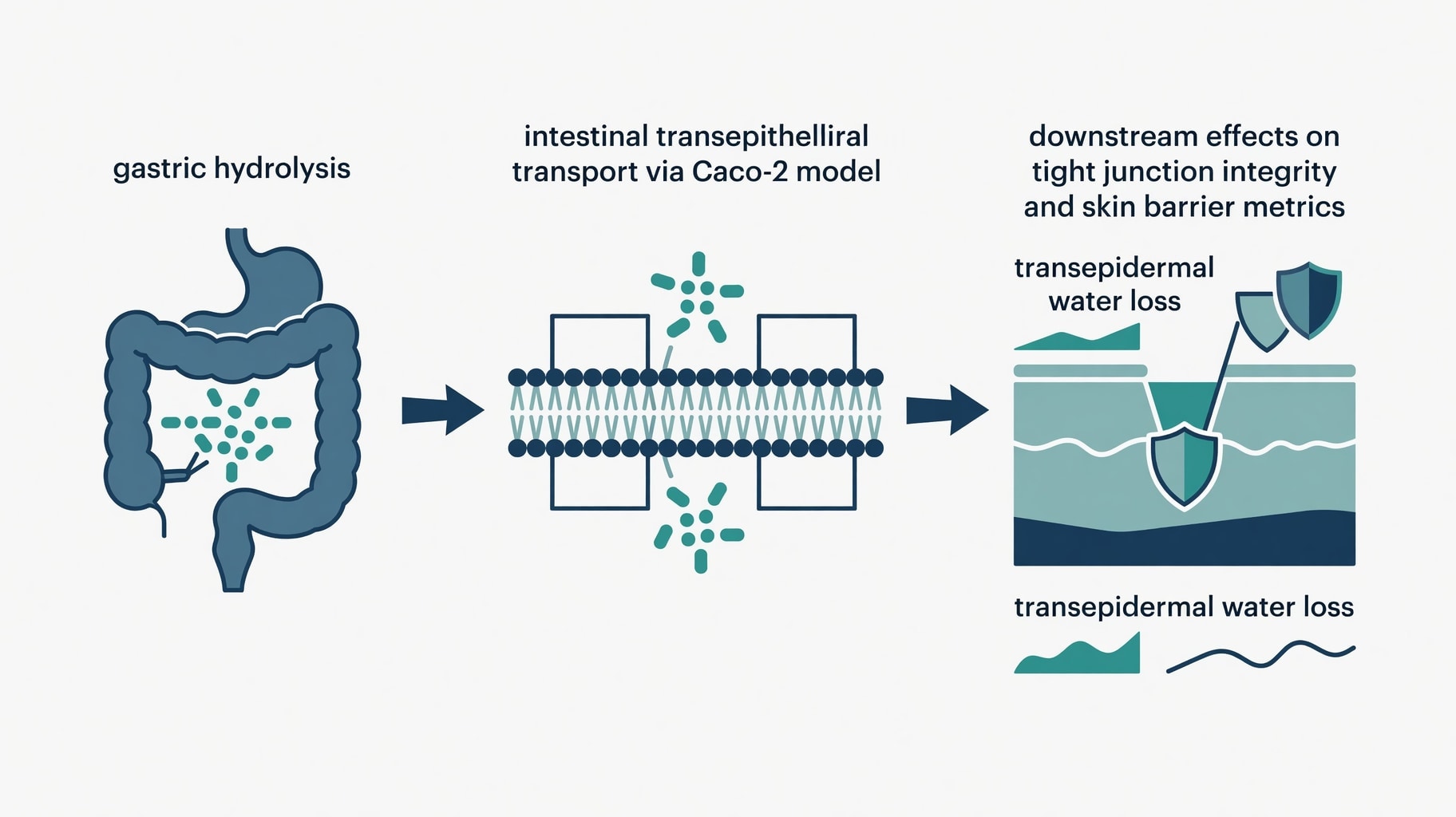
Figure 1: Pathway from in vitro GI survival and Caco-2 permeability to verified human clinical outcomes for oral bioactive peptides in skin health.
Gastrointestinal Stability and Transepithelial Transport Thresholds
Oral bioactive peptides encounter sequential pharmacokinetic barriers that invalidate simple extrapolation from test-tube assays to human physiology. Gastric acid and pepsin-mediated hydrolysis at pH 1.5–3.5 initiate degradation immediately upon ingestion, followed by intestinal brush-border proteolysis, hepatic first-pass metabolism, and rapid plasma clearance. These obstacles necessitate rigorous simulated gastrointestinal digestion (SGID) kinetic modeling before any human trial investment is justified.
Species differences in intestinal permeability and metabolic activity make animal-to-human extrapolation unreliable, according to bioavailability assessments published in PMC.
Consequently, regulatory bodies in both the United States and Asian markets increasingly view animal-derived bioavailability data as insufficient for substantiating human skin health claims, pushing ingredient suppliers toward validated human cell models and clinical endpoints.
Caco-2 cell monolayers serve as the primary validated tool for evaluating intestinal absorption in this regulatory context. These cells mimic human enterocyte physiology, incorporating tight junctions, brush-border enzymes, and efflux transporters such as P-glycoprotein. Researchers calculate the apparent permeability coefficient (Papp) to quantify transport, with peptides exhibiting Papp values above 1 × 10⁻⁶ cm/s considered highly permeable.
Most natural bioactive peptides reported in current literature display values below this threshold, limiting their potential for systemic delivery without modification or encapsulation.
The marine collagen peptide GPSGPQGSR, derived from Alaska pollock skin, meets these stringent transport criteria. Research confirms that this sequence maintains stability during simulated gastrointestinal digestion and traverses Caco-2 monolayers via transcellular routes, enhancing tight junction protein expression and mitigating TNFα-induced inflammatory responses in intestinal epithelial cells, as detailed in Marine Drugs.
This validates its role in supporting intestinal barrier function, yet conflating intestinal barrier protection with dermal barrier improvement remains a common regulatory error that invites scrutiny from agencies distinguishing between gut health and cosmetic claims.
Other sequences show similar promise but require comparable validation to withstand regulatory review. The peptides GAGQPFPI, FFPGAG, and FPGIG demonstrate high stability during gastrointestinal digestion and transcellular permeability across Caco-2 monolayers, with GAGQPFPI specifically exhibiting photoprotective effects against UVB-irradiated HaCaT cells and elastase inhibitory properties, according to recent advances documented on ResearchGate. However, these in vitro findings do not automatically translate to clinical skin health benefits because concentration-dependent absorption variability complicates predictions.
Studies on human milk peptides show that Caco-2 absorption profiles shift dramatically between 10 μg/mL and 1000 μg/mL concentrations, as reported in the Journal of Agricultural and Food Chemistry. Without standardized dosing correlations, in vitro permeability remains a screening tool rather than proof of efficacy.
Understanding these transport mechanics is essential when evaluating broader claims regarding collagen peptides bioavailability, as oral and transdermal delivery systems operate through fundamentally different biological pathways that regulatory reviewers scrutinize independently.
Human Clinical Endpoints Linked to In Vitro Bioavailability
Human double-blind, placebo-controlled trials provide the final evidentiary link for oral bioactive peptides targeting skin health, serving as the decisive factor in regulatory compliance and market access. Tuna collagen peptides have successfully traversed this gap, with a randomized, triple-blind clinical trial involving 72 women demonstrating statistically significant reductions in transepidermal water loss (TEWL) and improvements in skin elasticity after eight weeks of oral supplementation, according to findings indexed in PubMed.
Participants receiving tuna collagen peptides showed measurable improvements in skin hydration, elasticity, and density compared to placebo, with a post-ingestion follow-up period extending two weeks beyond the intervention to assess durability. This clinical success builds upon prior in vitro verification where the same research program first established gastrointestinal stability and Caco-2 permeability for the specific tuna-derived sequences used in the human trial.
This sequential validation approach aligns with current FDA and EFSA expectations for structure-function substantiation, distinguishing compliant products from those making unsupported claims based on generic collagen hydrolysate data.
Whey-derived peptides present a parallel case study in transport validation, illustrating how metabolic endpoints can inform dermal research methodologies. Research identifies novel cholesterol-lowering peptides from whey protein that traverse Caco-2 monolayers, providing theoretical support for the development of bioactive peptides that can be directly absorbed by the human body, as noted in PubMed. While this specific endpoint targets metabolic health rather than dermal barrier function, the methodological rigor applies equally to skin health claims.
Whey bioactive peptides must demonstrate both gastrointestinal survival and target-tissue bioavailability before formulators can assert dermal benefits. The same standard applies to egg membrane peptides targeting joint and skin health, meaning each protein source requires independent verification. Regulatory bodies increasingly reject generalized claims, with comprehensive reviews in The Protein Journal highlighting translational limitations including poor bioavailability, gastrointestinal instability, and limited large-scale clinical validation across the bioactive peptide category.
Batch-to-batch consistency in peptide sequence distribution becomes a compliance issue, not merely a quality control metric, as variability in purification precludes direct cross-study comparisons.
Signal peptides designed for topical application operate under different regulatory and biological rules, necessitating clear labeling distinctions. Tripeptide-29, for example, stimulates tripeptide 29 collagen synthesis through direct fibrillogenesis modulation in dermal fibroblasts. This mechanism relies on transdermal delivery systems such as liposomes or microneedles to bypass the stratum corneum, whereas oral bioactive peptides depend on systemic distribution following intestinal absorption and hepatic processing.
Confusing these mechanisms in marketing materials invites regulatory enforcement, as the safety and efficacy data required for topical application do not substantiate oral ingestion claims, and vice versa. Manufacturers must maintain separate technical dossiers for oral and topical peptide ingredients, even if they share similar amino acid sequences, because the route of administration fundamentally alters the risk-benefit profile evaluated by regulatory agencies.
Evidence Gaps and Regulatory Substantiation Standards
Despite progress in marine collagen research, significant evidence gaps persist across the broader bioactive peptide landscape, creating compliance risks for manufacturers relying on incomplete datasets. Standardized SGID protocols remain elusive, as variations in pH, enzyme-to-substrate ratios, and residence times across laboratories prevent direct comparison of bioactivity data. One laboratory’s "stable" peptide may degrade completely under another laboratory’s digestion parameters, rendering supplier-provided certificates of analysis potentially misleading for regulatory submissions.
Harmonization efforts are ongoing but incomplete, forcing formulators to verify protocol alignment independently. Large-scale replication studies are absent for most sequences beyond select marine collagen variants, meaning egg membrane peptides, whey derivatives, and plant-based sequences lack equivalent human RCT portfolios linking gastrointestinal survival to dermal endpoints.
This asymmetry creates market risk for products making broad "peptide" claims without sequence-specific substantiation, particularly as regulators in both the U.S. and Pacific markets increase scrutiny of functional food labeling.
Concentration-dependent effects further complicate regulatory positioning because Caco-2 permeability is not linear. Peptides absorbed efficiently at high concentrations in vitro may show negligible transport at physiologically relevant doses in humans. Human trials must use dosing regimens justified by pharmacokinetic modeling rather than arbitrary formulation decisions.
The 30-minute gastric emptying window identified in metabolic preload studies suggests timing matters for peptide delivery to proximal small intestine nutrient sensors, yet whether this kinetic principle applies to dermal-targeting peptides remains untested in controlled settings. Current FDA structure-function guidance and EFSA scientific opinion frameworks implicitly require a three-tier evidence base: SGID survival, Caco-2 Papp values, and human barrier-score RCTs. Sequences lacking any tier face substantiation challenges.
GPSGPQGSR meets the first two tiers for intestinal health but lacks direct dermal RCTs, while tuna collagen peptides meet all three for specific skin endpoints. Most other marketed peptide ingredients meet none.
This evidence hierarchy defines the current regulatory reality for oral bioactive peptides in skin health, establishing a clear delineation between ingredients that can support compliant structure-function claims and those that cannot. Suppliers must standardize SGID protocols and publish concentration-dependent transport data to remain competitive in regulated markets. Formulators must fund human trials using validated sequences at justified doses to avoid enforcement actions.
Regulatory professionals must distinguish between intestinal and dermal barrier claims in labeling and marketing materials to prevent misbranding.
Until these actions occur, only a narrow subset of marine collagen peptides can withstand evidentiary scrutiny for oral skin health applications. Pending harmonization of digestion models and expansion of human trial portfolios, the distinction between verified and theoretical bioavailability will continue to define market access for this ingredient class, rewarding manufacturers who invest in rigorous pharmacokinetic validation over those relying on generic category claims.
Further Clinical & Regulatory Context
For deeper analysis and cross-referenced evidence, see: - Related Clinical & Pharmacological Analysis: Dipeptide-2 Eye Contour Claims Rest on Proprietary Morphometry, Not Independent Assays