
Orexin Signaling Diverges Between Insomnia Antagonists and Narcolepsy Agonists
Orexin neurons promote arousal through a specific feedforward circuit where co-released orexin and glutamate activate ventrolateral preoptic GABAergic neurons to inhibit sleep-promoting targets, stabilizing consolidated wakefulness rather than simply initiating it. This neurobiological precision distinguishes clinical orexin hypocretin peptides arousal mechanisms from generalized wellness claims about energy or alertness. Therapeutic targeting of this system now operates on two fundamentally divergent axes: dual orexin receptor antagonists reduce wake drive in insomnia by competitively blocking signaling, while selective OX2R agonists restore deficient signaling in narcolepsy type 1.
Takeda’s oveporexton, marketed as Orzeyful, received FDA approval in August 2026 as the first oral OX2R-selective agonist to directly address the neurobiological deficit in narcolepsy type 1 (Takeda). This milestone validates decades of research linking hypocretin deficiency to cataplexy and excessive daytime sleepiness. The commercial stakes are massive. Pharmaceutical developers now face the challenge of distinguishing between receptor subtypes that govern vastly different physiological outcomes. Compounders and wellness marketers often conflate these pathways. Clinical evidence demands strict separation.
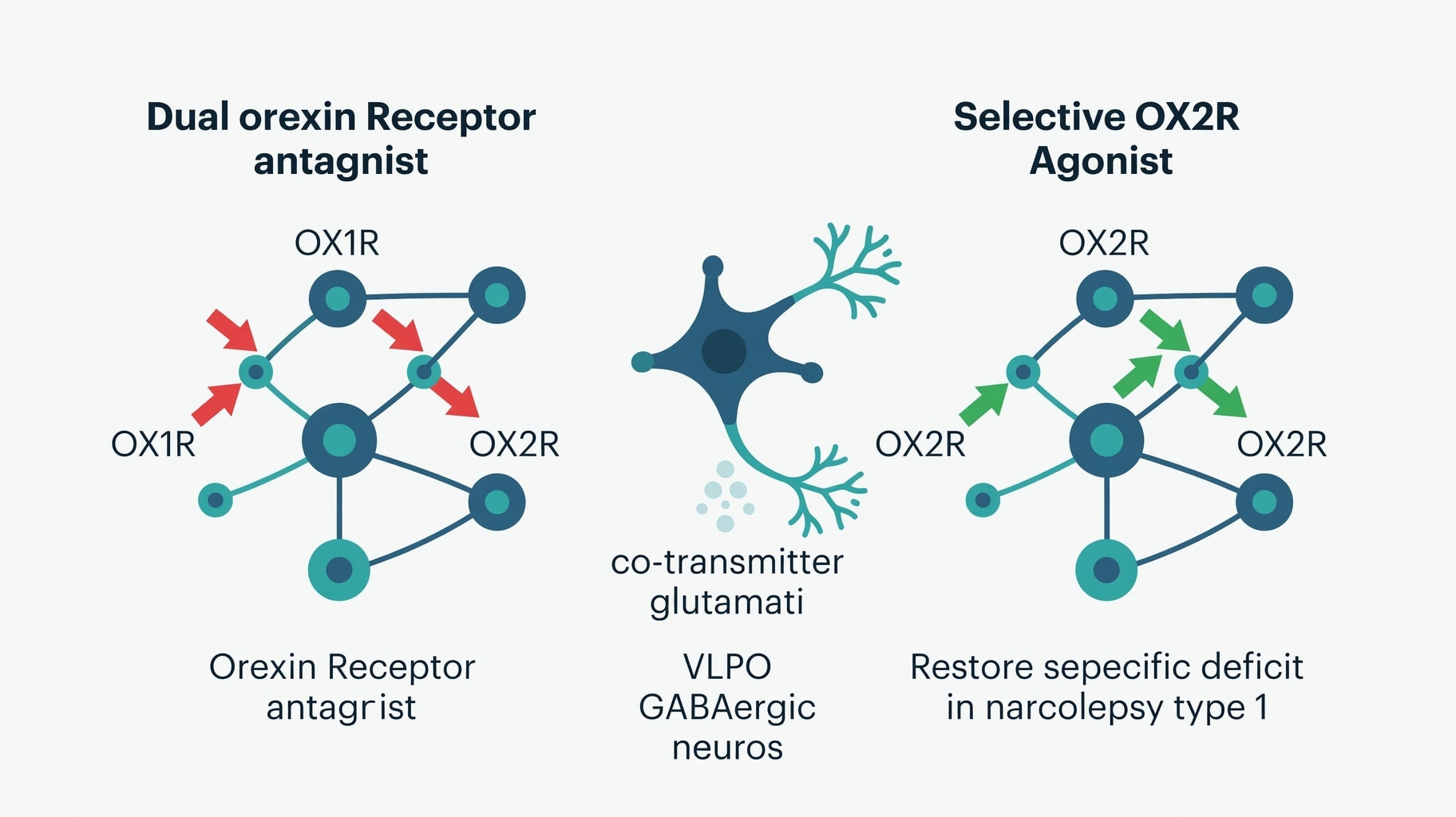
Figure 1: Divergent therapeutic targeting of orexin receptor pathways in insomnia antagonists versus narcolepsy OX2R agonists.
Understanding this divergence requires examining lateral hypothalamic projection mapping and receptor binding kinetics. Consumer content frequently presents orexin as a monolithic energy booster. The science tells a different story. OX1R and OX2R exhibit distinct anatomical distributions and functional specializations that dictate therapeutic utility. Insomnia drugs block both receptors to dampen hyperarousal. Narcolepsy drugs selectively stimulate one receptor to replace lost function. These opposing mechanisms share a molecular target but produce inverse clinical effects.
Receptor Specificity and Anatomical Distribution
The orexin system comprises two neuropeptides, orexin-A and orexin-B, which are produced exclusively in lateral hypothalamic neurons and bind to two G protein-coupled receptors. Gene expression studies have identified that OX1R predominantly modulates emotion, stress, and reward-associated arousal rather than serving as the principal receptor for sustained wakefulness (Mdpi). OX1R is preferentially expressed in the locus coeruleus, a nucleus critical for vigilance and stress response. Activation of this receptor triggers downstream transcriptional programs involving nuclear factor κB and hypoxic signaling pathways. This distribution explains why OX1R modulation influences affective processes more than sleep architecture itself.
OX2R plays the central role in maintaining sustained wakefulness and stabilizing sleep-wake state transitions. This receptor is highly expressed in wake-promoting nuclei including the tuberomammillary nucleus, dorsal raphe nucleus, and other brainstem regions involved in arousal regulation. Research published in NeurologyLive notes that while both receptors are co-expressed in areas like the ventral tegmental area, OX2R is the principal mediator for preventing inappropriate transitions from wakefulness to sleep. Loss-of-function mutations in OX2R induce narcolepsy in animal models, confirming its non-redundant role in wake maintenance.
The anatomical separation of these receptors creates therapeutic opportunities and risks. OX1R activates reward pathways that could create addiction liabilities if targeted indiscriminately. OX2R has a more pronounced effect on sleep regulation but presents structural challenges for drug design. The binding pocket of this G protein-coupled receptor is tight. Agonists must mimic a peptide ligand that is roughly seven times the size of a typical small molecule, as reported by Nature Reviews Drug Discovery. This biophysical constraint delayed the development of selective OX2R agonists by decades relative to antagonists.
Projection mapping further clarifies functional specialization. Orexin neurons project widely throughout the central nervous system. Viral-genetic labeling studies have mapped specific collateral projection patterns to the sublaterodorsal tegmental nucleus, a region involved in REM sleep regulation. Activation of this pathway prevents sleep-onset REM behavior by relieving REM sleep pressure, according to circuit mapping research in ScienceDirect. This projection-specific function demonstrates that orexin signaling is not a global on-off switch. Different neuronal subpopulations regulate distinct aspects of vigilance through targeted efferent connections.
Antagonist Kinetics in Insomnia Therapy
Dual orexin receptor antagonists treat insomnia by competitively antagonizing both OX1R and OX2R to reduce excitability of wake-promoting neurons. This mechanism differs fundamentally from GABAergic sedatives that produce global central nervous system suppression. DORAs inhibit downstream G protein-mediated signaling pathways within the wakefulness switch formed by lateral hypothalamic neurons. The result is hyperpolarization and decreased firing frequency without respiratory depression or cognitive impairment. Clinical trial readouts consistently show preserved sleep architecture with DORAs compared to traditional hypnotics.
Binding kinetics determine clinical differentiation among approved DORAs. Suvorexant, lemborexant, and daridorexant all block both receptors but exhibit distinct equilibrium profiles. Research published in PubMed demonstrates that almorexant reaches equilibrium very slowly at OX2R, whereas suvorexant and filorexant may take hours to reach steady state at both receptors. Lemborexant was structurally optimized for enhanced receptor-binding stability and rapid reversible kinetics. This kinetic profile contributes to lower residual next-day effects compared to earlier compounds. The timing is deliberate. Drug designers tune dissociation rates to match therapeutic windows.
Three orexinergic agents have received FDA approval for insomnia pharmacotherapy. Suvorexant obtained approval in 2014 as the first-in-class DORA. Its ability to block both OX1R and OX2R differentiates it from antihistamines and GABA modulators. Emerging evidence links heightened orexin signaling with chronic insomnia pathophysiology. Pharmacological antagonism of OX2R reliably promotes sleep. OX1R antagonism provides additional modulation of stress-related arousal components. This dual action addresses the heterogeneous etiology of insomnia better than selective targeting in most patient populations.
Safety profiles reflect mechanism-specific effects rather than off-target toxicity. DORAs exhibit significantly reduced adverse effects related to dependence and tolerance compared to conventional sedative-hypnotics. However, they are not without risks. Next-day somnolence remains dose-dependent. The competitive nature of antagonism means efficacy correlates with receptor occupancy timing. Patients with severe hepatic impairment metabolize these drugs differently. Prescribing information requires careful titration. These pharmacokinetic realities constrain real-world use despite mechanistic elegance.
Agonist Replacement for Narcolepsy Type 1
Narcolepsy type 1 results from the loss of orexin-producing neurons in the hypothalamus. This neurodegenerative process produces a cluster of disabling symptoms including cataplexy, sleep paralysis, hallucinations, and disrupted nighttime sleep. Oveporexton directly activates OX2R to restore orexin pathway signaling. This contrasts with stimulants and sedatives that target downstream symptoms rather than the primary neurobiologic deficit. The FDA approval represents the first therapy to address the root cause of narcolepsy type 1 rather than managing its consequences.
Clinical trial data for oveporexton demonstrated efficacy across the full symptom range of narcolepsy type 1. Takeda’s regulatory submission included evidence of reduced cataplexy episodes and improved daytime wakefulness. The drug selectively stimulates OX2R without significant OX1R activity. This selectivity avoids reward pathway activation and associated abuse potential. Nature Reviews Drug Discovery notes that industry is now eyeing broader indications for orexin receptor agonists beyond narcolepsy. Metabolic disorders, mood conditions, and respiratory diseases remain under investigation. None have achieved regulatory approval.
On-target adverse effects reveal OX2R’s physiological breadth. Lower urinary tract symptoms including urinary frequency and urgency emerged in clinical trials. These effects are consistent with OX2R agonism on central micturition pathways. Takeda’s prescribing information requires screening for lower urinary tract symptoms prior to treatment initiation. This safety signal confirms that OX2R activation extends beyond sleep-wake regulation. Bladder control circuits depend on intact orexin signaling. Therapeutic restoration of wakefulness necessarily engages these parallel systems.
The distinction between agonist and antagonist therapies carries implications beyond pharmacology. Wellness markets frequently promote synthetic orexin peptides as cognitive enhancers or energy supplements. No such products have FDA approval. Orexin-A levels in insomnia patients remain under active investigation, with ClinicalTrials.gov listing ongoing studies examining biomarker correlations. No evidence supports exogenous orexin administration for cognitive enhancement in healthy populations. The peptide’s rapid degradation and poor blood-brain barrier penetration make oral supplementation biologically implausible. Intranasal and intrathecal routes remain experimental.
Regulatory boundaries define current therapeutic reality. Oveporexton approval is pending DEA scheduling and final label publication. DORAs remain Schedule IV controlled substances due to theoretical abuse potential despite low observed dependence. These classifications reflect historical caution about novel psychoactive agents. Future scheduling decisions will depend on post-market surveillance data. The orexin field has matured from basic science discovery to differentiated therapeutics. Translation from bench to bedside required precise receptor mapping and kinetic optimization. Consumer narratives lag behind this scientific precision.
Evidence gaps persist regarding long-term OX2R agonist safety and efficacy beyond narcolepsy type 1. No clinical trials have validated orexin agonists for idiopathic hypersomnia, insufficient sleep syndrome, or age-related cognitive decline. Animal projection mapping does not directly translate to human dosing paradigms. Binding kinetics serve as proxies for but not guarantees of clinical efficacy. The next regulatory milestone will involve post-marketing commitment studies for oveporexton. Takeda has announced a tailored portfolio of investigational orexin agonists in preclinical and clinical stages for multiple sleep-wake disorders. Pending data from these programs will determine whether receptor selectivity can be further refined to separate wake promotion from urinary side effects.
Further Clinical & Regulatory Context
For deeper analysis and cross-referenced evidence, see: - Related Clinical & Pharmacological Analysis: Galanin Claims Outpace Clinical Evidence as Receptor Complexity Stalls Drug Development - Related Clinical & Pharmacological Analysis: CGRP Therapeutics Cross Border Between Clinical Evidence and Peptide Marketing