
CGRP Therapeutics Cross Border Between Clinical Evidence and Peptide Marketing
Spanish-language wellness creators and English-speaking biohackers increasingly discuss calcitonin gene-related peptide (CGRP) as a migraine intervention, yet this consumer conversation conflates eight distinct FDA-approved medications with unregulated research compounds. This linguistic overlap obscures the regulatory boundary between pharmaceutical-grade antagonists and unverified peptides sold directly to consumers. While social platforms treat "CGRP" as a monolithic wellness category, clinical reality defines it as a specific 37-amino acid neuropeptide with a validated receptor target. The U.S. Food and Drug Administration has approved four monoclonal antibodies and four small-molecule gepants that block either the CGRP ligand or its receptor complex to prevent or abort migraine attacks, establishing a verified therapeutic class distinct from the gray-market substances often discussed in the same digital spaces.
Galcanezumab binds specifically to the CGRP ligand to block biological activity, according to FDA prescribing information for Emgality. This molecular precision contrasts sharply with online marketing that frequently presents raw peptide powders as functional equivalents to approved biologics. Bilingual health content often uses the term "péptidos" broadly, failing to distinguish between synthesized research chemicals lacking quality controls and rigorously tested therapeutics like ubrogepant or rimegepant. Patients navigating these cross-border information flows encounter claims about CGRP's benefits that outpace the regulatory evidence, requiring careful separation of verified pharmacology from speculative wellness narratives. Understanding this distinction begins with the receptor mechanics that make CGRP a druggable target rather than a generic supplement.
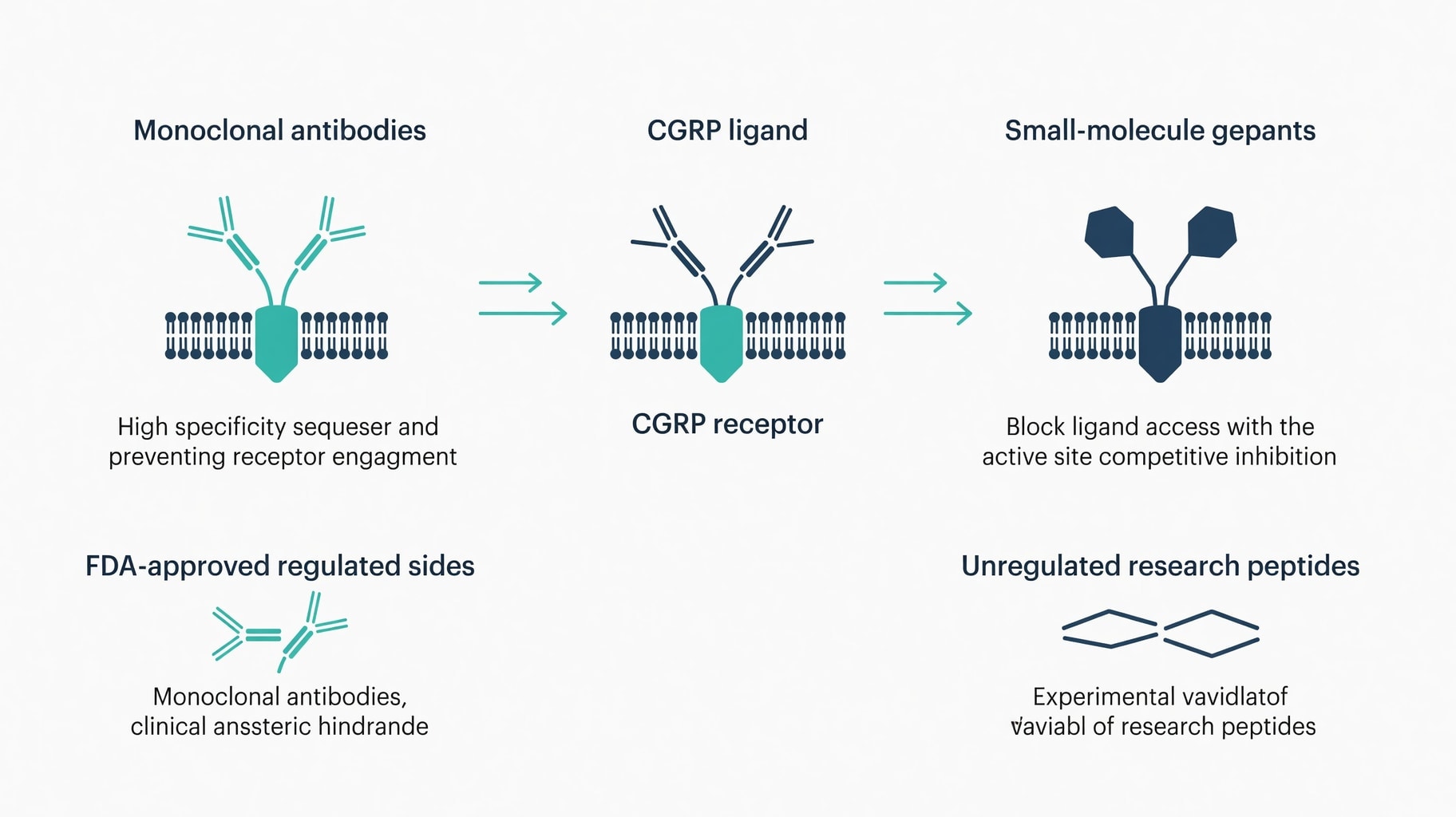
Figure 1: FDA-approved CGRP monoclonal antibodies and gepants versus unregulated research peptides in migraine pathophysiology.
Receptor Architecture Defines Therapeutic Specificity
CGRP does not signal through a conventional single-protein receptor but requires a heterotrimeric complex consisting of the calcitonin receptor-like receptor (CLR), receptor activity-modifying protein 1 (RAMP1), and the receptor component protein (RCP). Without RAMP1, CLR cannot traffic to the cell surface or bind CGRP with high affinity, according to molecular simulations published on Biorxiv. This structural dependency explains why developing selective antagonists proved challenging for decades and why current therapies target such specific molecular interfaces. RAMP1 establishes extensive contacts with the CLR extracellular domain, stabilizing a conformation that favors high-affinity ligand binding and enabling the downstream Gs-protein signaling that drives migraine pathophysiology.
Upon trigeminal nerve activation, CGRP released into the plasma undergoes rapid degradation with a half-life of less than ten minutes, suggesting its effects concentrate at release-site proximal regions rather than circulating systemically. The peptide binds at the interface between CLR and RAMP1, triggering cAMP accumulation and protein kinase A activation in smooth muscle cells and neurons. This localized signaling promotes non-endothelium-mediated vasodilation and sensitizes nearby A-fibers expressing functional CLR-RAMP1 receptors. Contemporary migraine models emphasize this trigeminocervical complex activation over historical vascular theories, as detailed in Pharmacy Times coverage of migraine advances. Vessel dilation now appears as a secondary phenomenon rather than the primary pain generator, reframing CGRP's role as a mediator of neurogenic inflammation and nociceptive transmission.
Selectivity remains pharmacologically complex because the same RAMP1 subunit partners with different receptor proteins to form distinct functional complexes. When RAMP1 associates with the calcitonin receptor (CTR) instead of CLR, it creates the amylin 1 (AMY1) receptor. Some gepants may antagonize both canonical CGRP receptors and AMY1 complexes due to this shared subunit, as noted in Frontiers in Pharmacology. AMY1 receptors colocalize with CGRP receptors in human trigeminal ganglia, and the amylin agonist pramlintide provokes migraine attacks in 88% of susceptible patients. This cross-reactivity suggests therapeutic benefit may derive from pathways beyond pure CGRP blockade, though pramlintide acts as a weak agonist at canonical CGRP receptors. Whether this secondary modulation contributes to clinical efficacy or represents an off-target effect remains under investigation.
Divergent Mechanisms of Approved Therapies
Eight FDA-approved therapies now target the CGRP pathway through two distinct mechanisms. Monoclonal antibodies provide sustained pathway blockade through monthly or quarterly subcutaneous or intravenous administration. Erenumab targets the CLR/RAMP1 receptor complex directly, while fremanezumab, galcanezumab, and eptinezumab bind the circulating CGRP ligand to prevent receptor engagement. These large molecules offer prolonged target suppression but cannot be rapidly titrated due to extended half-lives. Galcanezumab specifically binds the CGRP ligand and blocks both α-CGRP and β-CGRP isoforms from activating the receptor, according to FDA risk evaluation documents. This ligand sequestration prevents the peptide from docking at the CLR/RAMP1 interface regardless of receptor density.
Gepants function as competitive small-molecule antagonists at the CGRP receptor, physically occupying the peptide-binding cleft at the CLR-RAMP1 interface. Ubrogepant, rimegepant, atogepant, and zavegepant represent this oral and intranasal therapeutic class. Unlike triptans, which constrict blood vessels systemically and carry cardiovascular contraindications, gepants block migraine signaling without direct vasoconstrictive effects. This safety distinction makes them viable options for patients with cardiovascular comorbidities who cannot use traditional abortive therapies. Gepants competitively inhibit receptor activation, preventing the conformational change necessary for G-protein coupling and downstream cAMP signaling. Their shorter half-lives allow flexible dosing for acute treatment or daily prevention, contrasting with the sustained release profiles of monoclonal antibodies.
Consumer marketing in bilingual wellness spaces frequently fails to communicate these mechanistic distinctions. Content targeting Spanish-speaking audiences may describe "bloqueo de CGRP" without specifying whether a product targets the ligand, the receptor, or neither. Unregulated research peptides sold online lack the molecular engineering required for receptor selectivity and do not undergo the pharmacokinetic validation that defines approved therapies. Patients encountering terms like "CGRP péptido" in wellness forums may assume equivalence between a vial of unverified powder and a prescription for atogepant. This linguistic ambiguity creates risk when individuals substitute unregulated compounds for clinically validated treatments based on superficial naming similarities rather than pharmacological reality.
Evidence Boundaries and Pending Safety Data
Pregnancy safety presents a critical evidence gap absent from most consumer marketing. CGRP is posited to maintain low fetoplacental vascular resistance, and pre-eclamptic women demonstrate reduced CLR and RAMP1 expression in placental tissue. Less than 10% of maternal IgG crosses the placental barrier during the first trimester, but transfer increases substantially in later gestation, creating potential risk for pre-eclampsia or fetal growth restriction if CGRP monoclonal antibodies are administered during pregnancy. FDA guidance on migraine drug development does not establish specific pregnancy safety protocols for CGRP-targeted therapies, according to FDA draft guidance documents. Regulatory labeling currently advises against use during pregnancy based on theoretical risks rather than definitive contraindication data, leaving clinicians to handle uncertain risk-benefit calculations.
Non-responder populations represent another boundary where marketing claims exceed evidence. Biomarker stratification research has not yet identified reliable predictors of treatment response, and clinical trials continue to investigate why some patients fail to achieve meaningful reduction in migraine days. The BIOmarkers of MIGraine study currently enrolling participants aims to stratify responders to CGRP monoclonal antibodies based on biological signatures, according to ClinicalTrials.gov registry NCT04503083. Until such data mature, clinicians cannot prospectively identify which patients will benefit from CGRP blockade versus alternative pathways. Pituitary adenylate cyclase-activating polypeptide (PACAP) and adrenomedullin belong to the same peptide family and contribute to vasodilation and trigeminovascular activation, suggesting migraine pathophysiology extends beyond CGRP alone.
Cardiovascular safety monitoring continues as real-world exposure accumulates. CGRP functions as a potent vasodilator in cerebral and coronary circulation, raising theoretical concerns about compensatory mechanisms during ischemic events. Clinical trial exclusion criteria typically barred patients with recent myocardial infarction or stroke, leaving safety in high-risk cardiovascular populations incompletely characterized. Post-marketing surveillance and registry studies now track adverse events in broader populations than Phase 3 trials enrolled. The Nordic Chronic Migraine Trial currently compares dual therapy with CGRP monoclonal antibodies and onabotulinumtoxin A against monotherapy, according to ClinicalTrials.gov registry NCT07040813. Results from this and similar ongoing studies will determine whether combination approaches improve outcomes for patients who do not respond adequately to CGRP blockade alone.
Further Clinical & Regulatory Context
For deeper analysis and cross-referenced evidence, see: - Related Clinical & Pharmacological Analysis: Orexin Signaling Diverges Between Insomnia Antagonists and Narcolepsy Agonists