
Cortexin Clinical Trials Exist Only for Tissue Extracts, Not Synthetic Analogs
English-language wellness vendors frequently cite Russian clinical trials to sell synthetic Cortagen, but those studies tested a completely different substance: Cortexin, a tissue-derived pharmaceutical extract. This marketing conflation creates a significant evidentiary gap for consumers navigating neurotrophic repair claims across bilingual communities. Verified cortexin peptide clinical trials for traumatic brain injury and encephalopathy exist exclusively within Eastern European medical literature for the approved tissue extract, while the synthetic tetrapeptide analog lacks controlled human evidence. Patients and researchers evaluating these compounds must distinguish between the regional pharmaceutical with documented electrophysiological outcomes and the unregulated synthetic analog that borrows its name without sharing its data. Positive outcomes in Russian neurology journals do not constitute FDA-recognized evidence, nor do they validate the safety profile of research-grade AEDG peptides sold online for cognitive enhancement or nerve regeneration.
Divergent Evidence Bases for Extract and Synthetic Peptides
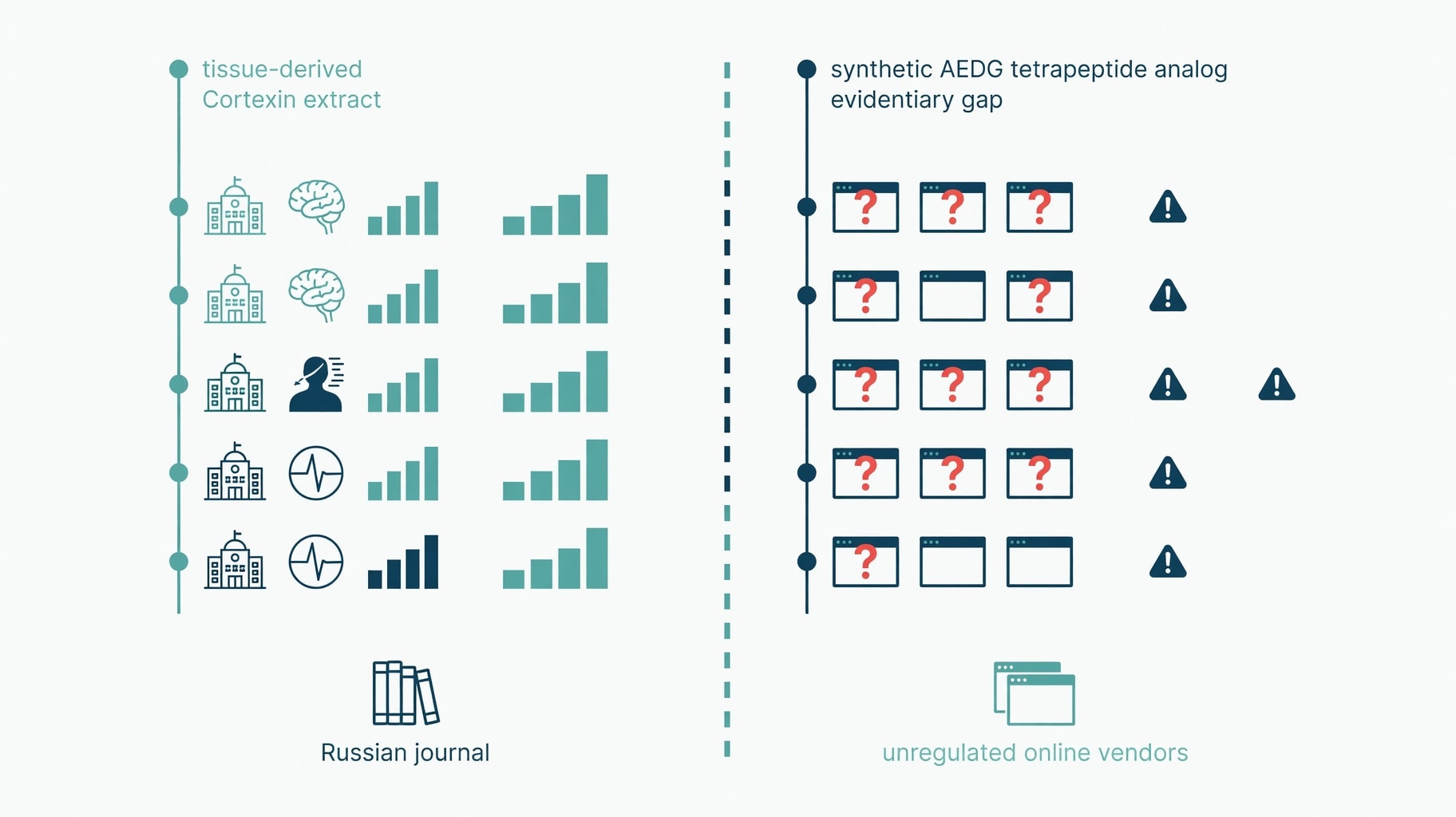
Figure 1: Divergent evidence bases between tissue-derived Cortexin extract used in Eastern European trials and unregulated synthetic analogs lacking human clinical data.
The nomenclature confusion represents a material safety risk rather than a semantic technicality. Cortexin refers exclusively to a standardized polypeptide preparation produced through enzymatic hydrolysis of purified porcine or bovine brain cortex protein. This complex biological mixture has undergone pharmaceutical manufacturing standards and post-market surveillance in Russia and neighboring states for decades. Regulatory records and clinical publications consistently describe this multi-component drug, not a single defined chemical entity. The compound occupies a unique position similar to Cerebrolysin, which Blackwell BioLabs notes is the only peptide mixture with multiple published randomized controlled trials and regulatory approval in some countries, yet remains unapproved by the FDA for human use.
Cortagen is a synthetic tetrapeptide with the sequence Ala-Glu-Asp-Pro (AEDG). Chemists designed this molecule based on amino acid analysis of the original tissue extract to isolate a putative active motif. While research indexed by The Peptide Catalog confirms that Khavinson-group researchers developed this synthetic analog from the extract's analysis, the clinical track record attached to the name in commercial marketing almost always belongs to the tissue extract. There is no controlled human-trial evidence base for the synthetic peptide in traumatic brain injury, encephalopathy, or nerve regeneration. Community reports clustering around subjective themes of mental clarity or focus for the synthetic version remain anecdotal and cannot be validated against published clinical endpoints achieved by the pharmaceutical extract.
This category error undermines evidence evaluation for bilingual consumers and cross-border researchers. When English-language vendors or social media creators attribute human neurological recovery data to synthetic AEDG, they cite studies performed with an entirely different biological substance. Analysis by PeptideList confirms that nearly all Cortagen efficacy data traces to the Khavinson research program and Russian collaborators, with Western laboratories failing to independently replicate core findings under modern trial-methodology standards. Conflating the two overstates what the synthetic peptide has been shown to do and misrepresents the depth of safety data available for the tissue preparation. In the United States and European Union, neither compound has been evaluated for safety or efficacy, meaning Western clinicians cannot legally prescribe the tissue extract based on Eastern European trial data and researchers cannot assume the synthetic analog carries the same risk-benefit profile.
Electrophysiological Endpoints in Regional Neurology
The clinical evidence supporting the tissue extract relies heavily on electrophysiological metrics that differ from standard Western cognitive testing batteries. Published studies in Russian-language journals utilize EEG spectral coherence and phase synchronization as primary biomarkers for treatment response in traumatic brain injury. Research abstracted in PubMed documents the use of these quantitative electroencephalography methods to assess cortical oscillatory activity before and after treatment courses with the tissue extract. Spectral coherence measures the consistency of phase relationships between EEG signals from different brain regions, serving as a proxy for functional connectivity, while phase synchronization analysis quantifies the temporal coordination of neural oscillations.
This methodological choice reflects a distinct neurological tradition that prioritizes direct electrophysiological correlates of brain network integrity over functional scales like the Glasgow Outcome Scale-Extended. Open-label trial results published in Russian medical literature report that treatment with the tissue extract in brain ischemia patients resulted in decreased or complete regression of focal neurological symptoms. The same study documented positive changes in cognitive impairment indicators, normalization of emotional status, and decreased depression levels during treatment. These outcomes were correlated with electrophysiological improvements, forming a coherent evidentiary package within that regional medical paradigm but remaining largely inaccessible to non-Russian-speaking researchers.
Translating these findings to Western clinical expectations requires recognizing regulatory boundaries. The FDA has acknowledged the potential of EEG data-driven machine learning for TBI classification in scientific forum discussions, but this does not equate to acceptance of historical Eastern European coherence studies as major efficacy evidence. Western regulators generally require pre-registered, double-blind, placebo-controlled trials with standardized clinical endpoints for drug approval. The existing cortexin peptide clinical trials largely consist of open-label designs or controlled studies that do not meet contemporary ICH-GCP standards for international registration. The mechanistic rationale proposed in these studies involves neurotrophic support and neurotransmitter balancing, with preclinical research indexed in PubMed demonstrating that both the tissue extract and synthetic analog accelerated recovery of disturbed behavior in rat models of chronic ischemia. However, animal model data cannot be presented as direct evidence of human TBI efficacy, and independent Western replication of these specific neurochemical effects in human subjects is absent from the published record.
Regulatory Gaps and Pediatric Evidence Limitations
The absence of Western-independent Phase 2/3 randomized controlled trials meeting ICH-GCP standards defines the current boundary of Cortexin’s evidentiary reach. No comprehensive international pharmacovigilance database exists for the compound outside its approved jurisdictions. Safety and contraindication data are limited to regional labeling and post-market surveillance reports that are not systematically integrated into global drug safety networks. Researchers and clinicians operating outside Eastern Europe cannot access the same depth of safety characterization available for locally approved pharmaceuticals. This geographic siloing of evidence is particularly consequential when the substance in question is a complex biological extract rather than a fully characterized synthetic molecule.
Pediatric neurology represents another area where evidence requires careful contextualization. While the compound is referenced in pediatric neurological practice within approved markets, specific pediatric cortexin peptide clinical trials are not readily available in English-language databases or international registries. Claims regarding pediatric safety or efficacy in traumatic brain injury should not be extrapolated from adult data or from animal models of perinatal hypoxic brain injury. Research on infant rat models showed mixed results, with positive effects observed at certain timepoints but not sustained at day 30 post-trauma. Translating developmental neurobiology findings from rodent pups to human pediatric patients involves significant uncertainty that marketing materials rarely disclose.
Commercial availability of research-grade peptides further complicates the evidentiary picture for consumers in the neuropeptides and CNS space. Vendors may list synthetic AEDG or unspecified "cortexin" products alongside compounds with established clinical literature, implying equivalence through shared nomenclature and adjacent catalog placement. For bilingual researchers evaluating this literature, the task involves assessing whether regional clinical data generated under one regulatory framework can inform decisions in another. The tissue extract’s established use in Eastern European neurology provides a legitimate clinical track record for specific indications within that healthcare system, but that track record does not transfer to synthetic analogs or satisfy Western regulatory requirements.
The European Medicines Agency’s Clinical Trials Information System currently lists no active interventional studies for synthetic Cortagen (AEDG) in traumatic brain injury or cognitive impairment indications within EU member states.
Further Clinical & Regulatory Context
For deeper analysis and cross-referenced evidence, see: - Related Clinical & Pharmacological Analysis: Pinealon’s DNA-Binding Claim: Separating Khavinson Institute Models from Clinical Proof