
The Raghava group at the Institute of Microbial Technology established CPPsite 2.0 in 2016 as an updated repository of manually curated cell penetrating peptides. The database holds 1,855 entries describing experimentally validated sequences drawn from research articles and patents as reported by Oup. The newer POSEIDON collection expands this record with quantitative uptake parameters.
Neither repository functions as a regulatory standard. No entry in CPPsite 2.0 or POSEIDON constitutes an active pharmaceutical ingredient designation. No entry satisfies 503B outsourcing compliance. Researchers querying these systems for procurement references receive experimental history. They do not receive statutory authority.
CPPsite 2.0 Architecture and Curation Thresholds
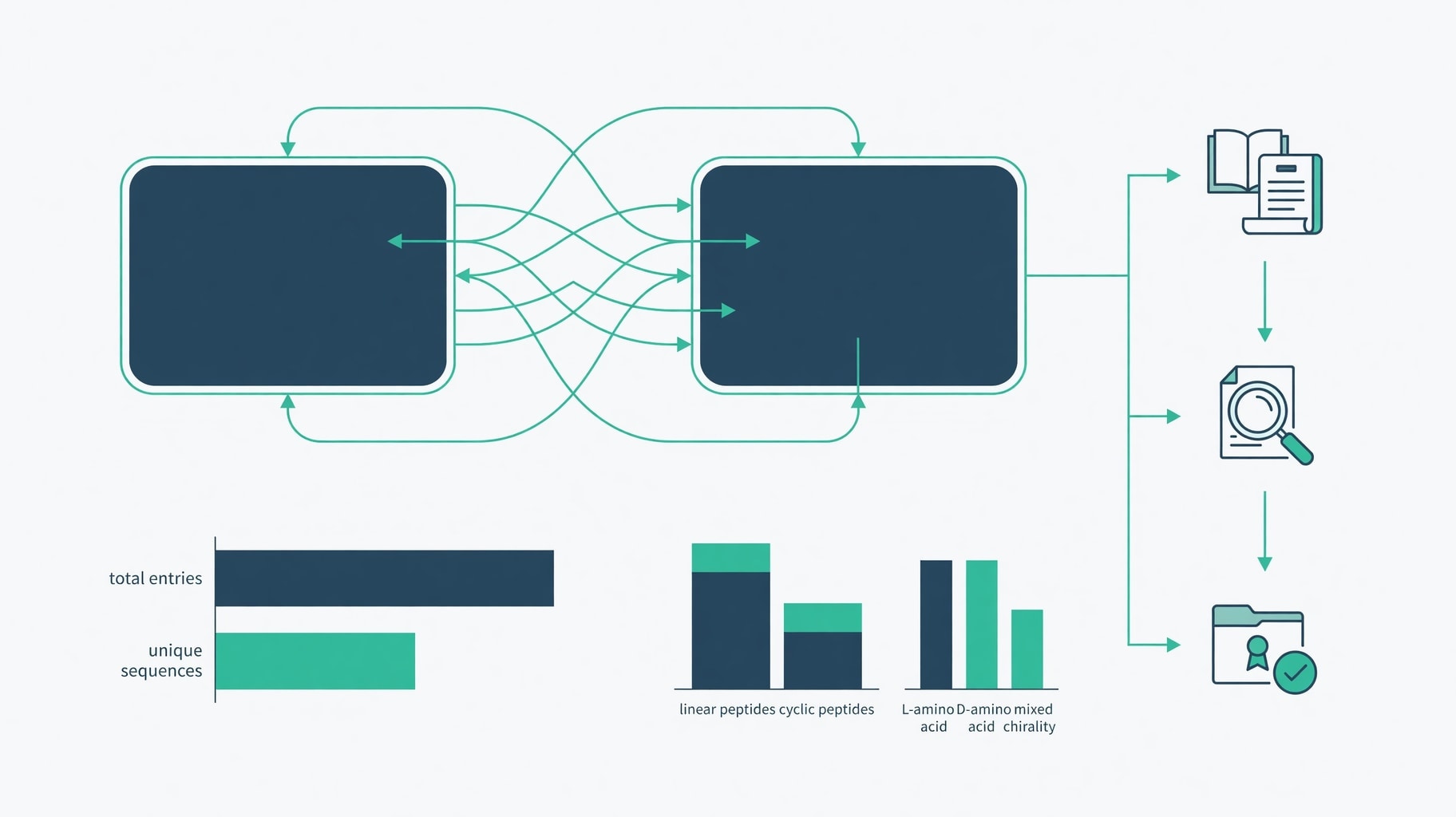
Figure 1: Architecture and curation overview of the primary public repositories for cell-penetrating peptide sequences.
CPPsite 2.0 contains 1,855 total entries covering 1,699 unique peptide sequences. Multiple entries document the same peptide tested across different cell lines or end modifications. The founding publication recorded 1,753 linear peptides, 102 cyclic peptides, 1,564 entries with L-amino acids, 63 with D-amino acids, and 32 with mixed chirality as reported by Oup.
The curation protocol required manual extraction from published literature and patents. Only experimentally validated sequences entered the database. The 1,017 synthetic entries, 774 natural protein derivatives, and 64 chimeric entries all passed this manual review as reported by Oup.
The first version of CPPsite launched in 2012 with 843 entries. Of those, 741 were unique sequences as reported by Oup. The 2016 update added 1,012 new entries compiled from research published in the preceding three years as reported by Oup. The expansion preserved the manual extraction requirement.
POSEIDON Quantitative Parameters
POSEIDON addresses a specific limitation in the CPPsite 2.0 architecture. The 2016 repository records qualitative uptake data. POSEIDON provides experimental quantitative uptake values for over 2,300 entries and physicochemical properties for 1,315 peptides as reported by Springer.
The database creators manually curated all scientific articles referenced in CPPsite 2.0 to extract quantitative uptake values and their units as reported by Springer. An associated machine learning regression model achieved a Pearson correlation of 0.87 and an r² score of 0.76 on an independent test set as reported by Springer.
These metrics describe the predictor's internal performance. They do not establish clinical validity. They do not satisfy the evidentiary requirements for a pre-market submission.
Cataloged Data Fields
CPPsite 2.0 assigns each entry a unique ID, a PubMed identifier, the amino acid sequence, peptide name, category, chirality, nature, and sub-cellular localization. Additional fields record N-terminal modifications, C-terminal modifications, uptake efficiency, uptake mechanism, in vitro and in vivo model systems, and cargoes delivered as reported by Edu.
The database integrates BLAST, Smith-Waterman, mapping, and alignment tools as reported by Edu. These tools allow users to query a candidate sequence against the stored records. For researchers working with bioactive peptides, the composition tool provides amino acid frequency, physicochemical property composition, and secondary structure composition modules as reported by Nih.
The structural fields illustrate the evidentiary boundary. CPPsite 2.0 stores 1,558 predicted tertiary structures. Of these, 58 derive from the Protein Data Bank, 1,411 were predicted using PEPstrMOD, and 89 used the I-TASSER suite as reported by Nih. Predicted structures are computational outputs. They are not experimental determinations. They do not function as release specifications or identity tests for regulatory submissions.
Regulatory Limits on Database Utilization
A database entry documents that a sequence was tested. It does not establish the sequence's status under U.S. law. The CPPsite 2.0 and POSEIDON records contain no administrative stays. They contain no interim guidance. They contain no enforcement discretion determinations. None of the supplied records document a pre-litigation notice or an active pharmaceutical ingredient designation involving these sequences.
The distinction carries liability for regulatory affairs professionals and formulation chemists. A procurement specification that cites a CPPsite 2.0 entry identifies a research-grade sequence parameter. It does not satisfy the statutory threshold for an active pharmaceutical ingredient. This boundary applies to cross-border supply chains sourcing peptides from Pacific markets. It applies equally to domestic facilities evaluating iv therapy peptide hormone clinic services.
The evidentiary gap between an academic repository and a regulatory standard remains absolute. Supply chain compliance requires documentation of manufacturing origin, purity testing, and impurity profiling. A manually curated database entry provides none of these records.
Selecting a Database for a Specific Task
Researchers verifying whether a sequence has known cell-penetrating activity should query CPPsite 2.0 first. The database remains freely accessible and holds the broadest manually curated record of experimentally validated sequences as reported by Edu. Users requiring quantitative uptake values across multiple cell lines should query POSEIDON. POSEIDON builds directly on CPPsite 2.0 source literature as reported by Springer.
Neither database replaces primary literature review. The PubMed identifiers in each entry point to the original experimental reports. A sequence retrieved from a database must be traced to its source publication before it enters a pre-market submission or a procurement specification. The database serves as an index. The underlying record carries the regulatory weight.