
Clinical notes from 652 patients indicate gray-market retatrutide delivered less than half the weight loss observed in Eli Lilly's Phase 3 TRIUMPH-1 randomized controlled trial, according to a preprint study published September 3, 2026. Users of the unapproved triple agonist achieved a mean 7.2% body weight reduction at 6 to 12 months (Medscape). The regulated 12 mg cohort in TRIUMPH-1 recorded 28.3% weight loss at 80 weeks and 30.3% at 104 weeks (AJMC).
The observational dataset draws from clinical notes rather than prospective dispensing records. It provides the first quantitative comparison between unregulated retatrutide sources and validated Phase 3 endpoints. In the retatrutide triple agonist triumph trials, Eli Lilly's investigational glucose-dependent insulinotropic polypeptide, glucagon-like peptide-1, and glucagon receptor agonist produced 28.3% mean weight loss at 80 weeks among 2,339 randomized participants (AJMC).
Within the 12 mg group, 45.3% of participants lost at least 30% of their baseline body weight (Los Angeles Times).
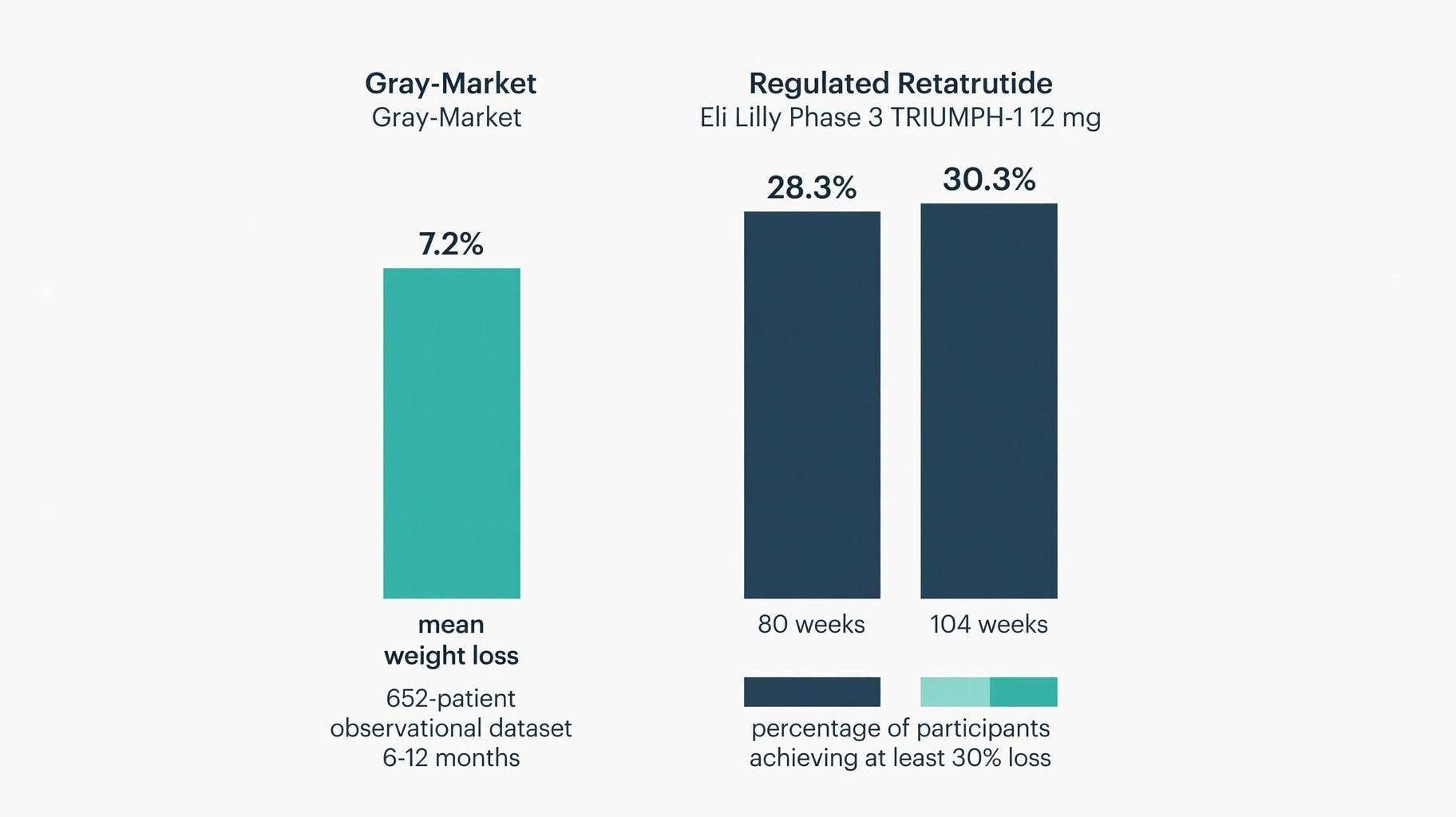
Figure 1: Head-to-head comparison of mean percent weight loss between gray-market retatrutide and Eli Lilly Phase 3 TRIUMPH-1 trial endpoints.
Compounders and direct-to-consumer suppliers produced a mean 7.2% body weight reduction at 6 to 12 months. This figure compares with 15.5% weight loss among 89 matched retatrutide trial participants evaluated over the same shorter interval (Medscape).
Cardiovascular Signals in Unregulated Cohorts
Heart rate elevation persisted in the gray-market group despite the reduced efficacy. Mean heart rate rose 2.5 beats per minute at three months among direct-to-consumer users (P=0.011) (Los Angeles Times). Trial participants showed a 4.3 beats per minute increase (P=0.028) (Los Angeles Times). Matched semaglutide users recorded a 0.0 beats per minute change. Matched tirzepatide users recorded a 0.1 beats per minute change over the same interval (Los Angeles Times).
The cardiovascular signal indicates that unregulated retatrutide products retain receptor-mediated chronotropic effects even while failing to replicate the primary weight loss endpoint. This pharmacokinetic divergence suggests the products contain sufficient active material to engage cardiac pathways without achieving the systemic exposure required for the primary endpoint. Some clinical notes document co-formulations with unapproved peptides including cagrilintide, BPC-157, NAD+, and IGF-1 analogues (Medscape). None of these combinations have been evaluated in a controlled human trial.
The structural difference between controlled clinical environments and unregulated distribution channels remains a primary variable. A cagrilintide-semaglutide combo achieves 20%+ weight loss in redefine 1 trial under a protocol that mandates batch verification, blinded dispensing, and scheduled dose titration. The gray-market cohort lacked these controls. European regulatory authorities and the FDA apply parallel pharmacovigilance standards to investigational peptides, but neither framework governs compounds sold outside licensed channels.
Methodological Constraints
The comparison carries structural limitations that preclude causal conclusions. The 652-patient dataset is observational. Index dates derive from clinical notes rather than dispensing records. Follow-up was short and uneven. The retatrutide arms had a median follow-up of roughly three months. Comparator groups had a median of six months. Gray-market products lack batch verification, making specific half-life or receptor affinity analysis impossible for the unregulated supply chain.
The TRIUMPH-1 benchmark reflects an 80-week controlled endpoint. The gray-market cohort includes heterogeneous dosing and variable exposure durations. Weight loss at 6 to 12 months in an observational setting does not map linearly onto an 80-week primary endpoint in a blinded trial.
Eli Lilly plans to file for FDA approval in the first quarter of 2027 (Los Angeles Times). The company has initiated eli lilly files six federal lawsuits to dismantle the retatrutide 'research-use only' mark to restrict unauthorized distribution. The 652-patient observational cohort establishes a quantitative baseline for the efficacy gap.
The mean weight loss of 7.2% at 6 to 12 months and the 2.5 beats per minute heart rate elevation at three months constitute the current recorded endpoints for unregulated retatrutide use.