Trulab Peptides publishes a flat rate of $200 per sample for standalone UHPLC purity analysis, with a $75 surcharge for 48-hour expedited turnaround Trulab. Vanguard Laboratory lists the same $200 base price for purity-only testing on raw powders Vanguard Laboratory. Those two published catalogs establish the commercial floor for third-party peptide purity testing cost in the United States.
The financial liability scales from that baseline. A procurement officer verifying a catalog peptide pays a commercial rate for chromatographic analysis. A facility preparing an active pharmaceutical ingredient for regulatory submission faces documentation requirements that elevate per-sample costs into the thousands.
Commercial Baseline Rates for HPLC and Mass Spectrometry
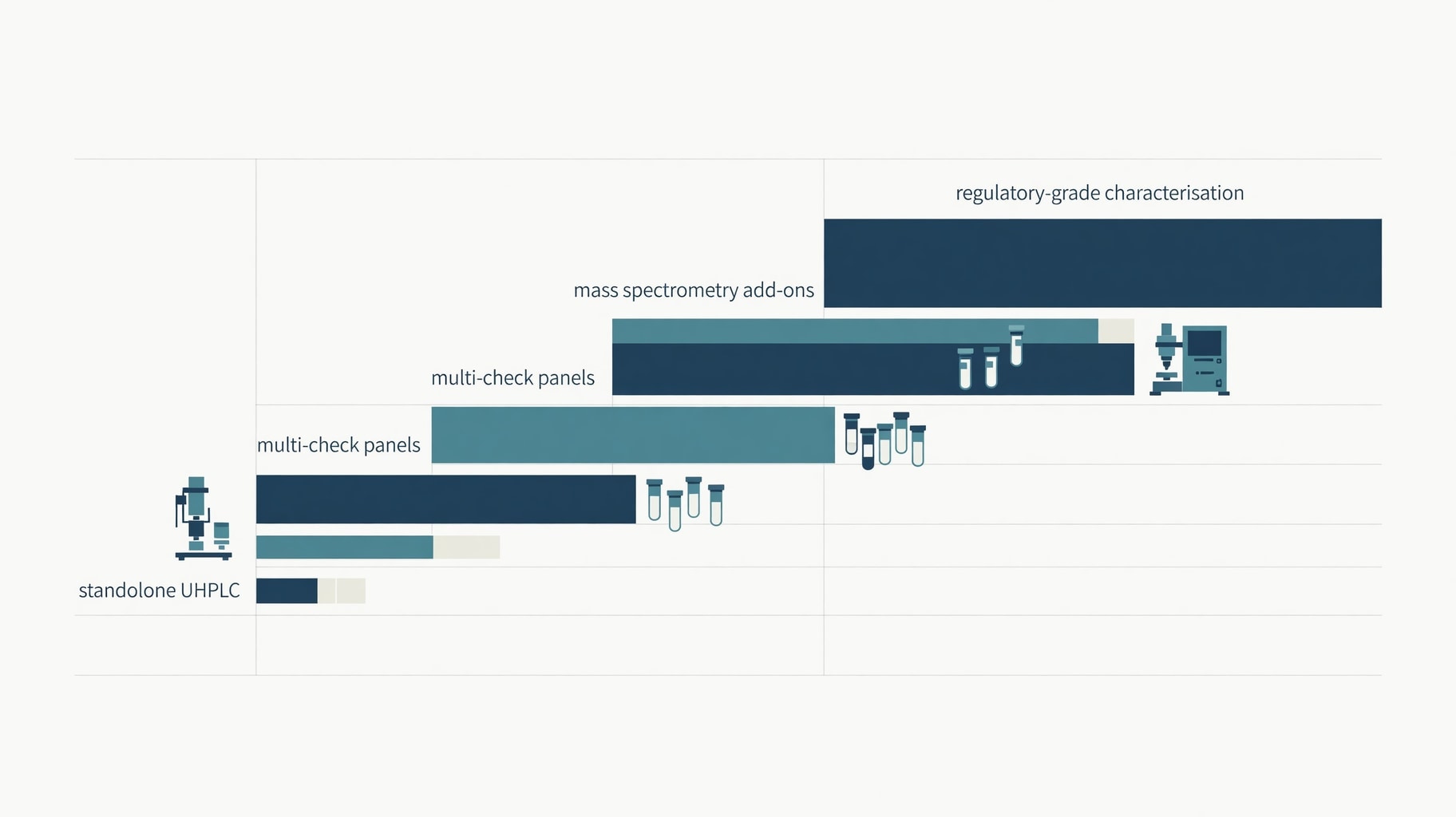
Figure 1: Commercial pricing tiers and analytical variables for third-party peptide purity testing services.
Independent consumer-facing laboratories publish transparent price lists. Trulab charges $200 per sample for UHPLC with a five-business-day turnaround. Vanguard Laboratory prices purity-only testing at $200. It offers tiered panels: Level 1 Silver at $250 for four checks on one vial, Level 2 Gold at $550 for eight checks on three vials, and Level 3 Elite at $700 for nine checks on four vials Vanguard Laboratory.
Mass spectrometry adds incremental cost. PeptideVerify, a UK-based verification service, lists HPLC purity testing at £300 and combined HPLC plus LC-MS identity verification at £395, both with a five-to-seven-business-day turnaround PeptideVerify. ACS Laboratory reports that identity plus purity testing costs $400 to $600 combined, while a comprehensive panel including net peptide content, contaminant screening, and microbial testing runs $800 to $1,500 ACS Laboratory.
PeptideTest prices purity and mass testing from $200 for sequences such as BPC-157 and TB-500. Tirzepatide and semaglutide begin at $300. Combination products like CagriReta reach $800 PeptideTest. The price variation tracks molecular complexity rather than laboratory overhead.
Regulatory Characterization Pricing by Peptide Complexity
ResolveMass, a Canadian analytical facility supporting Health Canada and FDA submissions, publishes a distinct pricing architecture. Its characterization services range from $800 to $5,000 per sample ResolveMass. Simple linear peptides under 15 amino acids cost $800 to $1,500. Standard peptides of 15 to 30 amino acids cost $1,500 to $3,000. Complex peptides over 30 amino acids with modifications cost $3,000 to $5,000.
The gap between consumer and regulatory tiers reflects statutory documentation requirements rather than market variation. A 503B outsourcing facility or a sponsor preparing a regulatory filing must produce analytical records that withstand agency audit. HPLC-UV analysis alone runs $300 to $800 per sample under that standard. LC-MS molecular weight confirmation costs $600 to $1,500. Peptide mapping for sequence verification costs $1,200 to $2,500 ResolveMass.
Institutional Core Facility Benchmarks
University core facilities publish rates that serve as the academic procurement benchmark. The Northwestern University Peptide Synthesis Core charges $55 per injection for analytical HPLC, $65 per injection for LCMS, and $14 per sample for molecular weight determination Northwestern. The UNC Peptide Synthesis Core lists HPLC and mass spectrometry analysis at $48 to $96 per sample, with purification services at $96 to $144 per 20 mg of crude peptide depending on target purity UNC.
These rates apply to institutional users and assume internal technical staff. Core facilities require direct inquiry for non-affiliated users. The per-injection model charges for instrument time. A commercial laboratory charges for a deliverable report.
Expedited Turnaround and Conformity Surcharges
Base rates understate total procurement liability during a supply constraint or when batch verification is time-sensitive. Trulab imposes a $75 rush fee for 48-hour service. PeptideVerify charges £450 for express HPLC plus LC-MS with a three-to-five-business-day turnaround, a £55 premium over its standard service PeptideVerify.
Multi-vial conformity testing adds a separate line item. Vanguard Laboratory charges a flat $100 per additional sample for conformity testing across one to three vials Vanguard Laboratory. Endotoxin testing appears as a discrete add-on across multiple catalogs: £180 at PeptideVerify, $210 at Vanguard, and $300 at PeptideTest. Sterility testing adds $150 at Vanguard.
A peptide purity testing kit does not exist as a standardized commercial product for end users. The procurement decision rests entirely on laboratory selection and method specification. The published fee schedule represents one variable. Accreditation status, instrumentation, and reporting format determine whether the resulting Certificate of Analysis satisfies agency scrutiny or internal batch release protocols. Buyers evaluating high purity research peptides must align the analytical method with the regulatory threshold governing the material.
Learning how to read peptide coa remains a prerequisite for procurement verification. Standard peptide testing protocols dictate the scope of the analytical work. Providers such as those detailed in analytical formulations inc peptide testing illustrate the commercial landscape for these services. Establishing research peptides quality requires matching the purchased assay to the intended statutory threshold.
What the Published Rates Do Not Cover
All figures above represent list prices from the supplied catalogs. They do not account for volume discounts, negotiated enterprise contracts, or currency conversion for international vendors. Consumer-facing laboratories and university core facilities operate under distinct quality systems. A $200 UHPLC run does not produce the same documentation package as an $800 regulatory-grade analysis.
The supply record contains no agency enforcement action or administrative stay that mandates testing costs. The published prices represent commercial procurement decisions. No statutory threshold dictates these commercial rates for non-approved materials.