
Pharmacokinetic uncoupling defines the clinical ceiling for cyclic antimicrobial peptides. In a healthy volunteer study of twelve males, colistin methanesulfonate (CMS) achieved a peak plasma concentration of 4.8 mg/L with a two-hour half-life, while the active colistin base reached only 0.83 mg/L with a three-hour half-life (PubMed). This delayed conversion establishes a baseline where efficacy and toxicity are temporally distinct.
Optimizing the therapeutic index requires distinguishing between outer membrane binding kinetics, which drive bacterial killing, and renal tubular uptake rates, which predict toxicity. Current evidence indicates this window varies significantly between North American and European regulatory frameworks. Dosing strategies must account for the fact that renal injury correlates more closely with tubular peptide load than with peak serum concentrations of the active drug.
Transatlantic development of these agents now depends on reconciling human pharmacokinetic data with mechanistic cellular assays to map safe administration boundaries.
Prodrug Conversion and Systemic Exposure Variability
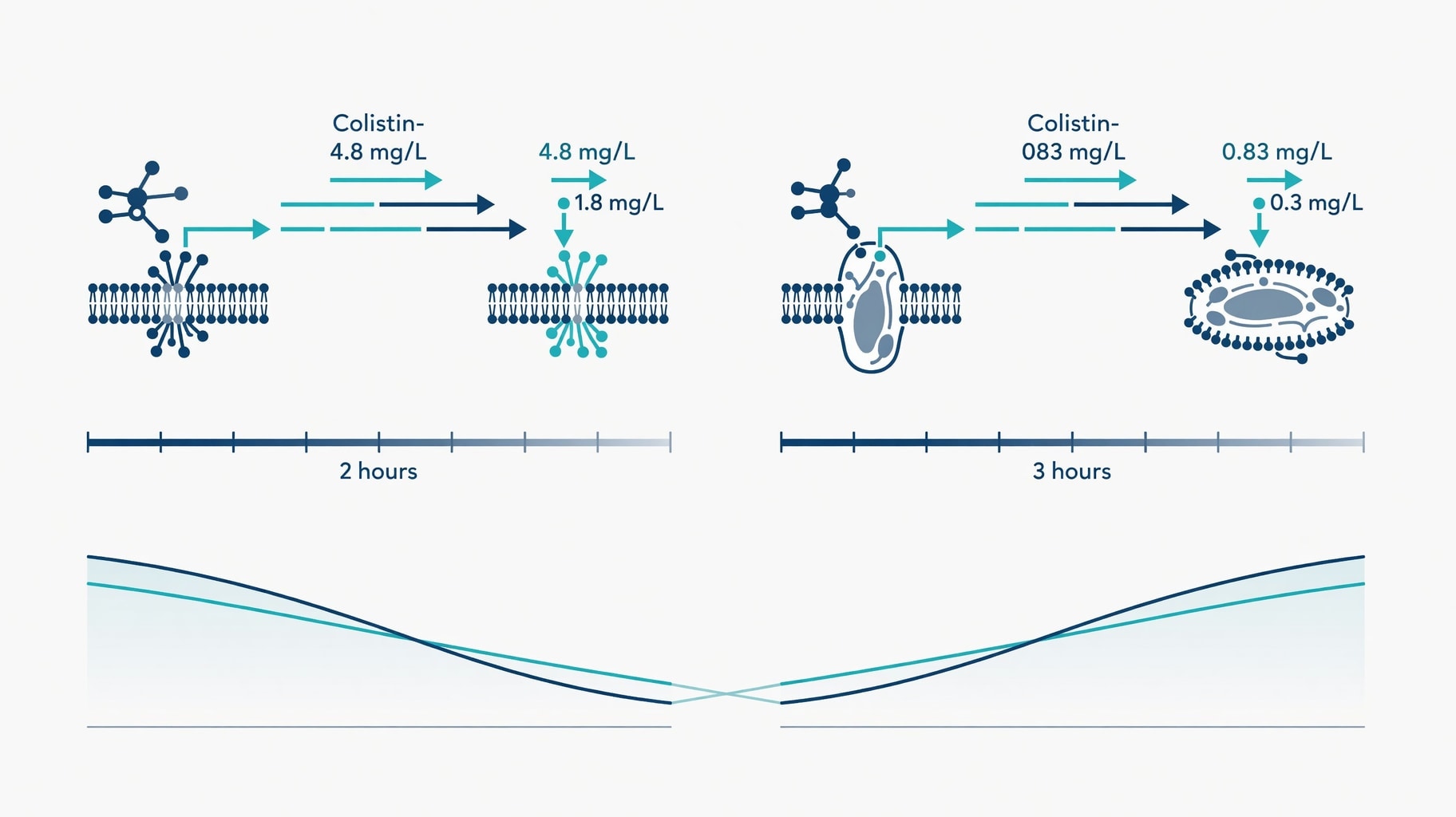
Figure 1: Divergence between bacterial LPS binding kinetics and renal tubular uptake driving the therapeutic index of cyclic antimicrobial peptides.
Polymyxin administration illustrates the critical distinction between prodrug kinetics and active drug exposure. Clinicians administer colistin as the inactive prodrug CMS to reduce immediate injection-site pain and acute toxicity. Conversion to the active form occurs spontaneously in aqueous solution and plasma, but the rate remains variable and incomplete. Couet et al. found that after a one-million international unit infusion of CMS in twelve healthy male volunteers, the prodrug cleared renally at 103 mL/min.
The active colistin base, by contrast, had a renal clearance of only 1.9 mL/min. This discrepancy indicates that the kidney handles the prodrug and the active peptide through fundamentally different transport mechanisms.
Inter-cohort variability further complicates dosing precision across populations. Japanese and Chinese pharmacokinetic studies show divergent exposure parameters even when normalized for weight. Mizuya-chi et al. reported that in fifteen Japanese males receiving 2.5 mg/kg of colistin base activity, the active drug achieved a maximum concentration of 4.38 mg/L. A separate cohort of eighteen Chinese subjects in the Fan et al. study reached maximum concentrations ranging from 1.06 to 1.30 mg/L under identical dosing regimens.
The half-life of the active drug also extended to approximately five hours in these Asian cohorts, compared to three hours in the French volunteer group. These differences suggest that population-specific physiological factors, potentially including renal transporter polymorphisms or body composition, significantly influence systemic exposure.
Critical care populations introduce additional pharmacokinetic uncertainty that deviates from healthy volunteer models. Critically ill patients often exhibit altered volumes of distribution and augmented or impaired renal clearance. The volume of distribution for active colistin in healthy volunteers ranges from 12.4 L to 1.39 L/kg across studies, but sepsis-induced capillary leak can expand this compartment unpredictably.
Because the conversion from CMS to colistin is non-enzymatic and time-dependent, standard loading doses may fail to achieve therapeutic concentrations rapidly enough in patients with high bacterial burdens. Conversely, maintenance dosing based on estimated creatinine clearance may overestimate exposure in patients with fluctuating renal function.
The slow formation of active colistin from CMS acts as a built-in rate limiter for systemic exposure, meaning steady-state concentrations of the active drug are not achieved until several half-lives have passed.
Clinicians must therefore manage a period of sub-therapeutic exposure during the initial phase of treatment or employ loading dose strategies that carry their own toxicity risks.
Membrane Targets Versus Renal Uptake Mechanisms
Bacterial killing by cyclic antimicrobial peptides relies on specific interactions with membrane components that differ fundamentally from the mechanisms driving host toxicity. For polymyxins, the primary target is lipopolysaccharide (LPS) in the outer membrane of Gram-negative bacteria. Biophysical assays indicate that this interaction is highly specific and saturable. Membrane potential assays and cryo-electron tomography studies have shown that cationic peptides induce envelope perturbation characterized by inner-membrane hyperpolarization.
This state is temporally associated with preferential interactions with LPS and anionic phospholipids rather than nonspecific permeabilization (Nature). This structural specificity drives efficacy but does not guarantee safety in host tissues.
The same physicochemical properties that enable bacterial membrane binding also drive nephrotoxicity through distinct pathways. Polymyxins accumulate in proximal tubule epithelial cells via receptor-mediated endocytosis, primarily involving the megalin-cubulin complex. This uptake is saturable and competitive. Cellular assays using primary cultures of pig kidney proximal tubule epithelial cells have demonstrated that peptide accumulation correlates with cytotoxicity.
Co-administration of cilastatin, an inhibitor of brush border dipeptidase, reduces toxic accumulation of peptides like cyclosporin A in these cells.
This finding, detailed in renal toxicity research, suggests that proximal tubule uptake is an active, modifiable process rather than a passive consequence of filtration. Toxicity arises not from off-target membrane disruption but from on-target receptor-mediated accumulation in a specific host tissue.
Investigational analogs attempt to exploit this distinction between bacterial and mammalian affinity. Preclinical data indicate that compound 12, a novel cyclic lipopeptide, exhibited reduced renal cytotoxicity and nephrotoxicity in animal models while maintaining antibacterial efficacy against carbapenem-resistant Gram-negative bacteria (ScienceDirect). Whether this improved selectivity translates to human pharmacokinetics remains unverified, as no clinical dosing data currently exist for this analog.
Generative AI platforms have identified other candidates with low hemolytic activity and retained efficacy in serum, suggesting they act through sub-microsecond membrane insertion consistent with established cyclic peptide mechanisms. Yet computational pore design studies and preclinical screening data remain theoretical until validated in human pharmacokinetic trials.
Regulatory Divergence in Renal Safety Monitoring
Transatlantic regulatory frameworks approach the management of peptide-associated nephrotoxicity with distinct emphasis, reflecting different interpretations of the same pharmacokinetic data. The European Medicines Agency assessment report for colistimethate sodium (Colobreathe) notes that CMS and colistin appear to have linear kinetics in clinically relevant doses but highlights that the half-life appears longer in critically ill patients (14 hours) compared to healthy subjects and those with cystic fibrosis (3-4 hours).
The EMA assessment report further specifies that around 60-70% of CMS is excreted renally in subjects with normal renal function, while colistin appears to undergo extensive tubular reabsorption and is cleared non-renally. This regulatory focus on tubular handling show a pharmacokinetic-driven approach to safety monitoring in Europe.
U.S. regulatory guidance emphasizes different parameters for establishing safe dosing. The FDA draft guidance on clinical pharmacology considerations for peptide drug products describes current thinking regarding the impact of hepatic impairment, drug-drug interactions, QTc prolongation risk, and immunogenicity risk on a peptide drug product’s pharmacokinetics, safety, and efficacy. The FDA guidance document directs sponsors to characterize these specific risks rather than focusing exclusively on renal tubular reabsorption metrics.
This divergence manifests in clinical trial design and post-marketing surveillance expectations.
Sponsors seeking global approval must handle distinct requirements for renal safety characterization, as a dosing regimen optimized for European therapeutic drug monitoring standards may not satisfy FDA requirements for fixed-dose justification.
Prescribers operating in multinational health systems must recognize that the standard of care for renal monitoring is not universally defined. The choice of dosing strategy and safety surveillance protocol depends on jurisdictional context and institutional capacity for therapeutic drug monitoring. Post-marketing commitments regarding renal safety surveillance also differ, with European authorities potentially requiring prospective observational studies correlating drug levels with tubular biomarkers while FDA requirements may focus on adverse event reporting in specific subpopulations.
For clinical pharmacologists, this divergence demonstrates the absence of a unified international standard for peptide antibiotic safety. The therapeutic index remains a moving target defined by local regulatory precedent as much as by biological evidence.
No human pharmacokinetic data currently validate whether preclinical reductions in renal cytotoxicity for novel analogs like compound 12 translate to improved safety profiles in patients.
Further Clinical & Regulatory Context
For deeper analysis and cross-referenced evidence, see: - Related Clinical & Pharmacological Analysis: Neoantigen Peptide Vaccines: Prediction Accuracy Versus Clinical T-Cell Expansion