
Personalized neoantigen peptide vaccines induce measurable antitumor T-cell responses in only 10% to 20% of computationally selected epitopes, according to a profiling study of 367 patients receiving peptide-pulsed dendritic cell therapy published in Frontiers in Immunology. This low clinical hit rate persists despite significant advances in high-affinity HLA binding prediction algorithms, revealing a substantial translational gap between theoretical immunogenicity and verified immune activation in human subjects.
For researchers developing peptide vaccines cancer immunotherapy strategies, this discordance establishes that computational affinity scores alone are insufficient predictors of clinical efficacy. The 367-patient cohort received 2,865 candidate neoantigen peptides designed to stimulate both CD8+ and CD4+ T cells, yet the vast majority failed to elicit a detectable response as reported by Frontiers in Immunology.
This finding contrasts sharply with preclinical models, where high-affinity predicted neoantigens induced CD8+ T cells against approximately 50% of targets in controlled murine studies according to Nature npj Vaccines. The discrepancy show that current evidence standards for advancing peptide vaccines beyond Phase 1/2 trials must rely on empirical flow-cytometric confirmation rather than in silico binding metrics.
HLA Binding Prediction Versus Empirical Validation
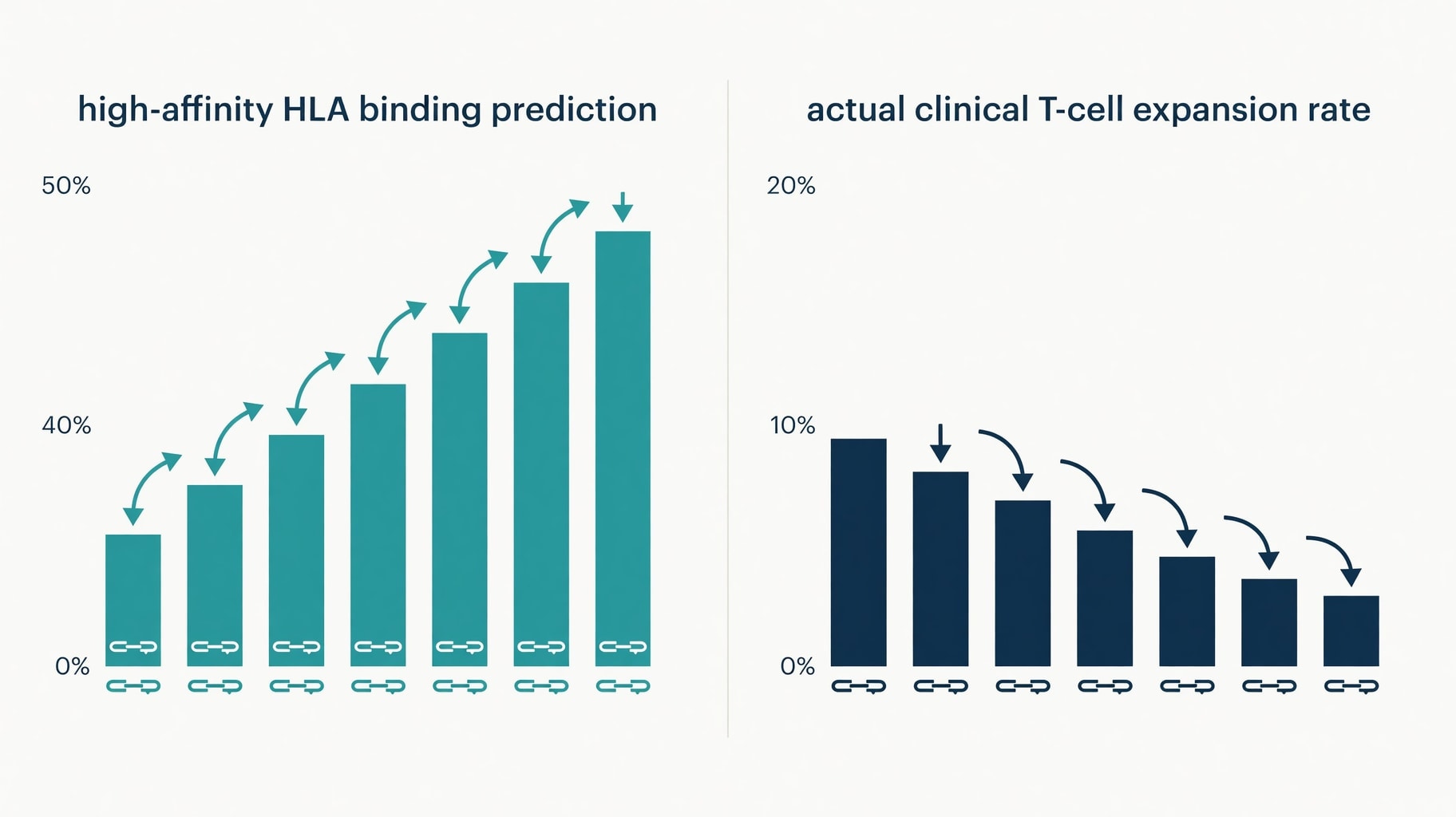
Figure 1: Discordance between in silico HLA-binding prediction accuracy and measured clinical T-cell response rates in neoantigen peptide vaccine trials.
Computational pipelines for neoantigen selection have grown increasingly sophisticated, integrating mutation calling, HLA typing, and peptide-MHC binding predictions to prioritize targets. Deep learning workflows such as MHCRoBERTa now employ transfer learning with label-agnostic protein sequences to improve pan-specific peptide-MHC class I binding prediction as detailed in Genes & Immunity. These tools represent a significant methodological advance over earlier matrix-based scoring systems, yet improved binding prediction has not translated proportionally to improved clinical immunogenicity rates.
Retrospective analyses reveal that computational models systematically miss a subset of clinically relevant epitopes. Approximately 20% of T-cell responses in vaccinated patients were induced by neoantigens predicted to bind poorly to HLA class I and II molecules according to research archived in PMC. This false-negative rate suggests that current algorithms filter out potentially therapeutic targets based on an incomplete understanding of antigen processing and presentation biology.
Conversely, many peptides with high predicted binding affinity fail to induce any measurable T-cell expansion in vivo, indicating that binding is a necessary but not sufficient condition for immunogenicity.
Mass spectrometry validation offers a potential bridge between prediction and reality, but technical limitations persist. HLA-bound tumor peptides can be isolated and identified directly from cancer samples, yet these approaches remain stochastic and typically lack individual-specific spectral libraries as noted in Nature Biotechnology. Without custom spectral libraries for each patient’s unique mutanome, mass spectrometry cannot comprehensively validate which predicted neoantigens are actually presented on the tumor cell surface.
This technical constraint forces continued reliance on imperfect computational prioritization followed by post-hoc empirical testing. Comparative studies suggest that vaccines using validated HLA binding data outperform those relying solely on predicted affinity. Research indicates that whole-tumor lysate or neoepitope vaccines incorporating in vitro binding validation demonstrate superior immunogenicity ranking compared to those selected exclusively through in silico methods according to PubMed.
This finding reinforces the necessity of wet-lab confirmation before committing manufacturing resources to specific peptide candidates, particularly given the high cost of personalized vaccine production.
The integration of tumor-intrinsic factors represents the next frontier in closing the prediction-validation gap. Incorporating mutant RNA expression levels, surface neoantigen-HLA complex density, and immune evasion pathways into selection algorithms is essential for developing more clinically relevant prediction frameworks. Current algorithms often treat all mutations as equally likely to be presented, ignoring transcriptional regulation and proteasomal processing efficiency that determine actual epitope availability.
Until these biological variables are systematically integrated, the field must accept that even the most advanced deep learning predictors will continue to generate false positives and false negatives at rates that necessitate extensive empirical screening. The 10-20% clinical response rate to computationally selected peptides therefore reflects not merely technical failure but fundamental biological complexity that pure sequence-based prediction cannot capture.
Flow-Cytometric Endpoints in Early-Phase Trials
Given the unreliability of prediction metrics, early-phase clinical trials now depend heavily on functional immune monitoring to establish vaccine activity. Ex vivo validation of neoantigen-specific immune responses is standardly performed through flow cytometric analysis or IFN-γ ELISpot using patient peripheral blood mononuclear cells as described in PubMed. These assays provide direct evidence of T-cell expansion and cytokine production that computational models cannot supply.
In a Phase 1 trial of the GNOS-PV01 DNA vaccine for MGMT unmethylated glioblastoma, investigators measured statistically significant increases in CD8+ and CD4+ T cells expressing activation markers CD69, CD137, and PD-1, alongside the proliferation marker Ki67 following neoantigen stimulation according to Nature Cancer. The trial correlated the percentage change in CD69 and IFNγ expression on T cells with overall survival from time of surgery, linking functional immune readouts directly to clinical outcomes.
This level of granular immunomonitoring is now expected in rigorous peptide vaccine development programs and serves as the primary evidence base for go/no-go decisions in early-phase trials.
Similar validation standards apply across tumor types, though response rates vary significantly. In a study of neoantigen-targeted dendritic cell vaccination for lung cancer, CD8+ T-cell reactivity was confirmed against nine of 33 selected neoantigens, with eight of nine responses demonstrated to be specific for the predicted HLA class I epitope as reported in ScienceDirect. While this 27% response rate exceeds the 10-20% baseline seen in larger cohorts, it still represents a minority of administered peptides.
The specificity confirmation for eight of nine responders validates the prediction pipeline for successful cases while highlighting the 73% failure rate. Flow cytometry gating strategies have become increasingly standardized to capture polyfunctional T-cell responses. Modern protocols assess cytokine production (IFNγ, TNFα) and degranulation (CD107a) simultaneously after ex vivo rechallenge with predicted minimal neopeptides according to PubMed.
Proliferation markers like Ki67 and activation markers including PD-1, LAG-3, TIM-3, and HLA-DR are tracked serially post-vaccination to distinguish vaccine-induced expansion from baseline immune activity. This multi-parameter approach reduces false positives from non-specific T-cell activation and provides a more nuanced picture of immune quality beyond simple frequency counts.
The distinction between peptide and mRNA platforms requires careful delineation when interpreting immunogenicity data.
While personalized mRNA vaccines have demonstrated durable T-cell immunity persisting for years in triple-negative breast cancer patients according to Nature, these results cannot be directly extrapolated to synthetic peptide vaccines. mRNA platforms encode multiple neoantigens in a single construct requiring intracellular processing and endogenous presentation, whereas synthetic peptides are directly loaded onto MHC molecules or taken up by antigen-presenting cells through distinct mechanisms.
Each platform demands independent validation of its immunogenicity thresholds. Adjuvant and delivery platform variables further complicate cross-trial comparisons. Peptide-TLR-7/8a conjugate vaccines chemically programmed for nanoparticle self-assembly have shown enhanced CD8 T-cell immunity to tumor antigens in preclinical models according to Nature Biotechnology. Multiple-course peptide vaccination regimens have induced high frequencies of circulating CD8+ T cells reaching 4.8% of total CD8+ population in some studies as reported in PubMed.
These formulation and scheduling variables interact with epitope selection in ways that current prediction algorithms do not capture, making direct comparison of immunogenicity rates across different vaccine platforms scientifically invalid without head-to-head trials.
Transatlantic Standards for Immunogenicity Evidence
North American and European regulatory frameworks both require empirical immunogenicity validation, yet they diverge in endpoint acceptance and assay standardization. Clinical trial protocols registered on ClinicalTrials.gov specify flow cytometry and ELISpot as primary or secondary immunogenicity endpoints with varying degrees of assay validation requirements. European Medicines Agency guidelines tend to emphasize standardized, centralized assay validation with predefined acceptance criteria, while FDA guidance often permits more sponsor-defined assay development provided analytical validation is documented.
This transatlantic divergence affects how immunogenicity data are interpreted across jurisdictions and complicates multinational trial design. European trials frequently mandate external validation of HLA-peptide binding through biochemical assays before clinical administration, aligning with evidence that validated binding outperforms pure prediction as noted in PubMed. North American protocols more commonly accept high-confidence computational predictions as sufficient justification for peptide selection, relying on post-hoc clinical immunomonitoring to confirm target validity.
Neither approach has demonstrated clear superiority in achieving higher clinical response rates, suggesting that the bottleneck lies in biological prediction rather than regulatory strategy.
Current evidence establishes that ex vivo validation via flow cytometry or IFN-γ ELISpot remains the requisite standard for confirming peptide vaccine activity in clinical development according to PubMed. No regulatory pathway currently accepts computational HLA binding prediction as a standalone surrogate endpoint for clinical immunogenicity.
The field must therefore continue to operate within a paradigm where computational tools serve as filters rather than definitive selectors, with the understanding that the majority of predicted targets will fail empirical validation.
This reality has significant implications for trial design, manufacturing timelines, and patient expectations. Until prediction algorithms incorporate tumor-intrinsic factors such as mutant RNA expression, surface neoantigen-HLA complex density, and immune evasion pathways, the 10-20% clinical response rate to computationally selected peptides is likely to persist as the baseline expectation for personalized neoantigen vaccine development.
Researchers and clinicians must frame this limitation transparently when designing trials and communicating with patients, acknowledging that the distance between a predicted epitope and a functional T-cell response remains the central challenge in peptide vaccine oncology.