
The Cosmetic Ingredient Review Expert Panel formally assessed acetyl hexapeptide-8 amide as safe for cosmetic use at concentrations up to 0.005% in the 2025 Johnson assessment, establishing a regulatory boundary that distinguishes this ingredient from unregulated research compounds or approved pharmaceutical neuromodulators (Superpower).
This specific safety determination anchors the commercial availability of argireline acetyl hexapeptide 8 in U.S. and Taiwanese supply chains as a cosmetic ingredient rather than a drug, regardless of marketing narratives that frequently invoke botulinum toxin comparisons.
The distinction matters because the biochemical evidence defines this peptide as a reversible competitive inhibitor of SNARE complex assembly with efficacy strictly constrained by stratum corneum penetration barriers. Formulators and regulatory teams must distinguish this temporary, dose-dependent modulation from the permanent enzymatic cleavage of SNAP-25 caused by injectable neurotoxins, as the former operates within cosmetic safety margins while the latter requires pharmaceutical approval and carries risks of ptosis or systemic toxicity.
Regulatory Safety Determination Versus Drug Approval Pathways
The 2025 CIR assessment provides the legal framework for manufacturing and labeling acetyl hexapeptide-8 in the United States, serving as the primary reference for compliance rather than FDA drug approval pathways. The Expert Panel’s conclusion relies on a comprehensive review of toxicology data, distinguishing the safety profile of topical application from the adverse event profiles associated with injected neurotoxins (Superpower).
This assessment validates the ingredient solely for cosmetic claims related to appearance, prohibiting structure-function claims that imply physiological alteration of muscle tissue or treatment of medical conditions like blepharospasm. While the CIR has cleared the ingredient at low concentrations, this does not equate to therapeutic authorization.
Regulatory affairs professionals must recognize that the safety ceiling exists to prevent systemic absorption levels that might trigger pharmacological effects, thereby maintaining the distinction between a cosmetic and a drug under the Federal Food, Drug, and Cosmetic Act.
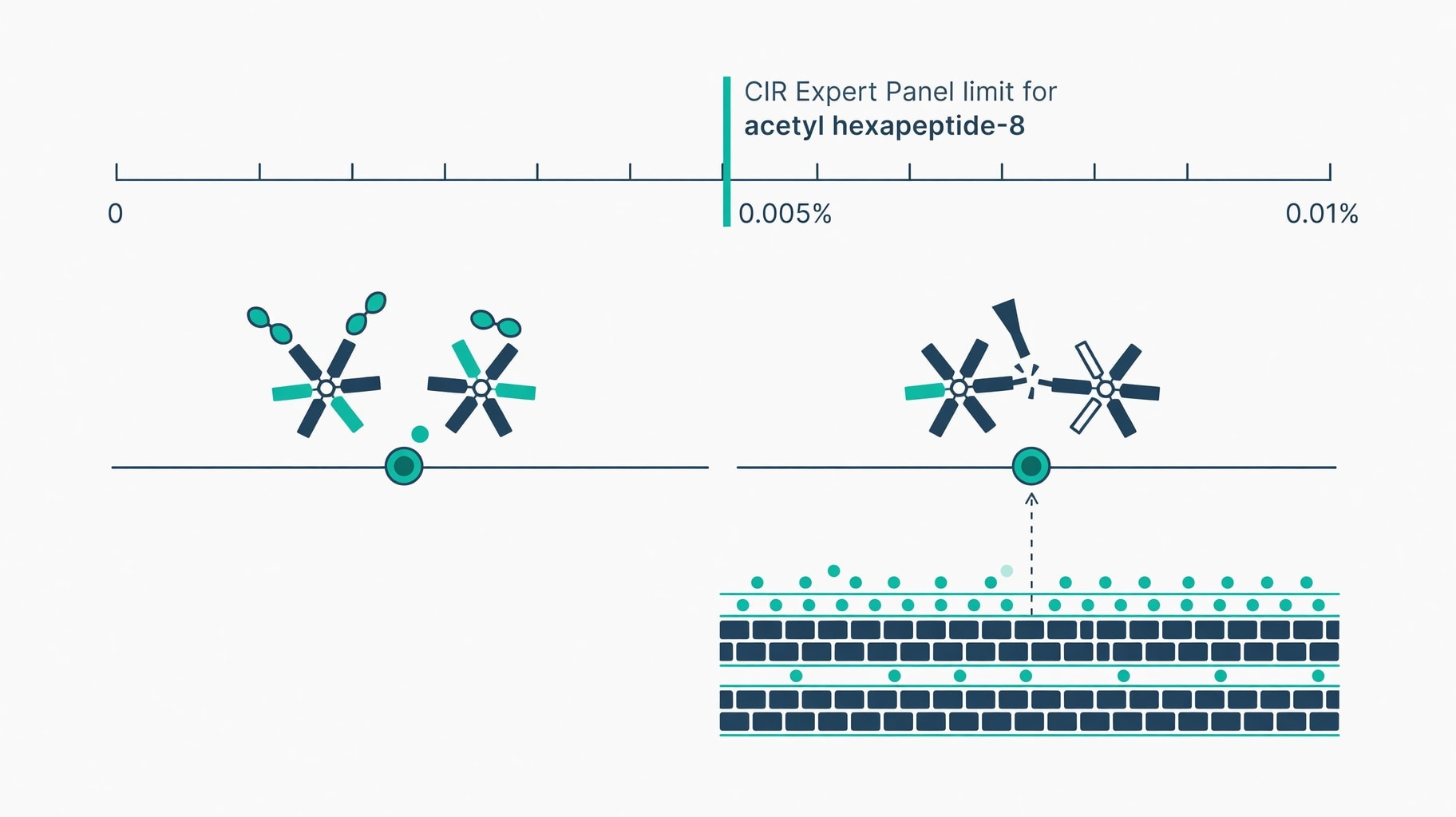
Figure 1: Regulatory safety ceiling and SNARE inhibition mechanics of acetyl hexapeptide-8 versus botulinum neurotoxin.
Taiwanese regulatory bodies and Pacific supply chain partners typically align with these established safety ceilings when evaluating raw material imports, though labeling requirements and nomenclature standards may differ across jurisdictions. The concentration limit of 0.005% for the amide form serves as a critical compliance checkpoint for contract manufacturers sourcing from trans-Pacific suppliers. Products exceeding this threshold without New Drug Application approval risk misbranding enforcement actions or import detentions.
This regulatory ceiling explains why many consumer serums contain the peptide at low percentages, creating an inherent tension between marketing promises of dramatic wrinkle reduction and the formulation constraints required to maintain cosmetic status. Manufacturers operating in cross-border markets must handle this disparity carefully; a formulation deemed compliant in one market based on local interpretations of "cosmetic" may face scrutiny in another if safety data does not support higher concentrations.
Safety assessments also differentiate acetyl hexapeptide-8 from structurally similar peptides like SNAP-8 (acetyl octapeptide-3), despite their shared mechanism of action. While both target the SNARE complex, they possess distinct INCI names and separate safety dossiers. Regulatory affairs professionals cannot extrapolate the CIR safety conclusion for acetyl hexapeptide-8 to SNAP-8 without independent verification, as the additional amino acid residues in SNAP-8 alter its molecular weight, penetration potential, and toxicological profile (Peptide Dosages).
This distinction prevents formulators from treating the entire class of neurotransmitter-inhibitor peptides as interchangeable regulatory entities. The commercial stakes are significant for brands navigating these nuances, as misclassification can trigger warning letters or import alerts in both U.S. and Asian markets.
Furthermore, the existence of clinical trials investigating acetyl hexapeptide-8 for conditions like blepharospasm show the ingredient's biological activity, yet these studies do not override its current regulatory status as a cosmetic unless a sponsor successfully petitions for drug designation.
SNARE Complex Interference and Biochemical Reversibility
Understanding the mechanism of action requires precision beyond general "Botox-like" descriptors often found in consumer marketing. Acetyl hexapeptide-8 functions as a synthetic mimic of the N-terminal domain of SNAP-25, a protein essential for neurotransmitter release at the neuromuscular junction. Research confirms that the peptide competes with native SNAP-25 for binding sites on the SNARE complex, specifically interfering with the interaction between SNAP-25 and vesicle-associated membrane protein (VAMP) (PMC).
This competitive inhibition destabilizes the four-helix bundle structure necessary for synaptic vesicle fusion, reducing the efficiency of acetylcholine release. Unlike botulinum toxin type A, which acts as a zinc-dependent protease to enzymatically cleave SNAP-25 and permanently disable the protein for months, acetyl hexapeptide-8 merely occupies a binding site temporarily. Once the peptide degrades or is cleared from the tissue, native SNAP-25 resumes its function, and normal neuromuscular transmission returns.
This reversibility is the defining biochemical difference between a cosmetic peptide and a pharmaceutical neurotoxin. Reviews in toxicological literature document that botulinum toxin biology extends beyond simple cleavage to include neuritogenesis and gene expression changes, complexities entirely absent in topical peptide application (Superpower). The "Botox in a jar" moniker fails to capture this fundamental kinetic difference. Acetyl hexapeptide-8 modulates signaling efficiency; it does not abolish it.
This mechanistic reality dictates formulation strategy, as the peptide must be present continuously at the target site to maintain any competitive advantage over native proteins. In vitro assays comparing SNARE inhibition potency suggest structural differences matter significantly. SNAP-8, an octapeptide with two additional amino acid residues, has demonstrated approximately 30% greater potency than acetyl hexapeptide-8 in head-to-head laboratory comparisons, attributed to enhanced binding affinity for the SNARE complex assembly interface (Peptides Lab UK).
However, in vitro potency does not automatically translate to superior clinical performance, as bioavailability remains the rate-limiting step for all topical neuromodulators.
The comparison to botulinum toxin must also account for delivery route. Injectable neurotoxins bypass the skin barrier entirely, delivering precise units of toxin directly to the motor endplate. Topical acetyl hexapeptide-8 must traverse the stratum corneum, a barrier evolved specifically to exclude large, hydrophilic molecules like hexapeptides. Consequently, even if the peptide possesses high intrinsic affinity for the SNARE complex, its effective concentration at the neuromuscular junction is a fraction of the applied dose.
This pharmacokinetic reality reinforces the regulatory distinction: the safety margin for topical application is wide precisely because systemic absorption is low. Were a topical formulation to achieve bioavailability comparable to injection, the safety profile would likely necessitate reclassification as a drug due to the increased risk of systemic neuromuscular effects.
Penetration Barriers and Clinical Measurement Standards
The stratum corneum presents a formidable barrier to hexapeptide bioavailability, defining the upper limit of clinical efficacy. A 2025 peer-reviewed review of acetyl hexapeptide-8 in cosmeceuticals concluded that while preclinical models confirm mechanism, low skin penetration limits overall therapeutic potential (Asterwood).
The fraction of applied peptide that successfully traverses the epidermis to reach the neuromuscular junction is small, explaining why clinical effects are milder and more variable than injectable alternatives regardless of the concentration applied to the skin surface.
Clinical measurement of efficacy relies heavily on profilometry rather than subjective assessment to quantify these subtle changes. Studies utilizing silicone replicas and optical imaging have documented measurable reductions in wrinkle depth following consistent application, typically ranging from 11% to 26% reduction after 28 days for related SNARE-inhibiting peptides (Peptides Lab UK). One frequently cited trial involving a 10% emulsion demonstrated wrinkle severity reduction, though measurement methodology and population demographics vary significantly across studies.
Research published in FEBS Letters showed norepinephrine release inhibition of up to 40% in chromaffin cells at micromolar concentrations, providing cellular validation that correlates with topographic skin changes (Asterwood). These clinical results must be contextualized against delivery system limitations. Standard aqueous solutions face significant permeation challenges.
Formulation scientists often employ liposomal encapsulation, glycols, or penetration enhancers to improve bioavailability, yet the CIR safety assessment applies to the ingredient itself, not necessarily to novel delivery systems that may alter systemic absorption profiles. The interplay between enhancing penetration and maintaining the cosmetic safety designation remains a primary formulation challenge. If a delivery system significantly increases flux, regulators may question whether the product remains within the safety parameters established for conventional formulations.
Comparative clinical data further illuminates the efficacy gap between topical peptides and injectables. While acetyl hexapeptide-8 produces statistically significant improvements in expression lines relative to placebo, the magnitude of effect does not approach that of botulinum toxin. Injectable neurotoxins produce near-complete neuromuscular blockade lasting three to four months. Topical peptides produce subtle, cumulative softening of dynamic lines that ceases upon discontinuation.
Pilot studies exploring acetyl hexapeptide-8 as an adjunct therapy for blepharospasm have investigated its utility in extending the duration of toxin injections, acknowledging its role as a supportive agent rather than a standalone replacement. Market availability reflects these evidence tiers. Products positioned as maintenance therapies between injection cycles align with the pharmacokinetic reality of reversible competitive inhibition.
Claims suggesting permanent structural alteration or equivalence to medical procedures contradict both the regulatory record and the biochemical evidence.
For regulatory affairs professionals and formulators, the value of acetyl hexapeptide-8 lies in its verified safety profile and defined mechanistic plausibility within cosmetic parameters, not in unverified equivalence to pharmaceutical neuromodulators.
Further Clinical & Regulatory Context
For deeper analysis and cross-referenced evidence, see: - Related Clinical & Pharmacological Analysis: Topical Versus Injectable GHK-Cu: Franz Cell Diffusion Data and Regulatory Evidence Gaps