
The U.S. Food and Drug Administration includes sermorelin acetate on the Section 503A Bulks List at Category 1, a designation that permits compounding pharmacies to prepare patient-specific formulations from the bulk active pharmaceutical ingredient. Ipamorelin holds no approved New Drug Application, no active Investigational New Drug filing, and no Category 1 bulks-list placement. That single regulatory asymmetry determines the legal exposure of any pharmacy or prescriber handling the sermorelin and ipamorelin combination.
The combination product inherits the risk classification of its least compliant component. A 503A pharmacy cannot invoke sermorelin's Category 1 status to shield ipamorelin from enforcement discretion. The statutory threshold for compounding eligibility applies to each bulk substance independently, not to the finished formulation as a unit.
Statutory Classification and Bulks List Status
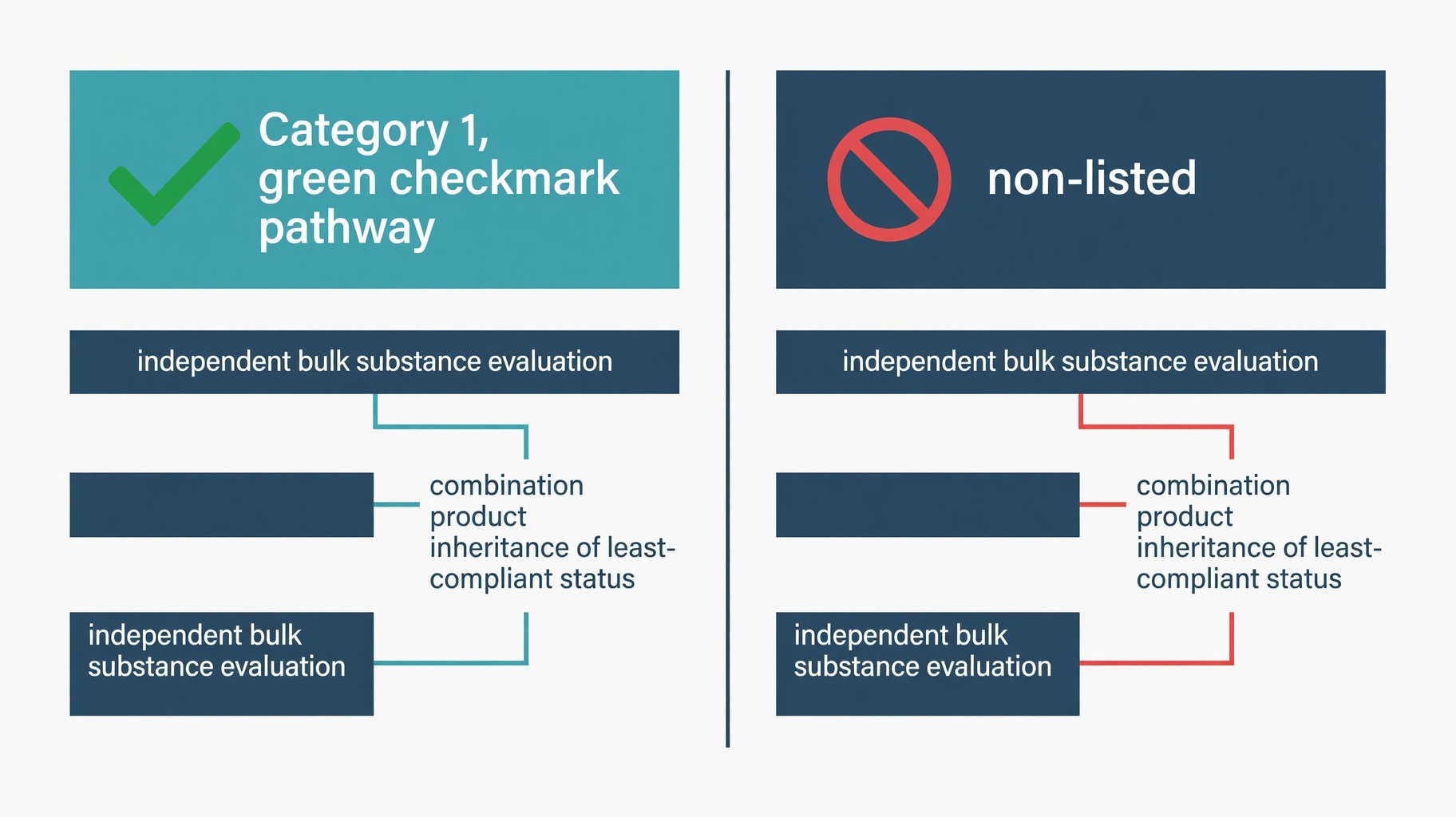
Figure 1: FDA 503A bulks list divergence between sermorelin (Category 1) and ipamorelin (non-listed) and resulting compliance risk for combination compounding.
Sermorelin is a synthetic analog of growth hormone-releasing hormone (GHRH), acting on GHRH receptors at the pituitary. It has occupied a Category 1 compounding pathway, meaning the FDA has determined it meets the criteria for inclusion on the bulks list used by 503A pharmacies (Drip Gym regulatory overview).
Ipamorelin is a pentapeptide that activates the growth hormone secretagogue receptor (GHS-R1a), the ghrelin receptor. It has never received FDA approval as a drug product. Scientific American reporting confirms that ipamorelin, alongside CJC-1295, GHRP-2, and GHRP-6, falls outside the approved drug category. The mechanism distinction between ghrh vs ghrp peptides maps directly onto this regulatory split: GHRH analogs like sermorelin have a longer administrative history, while the secretagogue class remains without a statutory compounding pathway.
Secondary sources reference a formal FDA review of ipamorelin compounding eligibility scheduled for mid-2026. No primary Federal Register notice or final agency order confirming the outcome of that review was available in supplied records. Until such a document issues, ipamorelin's compounding status remains governed by enforcement discretion rather than affirmative authorization.
Compounding Liability Under Section 503A and 503B
A 503A pharmacy compounding the blend for an individual patient prescription must source each active pharmaceutical ingredient through compliant channels. Sermorelin qualifies. Ipamorelin does not, absent a Category 1 or Category 2 designation. The pharmacy assumes the enforcement risk associated with the unapproved component.
A 503B outsourcing facility faces a stricter standard. Section 503B permits compounding only from bulk substances on the FDA's designated list or from approved drug products. Ipamorelin satisfies neither condition under current guidance. A 503B facility preparing a sermorelin/ipamorelin blend would operate outside its statutory authority.
Supply constraint compounds the liability. A Scientific American analysis of gray-market peptide samples found that between 40 and 70 percent of tested vials, including sermorelin and ipamorelin, failed basic quality criteria. Compounders sourcing ipamorelin API from unverified suppliers face additional exposure under adulteration and misbranding provisions of the Federal Food, Drug, and Cosmetic Act.
Medical Necessity Documentation Standards
Prescribers who write for the combination bear documentation obligations that differ by component. Sermorelin, as a Category 1 substance, requires a standard patient-specific prescription. Ipamorelin, lacking that designation, requires the prescriber to document a medical necessity rationale specific to the unapproved ingredient. The prescriber must articulate why no approved or Category 1 alternative meets the patient's clinical need.
This documentation functions as a defense against pre-litigation notice or enforcement inquiry. Telehealth prescribers face the same standard. The absence of a documented medical necessity record for ipamorelin converts the prescription from a clinical judgment into a regulatory violation subject to FDA action.
No interim guidance specific to the sermorelin/ipamorelin combination has been identified in supplied records. Prescribers and compliance officers should monitor FDA's Drug Compounding page for updates to the bulks list and any enforcement discretion memoranda.
Regulatory Distinction From CJC-1295 Combinations
The sermorelin/ipamorelin pairing differs in regulatory posture from the CJC-1295/ipamorelin combination. CJC-1295, like ipamorelin, has never held an approved NDA. Both components of the CJC-1295 stack lack Category 1 status, placing the entire formulation outside the 503A safe harbor. The sermorelin/ipamorelin blend, by contrast, contains one component with a defined compounding pathway.
That distinction matters for cjc 1295 vs sermorelin comparisons in a compliance context: the sermorelin leg of the combination provides a partial statutory anchor that CJC-1295 cannot supply.
For compounders evaluating ipamorelin vs ghrp alternatives, the regulatory calculus favors any formulation built on Category 1 substances. The broader class of ghrp peptides remains outside affirmative compounding authorization.
Limits of Available Evidence
No primary FDA guidance document or Federal Register notice addressing the sermorelin/ipamorelin combination specifically was available in supplied records. The Category 1 designation for sermorelin and the unapproved status of ipamorelin are reported in secondary trade and clinical sources. The mid-2026 review timeline for ipamorelin compounding eligibility appears in secondary reporting but lacks primary agency confirmation. Compliance decisions should rest on current FDA-published bulks lists and direct agency correspondence, not on secondary summaries.
This page is flagged for evidence review after 180 days.
Schema: Article, BreadcrumbList.
Related reporting explores epitalon peptide science.