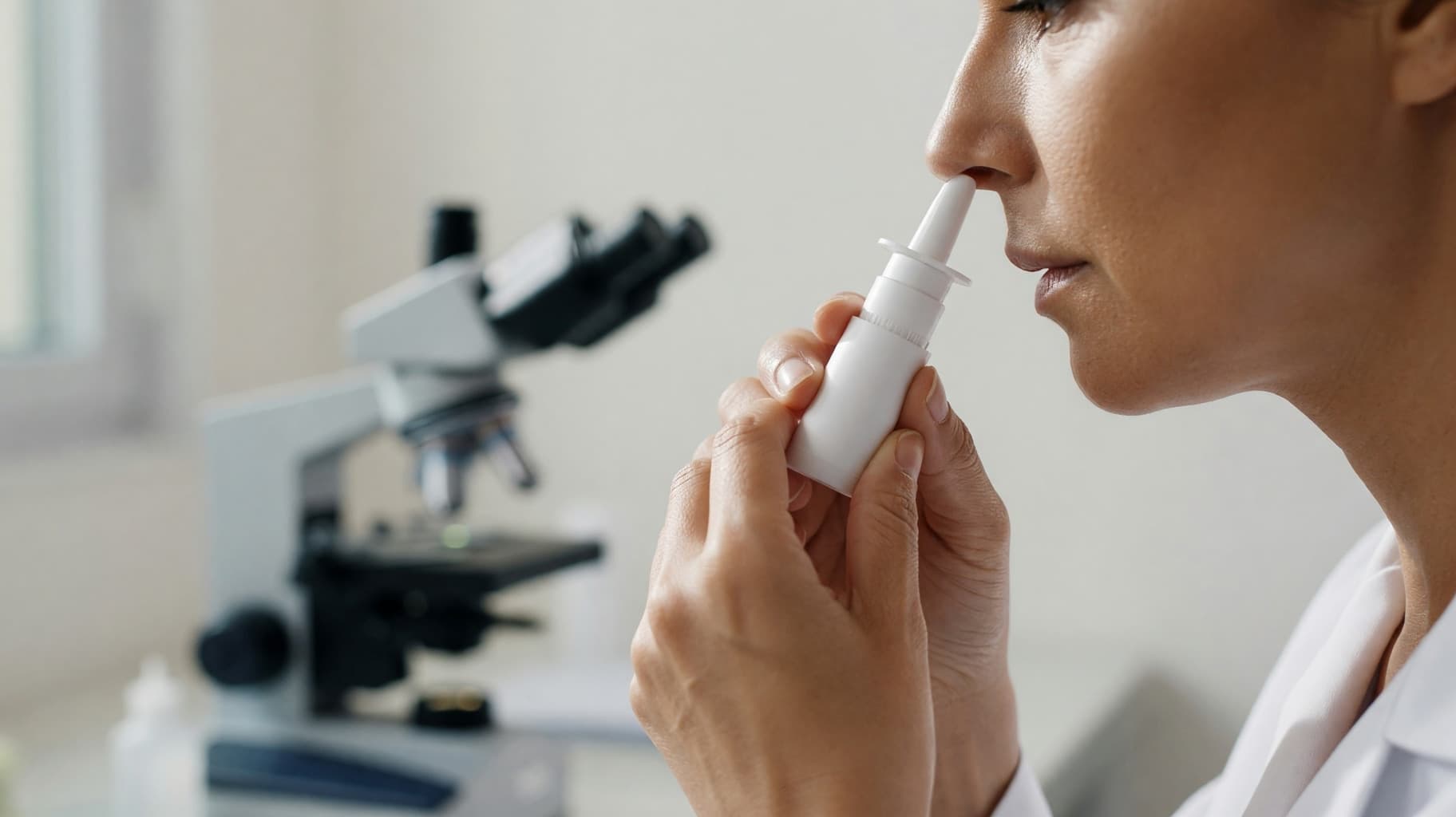
The U.S. Food and Drug Administration has not approved Semax nasal spray, nor its acetylated analogue N-Acetyl Semax Amidate, for any indication. The agency has issued no marketing authorization, no clinical protocol endorsement, and no GRAS determination for the peptide.
U.S. distribution consequently occurs through two narrower channels: research chemical vendors labeling the product for non-human use, and compounding pharmacies operating under state and federal rules that permit preparation of unapproved active pharmaceutical ingredients in defined circumstances.
U.S. Regulatory Status and Distribution Channels
Semax holds approved drug status in Russia, where it was developed at the Institute of Molecular Genetics of the Russian Academy of Sciences. Russian registration covers cognitive impairment, stroke recovery, peptic ulcers, and optic nerve atrophy, with intranasal administration as the standard clinical form used in most published human trials. That foreign approval does not transfer to the U.S. market.
The dosing guide published by Hello Regimen states the compound is "not FDA approved in the United States" and is available only as a research peptide or through compounding pharmacies. The Semax Polska administration guide confirms the nasal spray format was specifically chosen for Russian clinical use because it travels from the nasal cavity toward the brain via the olfactory pathway, bypassing the blood-brain barrier. That delivery rationale is anatomical, not a U.S. regulatory finding.
A separate evidentiary question concerns the Pharmacy Compounding Advisory Committee. Trade reporting from Pure Tested Peptides indicates Semax has been scheduled before PCAC as of 2026. Scheduling before an advisory committee is a procedural milestone, not a final agency decision. The committee's recommendations remain advisory to FDA.
No statute or interim guidance cited in the available records converts that docket placement into a 503B outsourcing approval or a determination that bulk Semax may appear on the agency's clinical need list.
Standard Semax Versus N-Acetyl Semax Amidate
The two compounds are chemically distinct and carry different evidentiary burdens. Standard Semax is a synthetic heptapeptide with the sequence Met-Glu-His-Phe-Pro-Gly-Pro, molecular formula C37H51N9O10S, and molecular weight 813.92 g/mol. The Limitless Life Nootropics product record lists those specifications along with CAS number 80714-61-0. The compound derives from the ACTH(4-7) fragment, Met-Glu-His-Phe, extended by a Pro-Gly-Pro tripeptide at the C-terminus.
N-Acetyl Semax Amidate adds two modifications: an acetyl group at the N-terminus and an amide group at the C-terminus. The American Peptides technical listing gives the full sequence as Ac-Met-Glu-His-Phe-Pro-Gly-Pro-NH2, molecular formula C39H54N10O10S, and molecular weight approximately 855 g/mol. The acetyl and amide modifications are described in vendor literature as stability enhancements, intended to slow enzymatic breakdown. That is a structural claim about the molecule. It is not a clinical finding.
The Russian clinical record that supports standard Semax does not extend to the amidated analogue. No U.S. or Russian trial data for N-Acetyl Semax Amidate appears in the supplied records.
This distinction matters for anyone evaluating the two sprays. Standard Semax carries decades of Russian human use. N-Acetyl Semax Amidate carries a chemical modification and commercial listings. The two are not interchangeable in a regulatory or evidentiary sense, regardless of how closely their names sit on a product page.
Intranasal Formulation Specifications
Research-grade Semax nasal sprays typically use sterile water or saline as the carrier, sometimes with a preservative such as benzalkonium chloride. Concentrations commonly range from 0.1% (1 mg/mL) to 1% (10 mg/mL), according to Pure Tested Peptides. The RWA Center product guide lists a 1.25 mg/mL nasal formulation and notes that bioavailability through the nasal route is variable, depending on mucosal health and spray technique. That variability is a delivery limitation, not a dosing recommendation.
The intranasal route is described in Russian clinical practice as reaching brain tissue within approximately two minutes via the olfactory pathway, a direct anatomical route that bypasses systemic circulation and the blood-brain barrier. The Semax Polska guide presents this as the rationale for choosing nasal administration in Russian protocols. U.S. regulators have evaluated none of these bioavailability claims for either standard Semax or the amidated analogue.
Side effect reporting follows the same geographic split. Rite Aid's peptide reference page describes reported effects as mild, including nasal irritation with intranasal use and occasional changes in alertness, drawn from the Russian clinical history. No equivalent adverse event dataset exists for N-Acetyl Semax Amidate in any jurisdiction covered by the supplied records.
Reading Vendor Claims Correctly
Commercial language on product pages requires the same distinction. A vendor describing Semax as supporting focus, memory, or mental clarity is making a commercial claim about a research chemical or a compounded preparation. The same vendor page typically carries a disclaimer that the product is not intended to diagnose, treat, cure, or prevent any disease. Those disclaimers are legal hedges. They do not convert the underlying compound into an FDA-regulated therapeutic.
For researchers and regulatory affairs professionals, the controlling facts are these. Standard Semax is a Russian-approved drug with a defined molecular sequence and a substantial clinical literature. N-Acetyl Semax Amidate is a structural analogue with an added acetyl and amide group, sold in U.S. commerce as a research peptide. The nasal spray format shared by both compounds originates in Russian clinical practice, where olfactory pathway delivery was selected for direct central nervous system access.
None of that history changes the U.S. status of either molecule.
The mechanism by which Semax may influence neurotrophic signaling, including BDNF and TrkB expression, is addressed in the companion guide on Semax BDNF and neuroprotection mechanisms. The question here is narrower: what is Semax nasal spray, and how do its two main variants differ.
The answer rests on a foreign approval that does not bind U.S. regulators, a chemical modification that lacks equivalent clinical backing, and a distribution system built on research-use labeling rather than marketing authorization.