The U.S. Food and Drug Administration has approved exactly two oral peptide drugs: oral semaglutide, marketed as Rybelsus, and oral octreotide, marketed as Mycapssa. Both rely on permeation enhancers. Both achieve absolute bioavailability below 1 percent (Rethink Peptides). These two products establish the regulatory baseline against which every alternative oral peptide delivery platform is measured.
The controlling variable is not whether a technology works in isolation. The controlling variable is whether it clears the evidentiary threshold the agency accepted for these two approved active pharmaceutical ingredients.
Approved Permeation Enhancers and Their Mechanisms
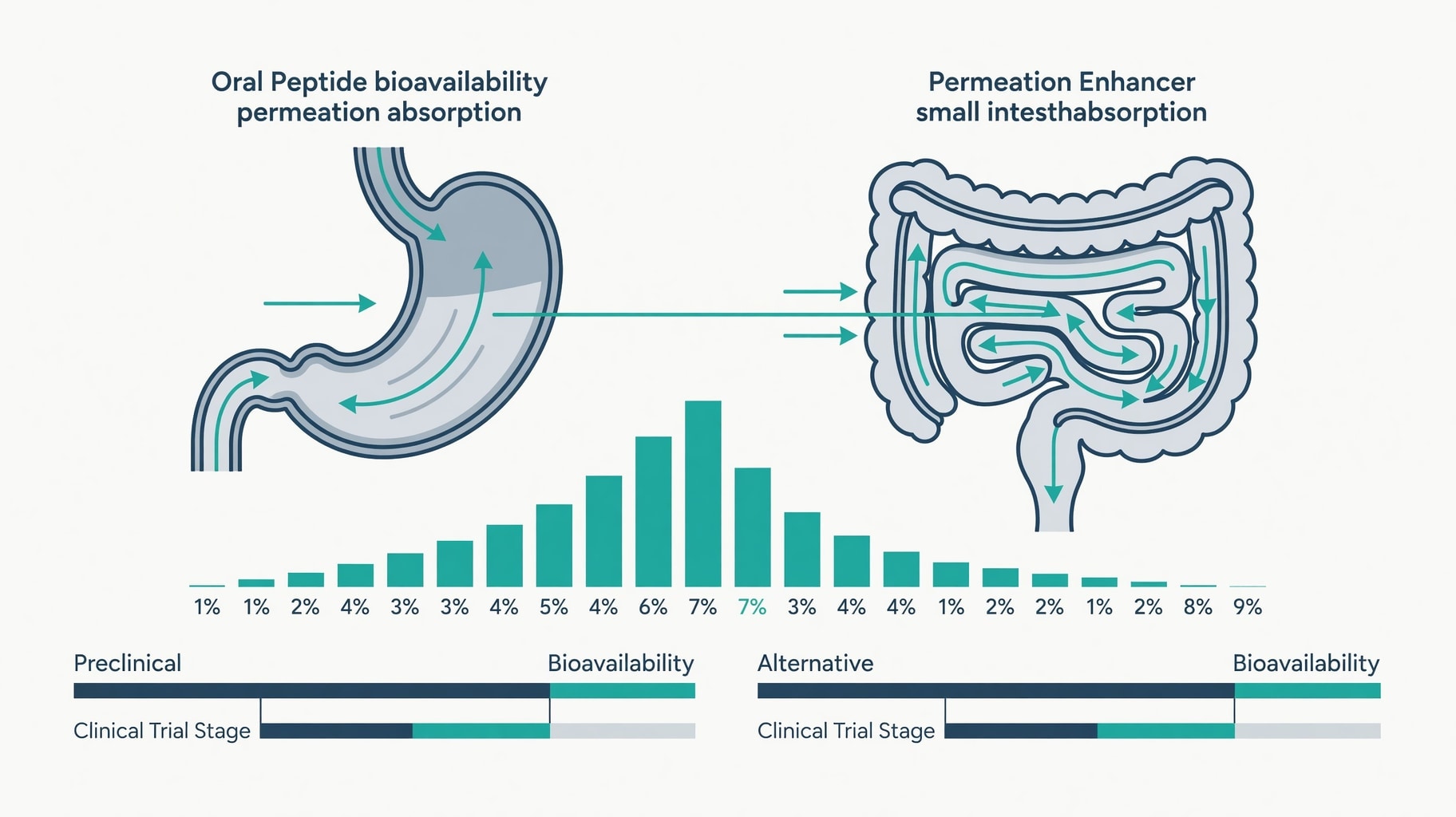
Figure 1: Comparison of permeation enhancer mechanisms and bioavailability benchmarks for the two FDA-approved oral peptide drugs versus emerging platforms.
Oral semaglutide uses SNAC, formally salcaprozate sodium. Oral octreotide uses sodium caprate, also called C10, through the transient permeation enhancer technology developed by Chiasma (Rethink Peptides). The two enhancers operate through different mechanisms. SNAC acts in the stomach, where it raises local gastric pH and creates transient membrane defects that permit transcellular transport. Sodium caprate acts in the small intestine, where it loosens epithelial tight junctions to enable paracellular transport (Rethink Peptides).
A catalog published in MDPI Pharmaceuticals maps the proposed mechanisms for additional enhancers. Medium-chain fatty acids such as C8 and C10 show both tight junction modulation and membrane fluidization. Bile salts operate through hydrophobic ion pairing. EDTA chelates calcium to reduce tight junction integrity. Choline geranate, an ionic liquid, combines tight junction opening with protection from enzymatic degradation and reduced mucus viscosity (MDPI Pharmaceuticals).
This mechanistic diversity has regulatory consequences. A permeation enhancer that targets transcellular transport may fail in a peptide whose charge distribution prevents membrane crossing. An enhancer that opens tight junctions may produce variable absorption across patient populations. No single mechanism addresses all gastrointestinal barriers.
Preclinical Platforms and Clinical Trial Phases
Beyond permeation enhancers, the development pipeline contains nanoparticles, liposomes, self-emulsifying drug delivery systems, microneedle devices, and chemical modification strategies. A review in ScienceDirect catalogs these platforms against their clinical trial phases (ScienceDirect).
Insulin provides the clearest snapshot of the field's maturity. Biocon's Insulin Tregopil combines sodium caprate with PEGylation and has entered Phase I and Phase II/III trials. Diasome's Oral HDV-Insulin uses hepatocyte-targeting molecules on a phospholipid bilayer and reached Phase II. Generex's Oral-lyn buccal insulin delivery entered Phase III. Novo Nordisk's GIPET platform, which uses microemulsions with medium-chain fatty acid glycerides in enteric-coated tablets, reached Phase II (ScienceDirect).
Novo Nordisk also holds two preclinical ingestible devices. The SOMA Milliposts system deploys peptide-loaded posts into gastric epithelium using a self-orienting device. The LUMI microneedle system uses a compressed spring driven by an osmotic pump to propel drug-loaded microneedles into the small intestine. Both remain preclinical (ScienceDirect).
None of these platforms has completed FDA review. Clinical trial phase is not equivalent to regulatory acceptance.
Combination Excipient Strategies
Single-mechanism platforms face formulation limits. The evidence from supplied reviews indicates that integrated excipient approaches produce stronger preclinical absorption data.
A Frontiers in Drug Delivery review reports that MEDI7219, an enteric-coated tablet formulation, achieved approximately 6 percent oral bioavailability in canine models. That represents a fivefold increase relative to oral semaglutide formulated with SNAC (Frontiers). The same review notes that Eli Lilly co-formulated an acylated GLP-1/glucagon co-agonist with sodium caprate plus soybean trypsin inhibitors and achieved approximately 1 percent oral bioavailability in minipigs when delivered in enteric-coated capsules (Frontiers).
Rethink Peptides reports that combining SNAC and C10 in a single oral tablet produced higher dose-corrected bioavailability for a GLP-1/GIP peptide than either enhancer alone in preclinical studies (Rethink Peptides).
These findings are preclinical. Canine and minipig data cannot be presented as predictive of human pharmacokinetics. The Frontiers review states this boundary directly: the enhancement observed with C10 plus meglumine was higher in dogs than in humans, where the combination performed similarly to SNAC (Frontiers).
Comparative Analysis of Barrier Coverage
A comparative analysis published in ScienceDirect maps each strategy against four barriers: pH, enzymatic degradation, mucus, and epithelial permeability (ScienceDirect).
| Strategy | pH barrier | Enzyme barrier | Mucus barrier | Epithelial barrier | |---|---|---|---|---| | pH modulation | Yes | Yes | No | No | | Chemical modification | Yes | Yes | Yes | Yes | | Encapsulation | Yes | Yes | Yes | Yes | | Enzyme inhibitors | No | Yes | No | No | | Permeation enhancers | No | No | No | Yes | | Microneedles | Yes | Yes | Yes | Yes |
Encapsulation addresses all four barriers but is complex and costly. Chemical modification addresses all four but may alter biological activity. Enzyme inhibitors address only one barrier and carry toxicity risk. No strategy is sufficient alone (ScienceDirect).
Evidence Boundary and Regulatory Path
Permeation enhancers remain the only oral peptide delivery mechanism with completed FDA review. Every nanoparticle platform, liposomal system, ingestible device, and self-emulsifying formulation remains in preclinical or active clinical trial evaluation.
A review in Pharmaceutics catalogs the clinical applications: TPE for Mycapssa, GIPET for oncology and GnRH antagonist candidates in Phase 2, Peptelligence for an oral calcitonin NDA and oral leuprolide in Phase 2, and Oramed's POD technology for oral insulin in Phase 3 and oral GLP-1 capsules (MDPI Pharmaceutics).
A Frontiers review of oral peptide development states the record plainly. Multiple technological generations, including enteric coatings, protease inhibitors, permeation enhancers, nanoparticles, and ingestible devices, have failed to produce predictable systemic exposure suitable for regulatory approval in most programs (Frontiers).
The regulatory consequence follows. Formulators comparing oral peptide bioavailability enhancement technologies must treat permeation enhancers, nanoparticles, and chemical modifications as components of a combined strategy. The two approved products succeeded because their enhancers were paired with peptide engineering and dosing constraints that made sub-1 percent absorption clinically viable. The agencies that reviewed those products accepted the data because efficacy, not absorption magnitude, was the controlling variable.
A panel vote or a promising Phase II readout is not a final agency decision. The path from preclinical bioavailability data to an approved oral peptide runs through demonstrated clinical efficacy under defined formulation conditions. That path has been completed twice.