
Integrity Research Peptides operates as a domestic United States vendor with three to five years of operational history. The company relies on Janoshik Analytical for third-party testing. Documented certificates of analysis report high-performance liquid chromatography purity in the 98 to 99 percent range. No sterility testing, no endotoxin verification, and no multi-lab confirmation appear in the available sourcing records (Seekpeptides).
This is a mid-tier profile. It places the vendor within the $300 to $600 monthly cost band alongside dozens of domestic competitors. It does not meet the documentation standard required for an in vivo cohort. Neither the Food and Drug Administration nor the European Medicines Agency maintains a public regulatory record or warning letter referencing this entity.
Analytical verification scope
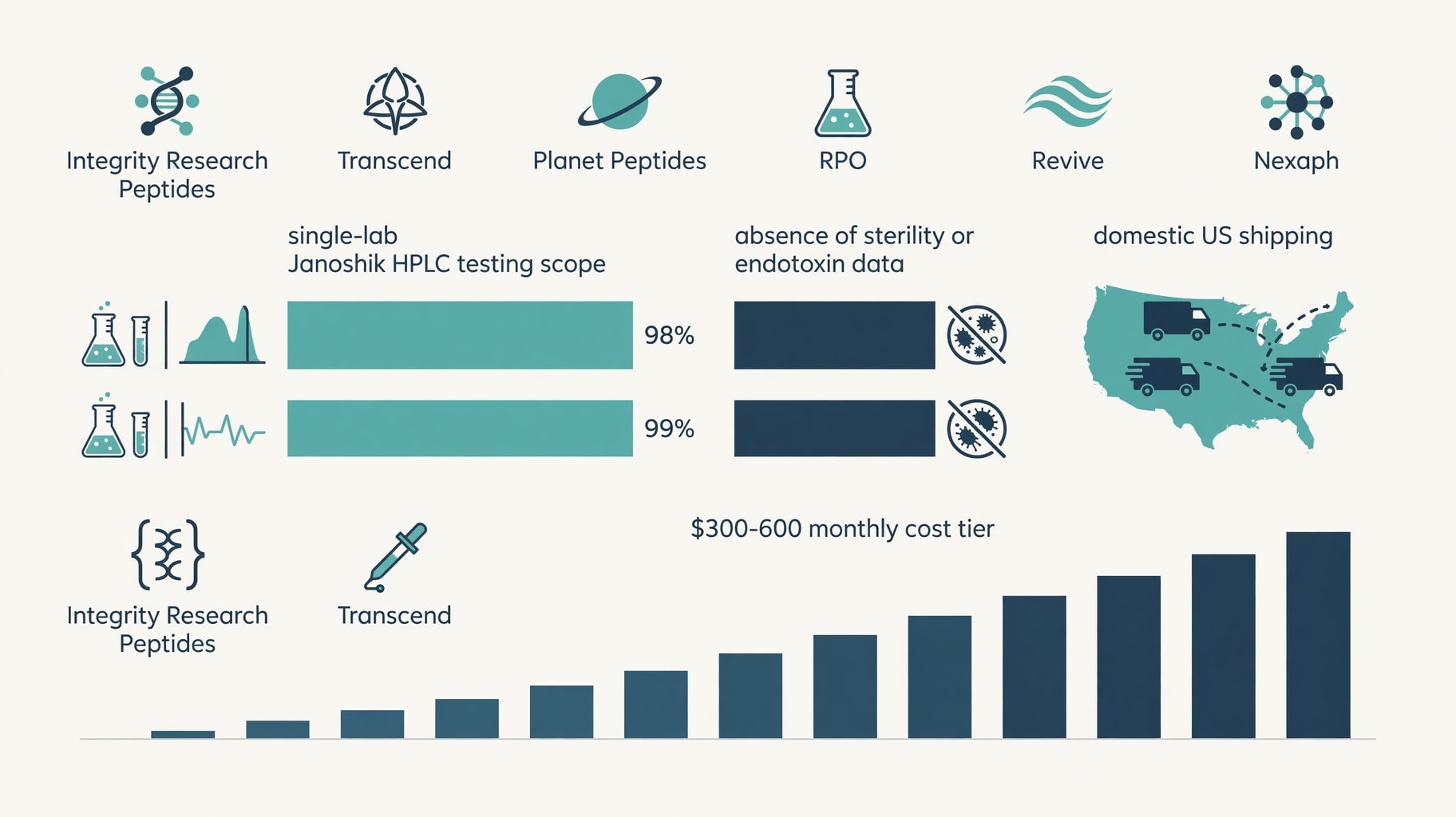
Figure 1: Analytical verification scope and tier positioning of mid-tier research peptide vendors using single-lab HPLC testing.
The Seek Peptides evaluation framework positions Integrity Research Peptides alongside Transcend, Planet Peptides, RPO, Revive, and Nexaph as functionally equivalent mid-tier suppliers (Seekpeptides). Each vendor relies on single-lab Janoshik testing. Each ships domestically. None disclose batch testing frequency, quality control reject rates, or wholesale supplier relationships.
The limitation is not the chromatography itself. A 98 percent HPLC purity result indicates that approximately 98 percent of the integrated chromatographic signal under that specific method was attributed to the peak assigned to the target peptide. It does not indicate that 98 percent of the vial content is pure by mass (Orionpeptide). This distinction dictates how researchers calculate concentrations and compare peptide batches across vendors.
Mass spectrometry adds identity confirmation. It verifies whether the observed peptide mass matches the expected sequence. Janoshik testing typically includes both HPLC and mass spectrometry. What remains missing is independent confirmation from a second laboratory. Two certificates from two different vendors can share a method, an operator, and a single point of failure when routed through the same small set of analytical laboratories (Buttondown).
The more consequential omission concerns sterility and endotoxin data. Neither assay appears in the documented quality program for this vendor (Seekpeptides). Introducing endotoxin-contaminated material into an in vivo cohort introduces an uncontrolled variable that confounds the primary endpoint. An HPLC result without endotoxin data does not establish suitability for injection in animal models. Heavy metals testing is also absent from the vendor's disclosed panels.
Distribution versus research designation
The research-only designation attached to Integrity Research Peptides products sits beside documented retail distribution. Third-party supplement retailers list BPC-157 and TB-500 capsules with specific microgram doses. Animal Supps, a retailer in Vineland, New Jersey, lists the dual-peptide product under the informal name Wolverine Stack. The listing specifies 700 micrograms per blend, 30 capsules, priced at $90 (Animalsupps). The listing is marked sold out.
XP Nutrition lists the same formulation under the name Thymo-Regen at $79.99. The product description states the formulation supports injury recovery and healing processes. That language moves beyond laboratory research framing and enters consumer-facing territory.
This pattern reflects the broader grey market peptides environment. Vendors deploy research-only disclaimers while products circulate through retail channels serving individuals outside institutional oversight. The retail listings do not constitute peer-reviewed evidence. They document a distribution model that extends beyond qualified laboratory procurement.
Evidence limits for preclinical use
No randomized controlled trial, peer-reviewed preclinical study, or regulatory filing references materials sourced from Integrity Research Peptides. The vendor name does not appear in the PubMed records supplied for this review. No FDA warning letter or EMA document identifies the company. The absence of a regulatory action is not a credential. It means the evidentiary record does not exist in any searchable form reviewed here.
The distance between a laboratory finding and a usable treatment remains the governing principle. Single-lab HPLC purity claims establish only that a particular chromatographic method produced a particular result for a particular sample. They do not establish batch consistency, stability under shipping conditions, or identity confirmation against an independent reference standard.
For researchers evaluating research peptides, the practical question is whether the documentation supports the intended experimental use. In vitro work with characterized endpoints may tolerate a mid-tier vendor with standard testing. In vivo cohorts introduce additional requirements around sterility, endotoxin burden, and formulation consistency that the available Integrity Research Peptides documentation does not address.
Procurement officers must request batch-specific certificates, verify the testing laboratory directly, and document the chain of custody from vendor to bench. Without multi-lab verification, the responsibility for analytical due diligence falls entirely on the purchasing institution.
A decade-long track record, published stability data, and multi-lab confirmation would represent a different evidentiary standard. None of those elements appears in the current sourcing record for this entity. The operational profile matches the saturated mid-tier segment: established enough to reduce scam risk, yet insufficiently documented to support controlled preclinical administration without independent verification.