
The U.S. Food and Drug Administration removed GHK-Cu from Category 1 of the 503A Bulks List on April 22, 2026, because nominators withdrew the submissions supporting its inclusion. A single re-nomination was filed on May 5, 2026 (FDA Bulk Drug Substances File, 2026). This administrative action terminated the statutory authority that had permitted state-licensed pharmacies to compound the copper peptide complex under Section 503A of the Federal Food, Drug, and Cosmetic Act since September 2023.
Pharmacies relying on the prior listing now operate without an operative Category 1 determination for non-injectable preparations.
The Administrative Record
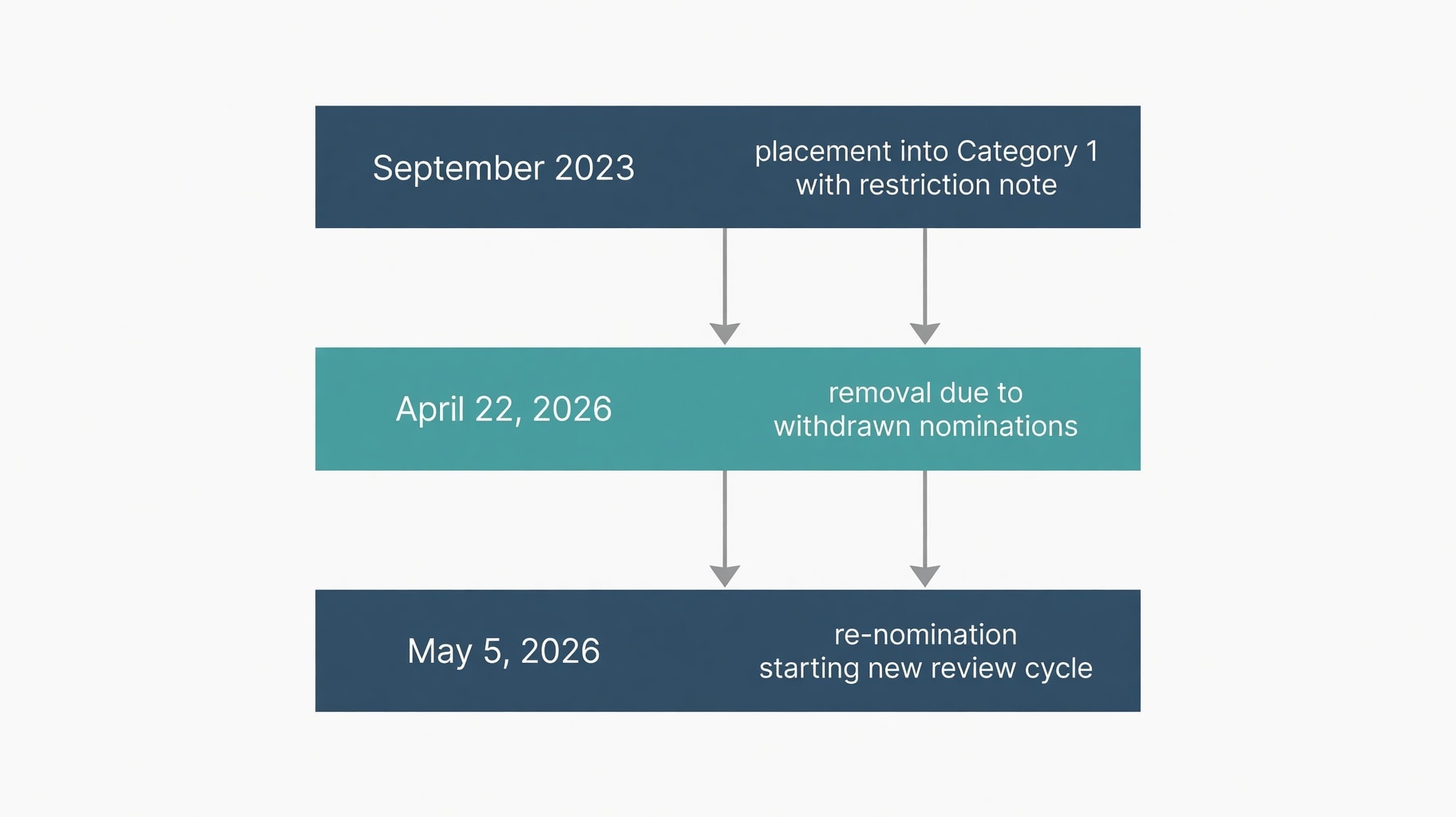
Figure 1: Timeline of GHK-Cu Category 1 listing, withdrawal, and re-nomination under FDA 503A bulk drug substances process.
The FDA bulk drug substances file documents the precise sequence of eligibility and withdrawal. GHK-Cu entered Category 1 in September 2023 with a specific restriction excluding injectable routes of administration (Fagron Academy, 2026). The April 22, 2026 removal occurred solely because the original nominators withdrew their support, not due to a new safety finding or adverse event report.
The May 5 re-nomination initiates a new review cycle rather than reinstating the previous status (FDA Bulk Drug Substances File, 2026).
This distinction carries direct legal liability. A Category 1 placement establishes the statutory threshold permitting compounding of a bulk substance absent an approved drug application. Removal of that placement eliminates the exemption. Compounding GHK-Cu during the interim between withdrawal and potential future approval lacks the specific 503A safe harbor that applied from September 2023 through April 2026.
Statutory Boundaries and Route Restrictions
The September 2023 listing never authorized injectable GHK-Cu. The explicit exclusion of injectable routes meant the Category 1 exemption applied only to topical or other non-parenteral preparations (Fagron Academy, 2026). Injectable GHK-Cu remains outside any FDA-approved product category and has never satisfied the statutory criteria for 503A compounding eligibility. This separation distinguishes regulated compounding from unapproved commercial blends or research-grade products marketed without statutory authorization.
Topical cosmetic formulations containing GHK-Cu operate under a separate regulatory framework. These products do not require 503A bulks list placement because they are regulated as cosmetics rather than drugs. The loss of Category 1 status affects only the compounding of GHK-Cu as a drug ingredient pursuant to a patient-specific prescription. Commercial skincare serums and over-the-counter creams remain subject to cosmetic labeling and safety substantiation requirements distinct from pharmaceutical compounding standards.
Chemical Identity and Endogenous Baseline
GHK is a tripeptide with the amino acid sequence glycyl-L-histidyl-L-lysine that forms a high-affinity complex with copper(II). First isolated from human plasma in 1973, the molecule occurs endogenously in plasma, saliva, and urine (Pickart et al., 2015). Plasma concentrations average approximately 200 ng/mL at age 20 and decline to roughly 80 ng/mL by age 60 (Pickart et al., 2015; Wikipedia).
This measured decline correlates with reduced regenerative capacity in published literature but does not establish a therapeutic target or dosing benchmark for compounded preparations.
Verification of chemical identity is critical for any future compounding eligibility. The copper-coordinated complex GHK-Cu is chemically distinct from the metal-free GHK tripeptide. The coordination state alters stability, biological activity, and regulatory classification. Raw material specifications must confirm the copper complex form to satisfy pharmaceutical standards should the May 2026 re-nomination succeed. Sourcing uncoordinated GHK would produce a substance with different physicochemical properties than the nominated bulk ingredient.
Documented Mechanisms and Evidence Limits
Preclinical studies demonstrate that GHK-Cu stimulates both synthesis and breakdown of collagen and glycosaminoglycans at nanomolar concentrations. The peptide modulates metalloproteinases and their inhibitors TIMP-1 and TIMP-2 while restoring replicative vitality to fibroblasts after radiation exposure (Pickart et al., 2015). Gene expression assays show GHK-Cu influences transcription of thousands of human genes, including suppression of RNA production in 70% of 54 genes overexpressed in metastatic colon cancer cells at micromolar concentrations (Pickart et al., 2015).
These findings derive from in vitro and animal models. Controlled human facial studies supporting cosmetic applications have involved small sample sizes and short treatment durations (Wikipedia). No major clinical trials support systemic indications or establish safety profiles for injectable administration. The toxicology literature describes low toxicity at nanomolar concentrations in cellular assays but lacks rigorous safety data for compounded drug products in human subjects (Pickart et al., 2015).
Regulatory decisions must distinguish between documented molecular mechanisms and verified clinical endpoints.
Stability Constraints and Handling Parameters
GHK-Cu requires specific storage conditions to maintain chemical integrity. Lyophilized powder should be stored at −20°C in a desiccated, light-protected environment. Reconstituted solutions require storage at −80°C and use within two to four weeks to minimize copper dissociation and peptide oxidation (SourcePeptides Research Guide, 2026). These parameters represent industry guidance from research suppliers rather than validated compounding standards adopted by pharmacopeial authorities.
The stability profile imposes operational constraints independent of regulatory status. Repeated freeze-thaw cycles degrade the copper-peptide complex. Formulations must account for this degradation kinetics to ensure consistent potency. Pharmacies resuming compounding upon potential re-nomination approval would need validated stability data meeting pharmaceutical standards rather than relying solely on research-grade handling recommendations. The absence of compendial monographs for GHK-Cu places additional validation burden on individual compounders.
Operational Consequences for Compounding Pharmacies
The April 22 removal creates an immediate compliance gap. Pharmacies that compounded GHK-Cu under the September 2023 Category 1 listing lack continuing statutory authority for new prescriptions. Existing inventories prepared under the prior listing face uncertain dispensing eligibility. The May 5 re-nomination does not provide interim enforcement discretion or retroactive authorization for the between withdrawal and potential future approval.
Blended formulations containing GHK-Cu cannot rely on the withdrawn Category 1 placement. Each active ingredient in a compounded preparation must independently satisfy 503A eligibility criteria. Unlike glp 1 peptides, which benefit from shortage-driven enforcement discretion and approved drug product precedents, GHK-Cu currently lacks any operative regulatory pathway for drug compounding.
Adjacent categories such as glow peptide, the KLOW peptide stack, PT-141 nasal spray, and the Wolverine peptide stack each maintain distinct regulatory statuses that do not transfer to GHK-Cu formulations. The administrative record, not market precedent, determines current eligibility.