
Patients present to clinics with elevated liver enzymes and elevated copper levels after purchasing and self-injecting GHK-Cu from online sellers, operating outside any cosmetic safety review as reported by Npr. These are individuals navigating informal wellness markets. They encounter a supply chain that lacks the adverse event reporting, formulary exclusion checks, or out-of-pocket threshold protections present in regulated clinical settings.
Understanding how the Cosmetic Ingredient Review panel evaluates topical peptide ingredients separates the documented safety of retail cosmetics from the regulatory limbo surrounding these injectables.
The panel concluded that Acetyl Hexapeptide-8 Amide is safe in leave-on cosmetics at concentrations up to 0.005%, while finding available data insufficient to evaluate safety at higher concentrations where drug-like effects on the dermis may occur as reported by Cir-safety. This concentration ceiling defines the boundary of the cosmetic assessment.
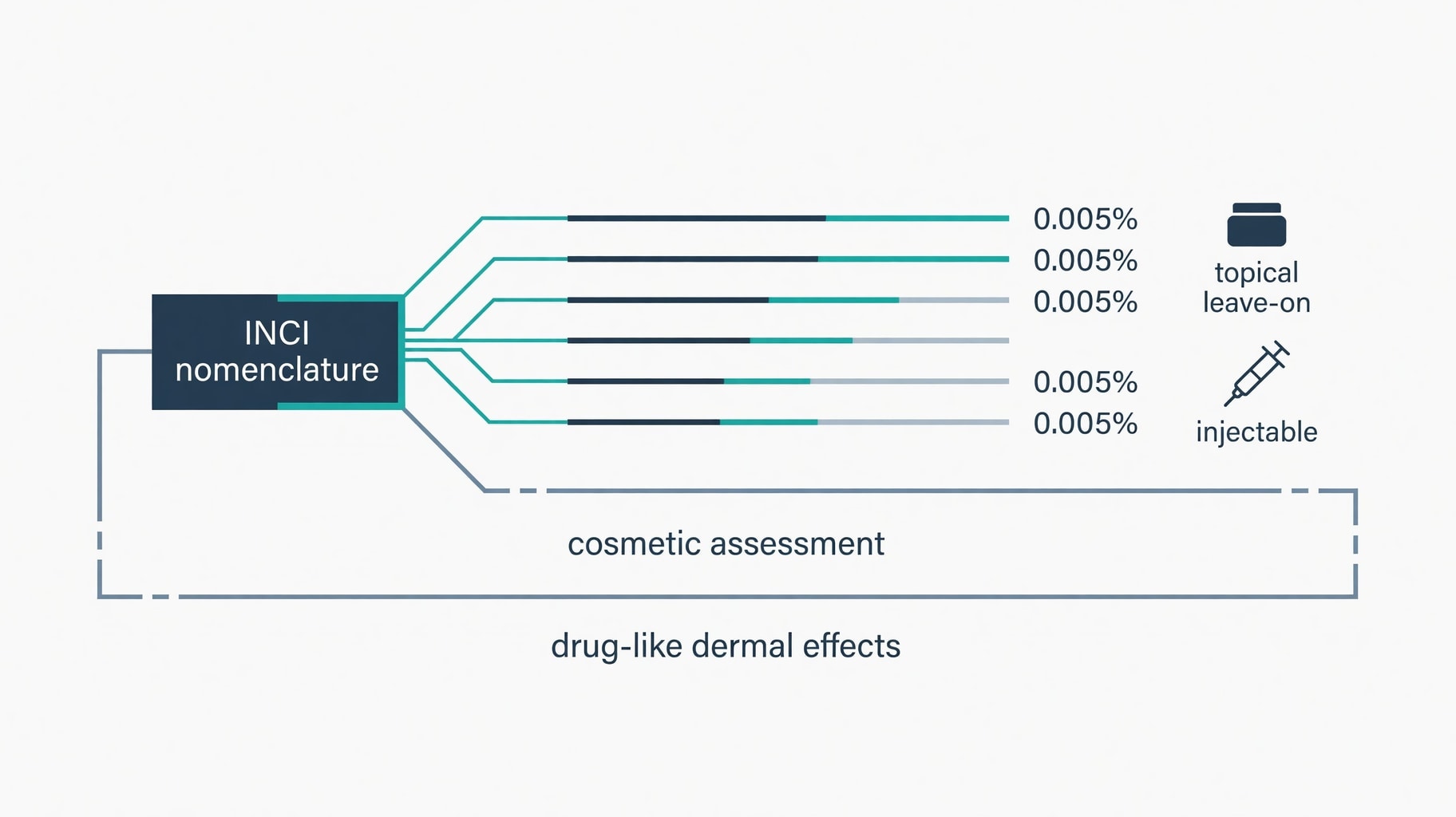
Figure 1: CIR safety assessment framework for topical peptide ingredients showing INCI, concentration, and exposure boundaries.
Reading a CIR Safety Assessment
A CIR safety finding applies to a specific molecule, a specific product category, and a specific concentration. Evaluating an assessment requires a defined sequence.
1. Verify the INCI name and CAS number. The panel reviews the exact substance. A different chain length or modification requires a separate review. 2. Confirm the reported function. The panel assesses ingredients as skin conditioning agents or similar roles, not as therapeutics. 3. Locate the maximum use concentration and product category. Safety is determined within leave-on or rinse-off applications. 4. Identify missing data. The panel states when systemic toxicity, genotoxicity, or reproductive data are absent. 5. Check the conclusion scope. A conclusion of safe use applies to the present practices of use and concentration described in the assessment as reported by Cir-safety. It does not extend to untested formulations.
This sequence determines whether a specific formula falls within the evaluated range or outside it.
INCI Nomenclature and Ingredient Identification
The International Cosmetic Ingredient Dictionary and Handbook provides the standardized name the panel uses to identify structure, amino acid sequence, and function. An INCI name encodes the primary structure of the peptide.
Take the INCI name tripeptide-1 (CAS 49557-75-7). The prefix "tri" indicates a three-amino-acid chain. For palmitoyl pentapeptide-4, "palmitoyl" identifies the attached fatty acid modification, "penta" specifies five amino acids, and "peptide-4" identifies the KTTKS sequence as reported by Cir-safety.
This precision matters across clinical and retail settings. Formulators and public health researchers use the INCI name to determine whether the safety data on record apply to the specific ingredient in a given bottle.
Concentration Thresholds and Missing Data
The panel addresses missing systemic toxicity data by evaluating peptide structure and the likelihood of percutaneous absorption for topical applications.
| Peptide Ingredient | Reported Function | Documented Maximum Use Concentration | Assessment Status | | :--- | :--- | :--- | :--- | | Acetyl Hexapeptide-8 Amide | Skin conditioning agent | 0.005% in leave-on cosmetics | Safe at documented concentration; insufficient data above 0.005% as reported by Cir-safety | | Palmitoyl Pentapeptide-4 | Skin conditioning agent | Maximum reported concentration in face and neck products | Safe in present practices of use and concentration as reported by Cir-safety | | Myristoyl Pentapeptide-4 | Skin conditioning agent | Maximum reported concentration in face and neck products | Safe in present practices of use and concentration as reported by Cir-safety |
For Acetyl Hexapeptide-8 Amide, the panel noted the absence of systemic toxicity and detailed genotoxicity data. Concern over this gap was mitigated by the peptide structure and a partitioning coefficient indicating percutaneous absorption is unlikely, combined with the low maximum use concentration of 0.005% in leave-on cosmetics as reported by Cir-safety.
A formulation at 0.01% falls outside this reviewed range. A formulator or regulator reviewing that formulation must treat it as unevaluated by this specific assessment, because the panel determined that a no-observed-adverse-effect-level for collagen synthesis would be needed to evaluate safety at concentrations greater than 0.005% as reported by Cir-safety.
The panel also evaluates delivery methods. There are currently no validated skin irritation methods specifically designed for isolated peptide ingredients, meaning assessors rely on methods applied to finished formulations as reported by Sciencedirect.
The Boundary Between Cosmetic and Drug Claims
A peptide in a moisturizer works at the skin surface. It sits in a cosmetic formula, at a cosmetic concentration, under cosmetics law. It is not designed to enter the bloodstream. An injectable peptide acts systemically and represents an entirely different regulatory and safety question as reported by Theinkeylist.
The Acetyl Hexapeptide-8 Amide assessment records the panel's awareness of a consumer product purporting to contain 10 to 30% of the peptide. The panel noted that whether this product is a drug or cosmetic remains unknown, and stated that a drug effect on the dermis would not be likely at 0.005% but may be apparent at higher use concentrations as reported by Cir-safety.
Copper peptides demonstrate this treatment disparity. Non-injectable GHK-Cu skin care creams fall under cosmetic regulation as long as companies avoid medical claims, meaning they are not subjected to pre-market safety approval by the FDA as reported by Allure.
Clinical Risks Outside the Cosmetic Framework
The consequences of bypassing the cosmetic framework appear in adverse event reporting from clinical consultations. Physicians report seeing patients who purchased GHK-Cu from online sellers and injected it themselves. It remains unclear whether the copper peptides, undisclosed substances, or impurities are responsible as reported by Npr.
GHK-Cu exists in regulatory limbo. Compounding pharmacies in the United States are not technically allowed to offer it for injection in humans, though an FDA advisory committee recommended reclassifying several wellness peptides to alter that status as reported by Npr. For a patient weighing a compounded cream against a retail option, understanding the clinical evidence for cosmetic peptide ingredients clarifies what the available trials actually measure.
Retail cosmetics sit within a framework requiring safety substantiation and adverse event reporting as reported by Theinkeylist. Injectable wellness peptides sourced online operate outside it. The consumer purchasing an unregulated injectable absorbs the entire risk of that gap.