
Bryan Johnson's September 12 X post referencing the BPC-157 and TB-500 combination marketed as the "Wolverine Stack" for his dog landed inside a regulatory gap that no federal agency has closed. The FDA's Center for Veterinary Medicine has issued no approval, tolerance, or compounding allowance for either compound in any animal species. Johnson's post did not create that absence, but it accelerated consumer demand in a space where safe dosing has not been established.
Six weeks earlier, the FDA's Pharmacy Compounding Advisory Committee met July 23–24 at the agency's White Oak campus and voted narrowly to recommend BPC-157, TB-500, KPV, MOTS-c, Semax, and epitalon for the 503A Bulks List, overriding career scientists who had recommended against all seven compounds. That list governs what state-licensed pharmacies may compound for human prescriptions. Scott Brunner, CEO of the Alliance for Pharmacy Compounding, stated that FDA must formally adopt the panel's recommendations before any pharmacy may legally prepare the substances. No rulemaking has been completed. CVM has not opened a parallel proceeding for veterinary use.
No long-term canine safety data exists
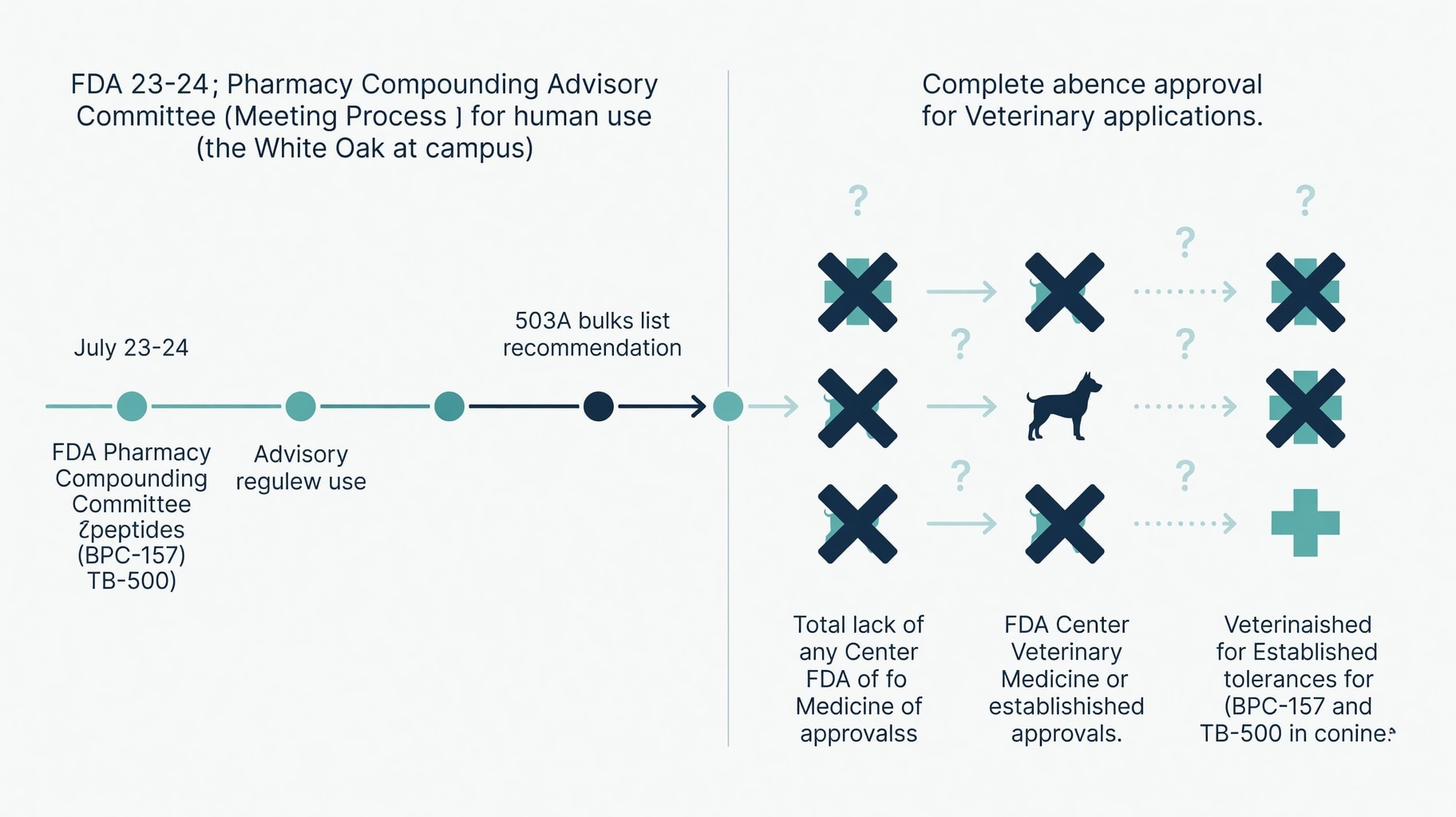
Figure 1: Regulatory gap between human compounding recommendations and lack of FDA CVM approvals for BPC-157 and TB-500 in veterinary use.
Andrew Bugbee, chief medical officer at Texas A&M University Small Animal Teaching Hospital, warned that "the biggest concern is the lack of safety data," adding that no long-term studies evaluate these supplements in dogs, according to LADbible's August 25 report on the viral trend. The same report documented an 11-year-old dog whose owner posted before-and-after mobility videos following BPC-157 injections, drawing warnings from veterinary pharmacologists. One published paper on BPC-157 included six dogs, a sample too small to generalize across breeds or body weights. FDA's own briefing materials for the July PCAC meeting found that the five available BPC-157 trials were short in duration, small in sample size, and insufficient to establish safety or effectiveness for the proposed indications. The panel's composition drew conflict-of-interest scrutiny because of increased representation from clinicians and businesses involved in prescribing or producing peptides, AJMC reported in its analysis of the reversal. HHS Secretary Robert F. Kennedy Jr., who has called himself "a big fan" of peptides, could seek to expedite formal adoption of the advisory vote, though no timeline has been announced.
Research-only vials reach dogs without verification
Peptides sold online under "research use only" labels carry no purity or sterility verification before sale, and FDA reviewers found the human evidence thin, Medical Daily reported. Those same unverified vials are the products most accessible to pet owners, because no compounding pharmacy can legally prepare BPC-157 or TB-500 for an animal prescription until CVM acts. The pharmacological distinction between the two compounds—BPC-157, a synthetic derivative of a gastric-juice compound, and TB-500, a fragment of Thymosin Beta-4 involved in cell migration—does not resolve the shared regulatory problem: neither has entered the animal-drug approval pathway. Readers parsing the difference between the research-grade and compounded forms can find the regulatory breakdown in our BPC-157 stability comparison and our TB-500 mechanism overview, though neither constitutes a dosing recommendation.
FDA must still issue a final rule on the PCAC's 503A recommendations before human compounding can proceed legally, and CVM has signaled no schedule for reviewing these compounds in animals. Until both steps occur, every injection of the Wolverine Stack into a dog falls outside federal drug law.