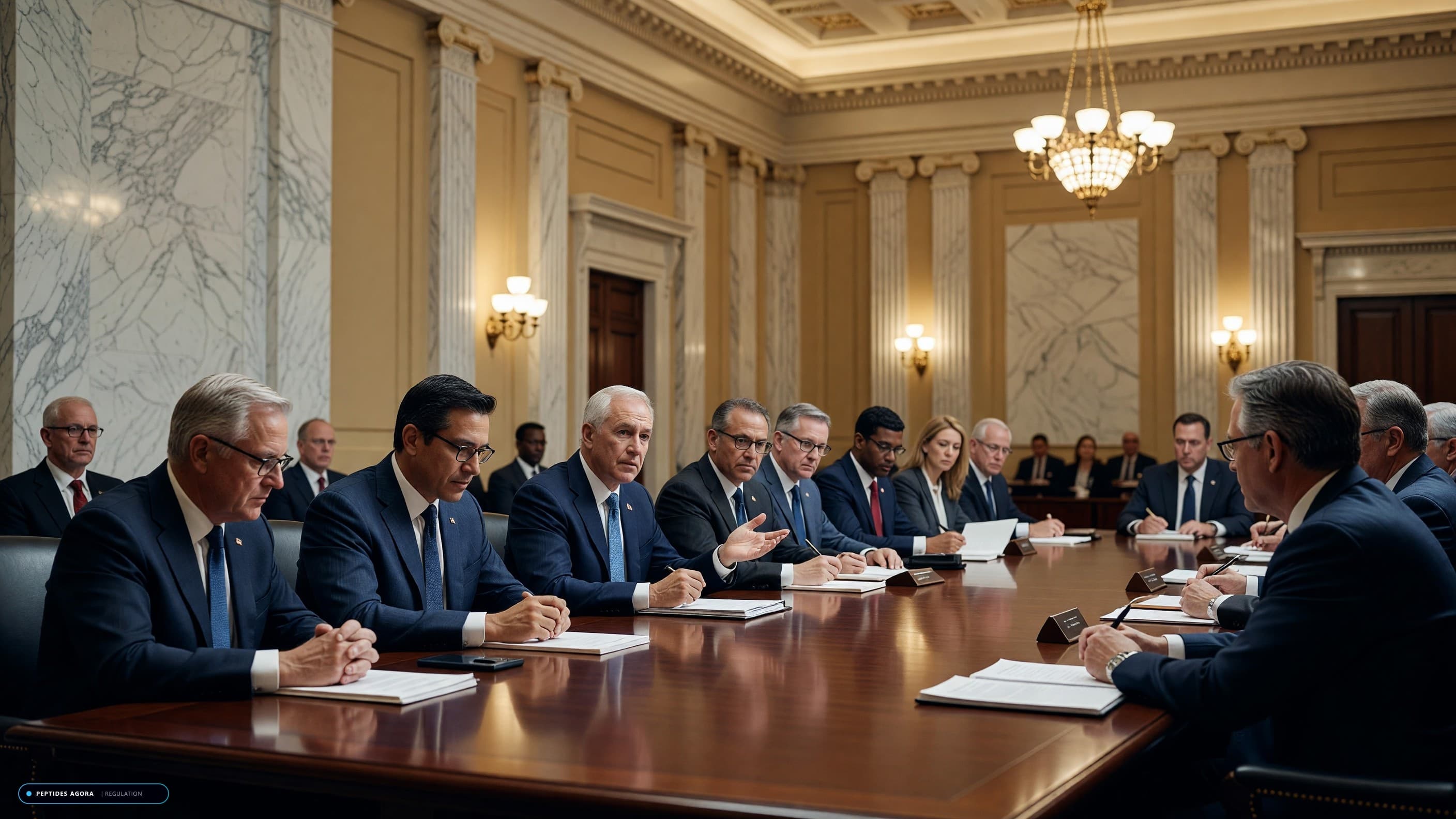
Health and Human Services Secretary Robert F. Kennedy Jr. secured the advisory endorsement he has pursued since February when the FDA's Pharmacy Compounding Advisory Committee voted 8 to 6, with one abstention, on July 23 to recommend that compounding pharmacies be permitted to produce injectable peptides including BPC-157, TB-500, and KPV. Agency staff scientists told the panel the same day that the substances lack sufficient evidence of safety or effectiveness.
The nonbinding recommendation would shift six of seven peptides under review from Category 2, the FDA's designation for substances that "present significant safety risks" and are barred from pharmacy compounding, into Category 1, where licensed pharmacies may prepare them under a physician's prescription. No final rule has been issued. For manufacturers and cross-border distributors tracking whether peptides are legal in the U.S., the gap between an advisory vote and a binding reclassification remains the operative distinction.
A committee reshaped before the vote

Figure 1: Regulatory pathway and advisory committee evaluation framework for FDA Advisory Panel Sides With Kennedy's Peptide Agenda Over Its Own Scientists' Warnings.
Kennedy appointed new members to the fourteen-person panel after taking charge of HHS. The Guardian's July investigation found that the committee's membership includes "many people with financial ties to the burgeoning peptide industry." The thin margins on July 23 came despite career reviewers' unanimous finding of insufficient evidence for the peptides under consideration. Russell Wesdyk, an associate director in FDA's drug center, told the panel that substances like TB-500 carry no recognition as official pharmaceutical ingredients in the United States. "There's no way to know what the substance actually is, was or will be tomorrow because that name has no legal meaning," Wesdyk said, as recorded in PBS NewsHour's broadcast of the hearing.
Kennedy had already moved before the panel convened. In April, he removed several peptides from the Category 2 list without assigning them to Category 1, leaving them without any regulatory designation. The Guardian reported that smaller compounding operations began producing the undesignated peptides within weeks, ahead of formal review.
Compounding as a bypass around clinical proof
Placing a peptide on the Category 1 list does not require the manufacturer to submit preclinical toxicology data or Phase I–III trial results. Compounding pharmacies prepare customized medications for individual prescriptions under a separate regulatory framework from drug manufacturers seeking FDA approval. The Guardian described the resulting pathway as one that lets compounders "create and sell these medications before their safety and effectiveness has been proven." As of mid-2025, the Partnership for Safe Medicines counted 93 registered bulk compounding facilities; 81 percent of newer entrants had not yet been inspected by FDA staff.
The Washington Post's editorial board wrote on August 17 that Kennedy's approach amounts to "a 19th-century approach to U.S. drug safety standards." Kennedy has countered that the 2023 Biden-era restrictions pushed consumers toward unregulated grey-market peptide supply and that domestic compounding would restore a measure of oversight. Wesdyk told the panel he holds no additional authority to impose safety parameters once a substance reaches the Category 1 list. "I don't have any guardrails to apply," he said.
FDA leadership has not announced a timeline for a final determination. Kennedy oversees both the FDA and the National Institutes of Health, and his office has not specified whether it will pursue formal notice-and-comment rulemaking or rely on enforcement discretion to open the market sooner. Until the agency publishes its decision, the six peptides recommended for reclassification remain in the same regulatory gap that smaller compounders have already begun filling.
Related Peptides Agora coverage examines are peptides legal.